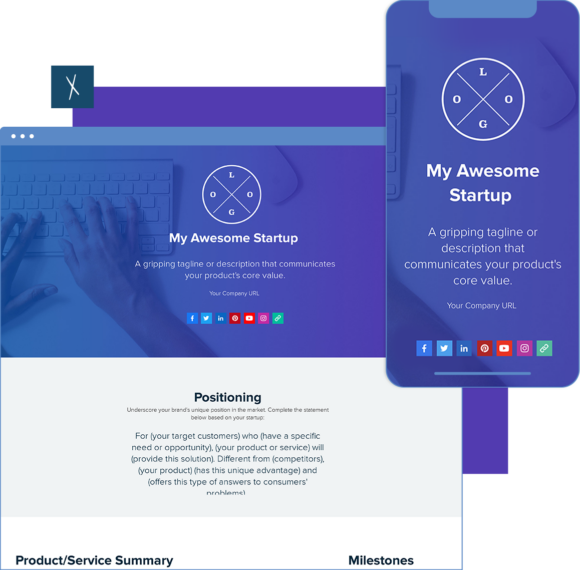
Startup One Pager Template
Turn your idea into a clear, branded one-pager — automatically.
Xtensio’s AI One Pager Builder helps you organize your story, apply your branding, and create a professional one-pager in minutes — not days.
Message structured. Visuals found. Branding applied.
Built automatically into a living, share-ready folio for your team, clients, or investors.
Communicate your value with clarity and consistency — no design skills required. Update it when your story evolves — your live link stays current.
Try it free and see your story come to life.
Xtensio is your team’s deliverables workspace.
Create, collaborate, and deliver client-ready docs—then keep them current.
Join 410,571 using Xtensio.
Xtensio is the workspace for professional deliverables.
Make one deliverable today—then build a repeatable system for every client and project.
This is where teams create, collaborate, organize, and deliver the documents that run their work.
Everything stays on-brand, current, and ready to share.

Organize every deliverable
Keep strategy, sales, marketing, and client docs together by workspace.
Create fast, stay consistent
Start from 200+ templates or AI drafts, then apply your brand kit.
Collaborate in the doc
No more “final_v7.pdf” loop.
Standardize across deliverables
Apply your brand kit + reusable modules so every deliverable matches.
Improve what you send
See engagement, iterate, and reuse what works across projects.
Free
Dive in without worrying about fees.
Build for Collaboration
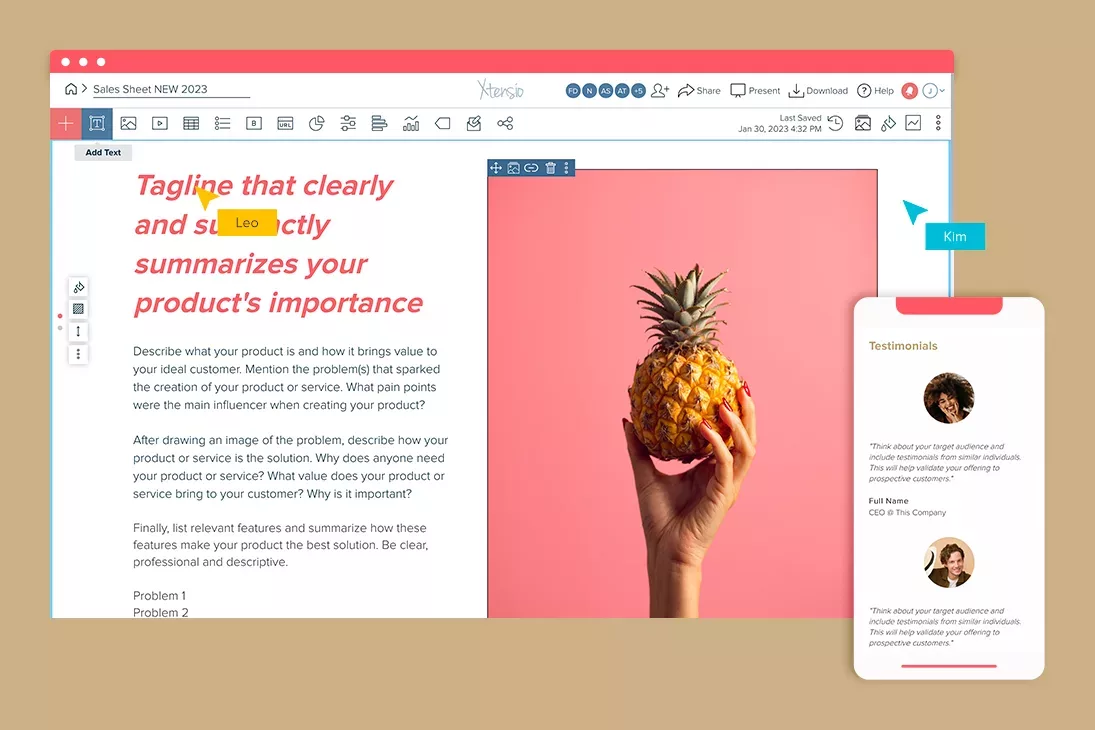
Bring your team together right inside the template. work together in real time.
Fully customizable
Just click and edit everything. Change it up to reflect your style or match your company’s colors and fonts. It’s all just drag-and-drop easy.
Includes guidance
Not sure where to start? We’ve got your back with handy tips, how-to guides, and prompts right where you need them, guiding you through each step.
Easy to share
Share with a simple link, your stakeholders can see what you’re up to, anytime and anywhere. You can also present, embed, or download as PDF and PNG.
Accessible from any device
On the go or at your desk, your work is always ready for you. It’s all online, so you can pick up right where you left off from any device. It is responsive so it will look everywhere.
Comes with analytics
Get detailed insights on who is viewing your work and how they are consuming it.
Very simple and Intuitive
Jump right in without the steep learning curve. We’ve kept everything straightforward, so you can focus on what matters.
Secure and private
We take your privacy very seriously. Brainstorm in peace, knowing your ideas are protected.
Great support
Stuck on something? Reach out! We’re here to help with tips, tricks, and friendly advice.
Other Startup One Pager templates
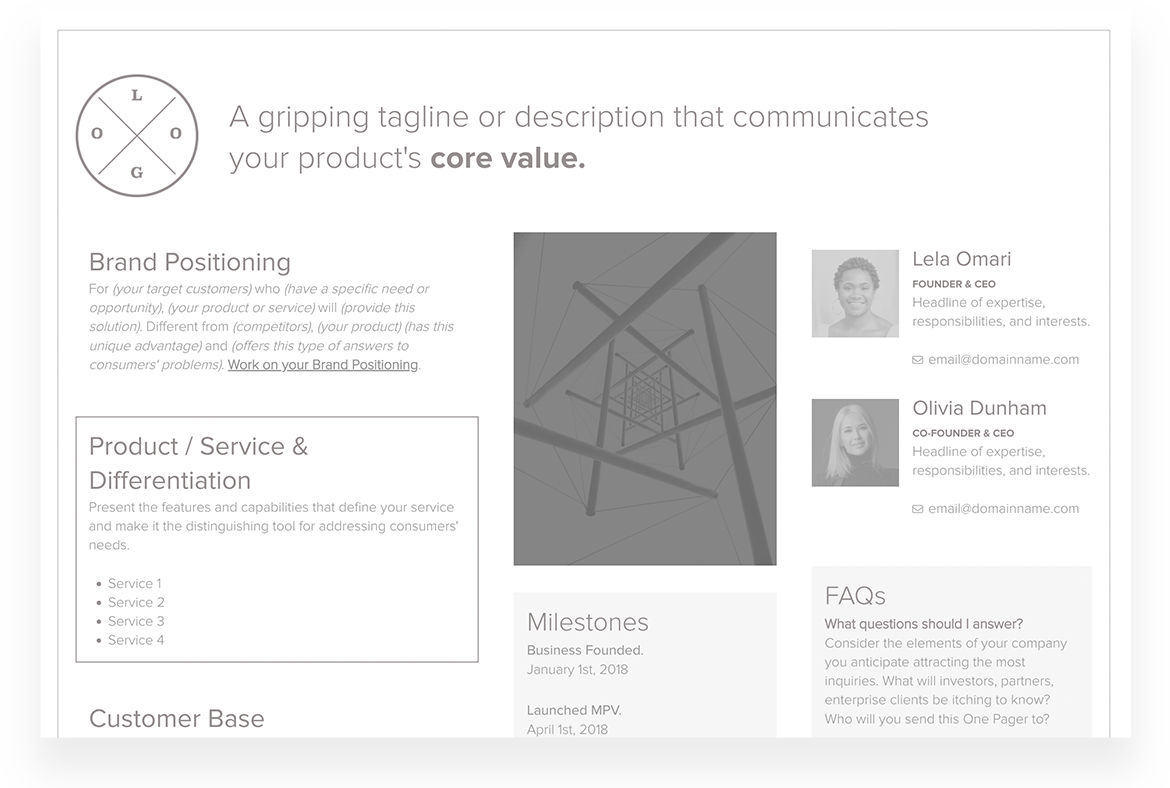
Design, manage and share beautiful living documents… easily, together. Explore Xtensio
- Click and edit anything… together.
- Customize to match your branding.
- Share with a link, present, embed or download.
What is a one-pager?
A one-pager is a single-page document that gives a concise, visual overview of your business, product, project, or idea. It is designed to communicate the most important information in under a minute, making it the go-to format for first impressions with investors, partners, clients, and stakeholders. Short on time? Generate a one-pager with AI and edit it from there.
Unlike pitch decks (which require a meeting) or business plans (which require commitment to read), a one-pager works in the moments between — the quick email intro, the networking follow-up, the conference handout, the investor teaser before a full pitch. The best one-pagers are visual, branded, and immediately scannable.
What to include in a startup one-pager
Every one-pager should be tailored to its audience, but these sections form the foundation that investors and partners expect to see:
- Company name, logo, and tagline — Your identity in a glance. The tagline should explain what you do in one sentence.
- The problem — What pain point or gap in the market does your product address? Be specific. “Businesses waste time on documents” is weak. “Teams spend 5+ hours per week reformatting deliverables across tools” is strong.
- Your solution — How your product solves the problem. Focus on the outcome, not features.
- Target market — Who are your customers? Be specific about segment, size, and why they buy.
- Business model — How do you make money? Subscription, freemium, transaction-based?
- Traction and key metrics — Users, revenue, growth rate, partnerships, or other proof points that show momentum.
- Team — Key founders and their relevant experience. Investors bet on teams as much as ideas.
- The ask — What do you want from the reader? A meeting, investment, partnership? Make the next step clear.
One-pager vs pitch deck vs executive summary
These three formats serve different moments in your business communication:
- One-pager — A single page that works as a standalone introduction. Best for cold outreach, quick intros, networking events, and pre-meeting context. Designed to earn the next conversation.
- Pitch deck — A multi-slide presentation for scheduled meetings. Best for investor pitches, board updates, and team presentations. Designed to close a decision.
- Executive summary — A 1-2 page narrative overview, typically part of a longer document like a business plan. Best for formal applications, grants, and due diligence. Designed to summarize depth.
Most founders need all three, but the one-pager comes first — it is what opens the door to everything else.
Tips for a one-pager that gets results
- Lead with the problem, not your company name. Investors care about the market opportunity first.
- Use visuals over text walls. Charts, icons, and images communicate faster than paragraphs.
- Brand it. Your one-pager is a first impression of your company. Use your brand colors, fonts, and logo consistently.
- Keep it to one page. If you cannot fit it on one page, you have not prioritized ruthlessly enough.
- Share as a live link, not a PDF. A live link always shows your latest version, lets you track who viewed it and for how long, and avoids the “which version did I send?” problem.
- Update it regularly. Your metrics, team, and positioning evolve. Your one-pager should evolve with them.
Why build your one-pager in a deliverables workspace
A one-pager is not a one-time output. It is a living document that evolves with your business — new metrics, new team members, new positioning after each funding round or product milestone.
Static tools like PowerPoint or Google Docs force you to re-export, re-email, and re-share every time something changes. By the time an investor opens your PDF attachment, the numbers may already be outdated.
With Xtensio, your one-pager lives in a project workspace where you can:
- Share a single live link that always shows the latest version — no more “v2_final_FINAL” file names
- Track engagement — see who viewed your one-pager, when, and for how long
- Collaborate with cofounders in real time — no more emailing drafts back and forth
- Brand it professionally with your colors, fonts, and logo in seconds
- Export as PDF when someone needs a file, while keeping the live version as your source of truth
- Keep it alongside your other deliverables — pitch deck, business plan, investor update — all in one workspace
Your one-pager is the front door to your business. Make it professional, keep it current, and know when someone walks through it.
Teams use Xtensio to create, share, and improve professional deliverables.
Trusted by 410,571 teams, founders, and consultants.



Jeff Schenck
Marketing Manager @

David Nason

Grace Ghunaim
Global Chief Strategy Officer (CSO) @

Ben Cary
Founder @

Leon Coe
Instructor @
Texas A&M University

Jennifer Alt
UI/UX Designer @

Zac Heisey
Director of Digital Marketing @

Jenny Johansson
UX Manager @

Ryan Dobson
Global Engineering Manager @
One-pager examples by use case
The one-pager format adapts to dozens of situations. The structure stays the same — concise, visual, single page — but the content shifts depending on who you are talking to and why.
Investor one-pager
Your audience has seen hundreds of pitches this month. Lead with your market size and traction metrics before explaining the product. Include your ask (how much you are raising, at what terms) and one line about why you are the right team. Skip the mission statement — investors will read your About page later if they are interested. The goal of an investor one-pager is to get a meeting, nothing more.
Sales one-pager
A sales one-pager focuses on the prospect, not your company. Lead with the problem your prospect faces, then show how your product solves it with proof (case study metrics, testimonial quotes, ROI figures). Include a clear pricing snapshot or “starting at” anchor, and close with a next step. The best sales one-pagers are customized per account — swap the client logo, industry stats, and relevant case study for each deal.
Project one-pager
Internal teams use one-pagers to pitch new projects, summarize quarterly initiatives, or align stakeholders before kicking off work. Focus on: what you are proposing, why it matters (tie to OKRs or revenue), what resources you need, and the timeline. Project one-pagers replace the 10-page proposal nobody reads. If your executive team cannot approve a project from a single page, the scope is not clear enough yet.
Partnership one-pager
When reaching out to potential partners, your one-pager should answer three questions: what does your company do, what is the proposed partnership structure, and what is in it for them. Include your audience overlap, distribution channels, and one or two examples of what the partnership could look like in practice. Keep the tone collaborative, not sales-driven.
Common one-pager mistakes (and how to avoid them)
Most one-pagers fail not because the content is wrong, but because they do not respect the format. These are the mistakes we see most often across the hundreds of thousands of one-pagers built on Xtensio:
- Too much text. A one-pager is not a blog post. If you have more than 300 words on the page, you are asking too much of your reader. Cut every sentence that does not directly serve the goal of the document.
- No visual hierarchy. When everything is the same size and weight, nothing stands out. Use bold headlines, clear section breaks, and one accent color to guide the reader’s eye to what matters.
- Generic positioning. “We are disrupting the X space” tells the reader nothing. Replace it with specifics: “We help mid-market agencies cut deliverable turnaround time from 2 weeks to 3 days.” Numbers and specifics beat adjectives.
- Sending it as an attachment. PDF attachments are dead on arrival in a world of full inboxes. Share a live link instead. It is always up to date, you can track views, and it does not get buried in a downloads folder.
- Forgetting the ask. The most common omission. Every one-pager needs a clear call to action. “Book a 15-minute call” is better than “Let us know if you have questions.”
- Not updating it. A one-pager with last quarter’s metrics undermines your credibility. Set a calendar reminder to refresh your numbers monthly, or use a live document that you can update without re-sending.
How to write each section of your one-pager
Walking through a blank one-pager can feel daunting. Here is how to approach each section so you end up with something polished in 30 minutes, not three hours.
Headline and tagline: Write this last. It is easier to summarize after you have filled in the details. Aim for under 10 words. Test it by asking: “Would someone who knows nothing about my company understand what we do from this alone?”
Problem statement: Describe the pain in your customer’s language, not yours. Talk to three recent customers and write down the exact words they use to describe the problem. Use those words — they resonate more than marketing copy.
Solution: One to two sentences. Focus on the outcome (“teams ship deliverables 3x faster”), not the mechanism (“drag-and-drop editor with real-time collaboration”). Save the how for the demo.
Traction: Pick your strongest proof points — ideally three. Monthly revenue, user count, growth rate, notable customers, or partnership logos. If you are pre-revenue, use waitlist signups, pilot results, or letter-of-intent counts. Do not fake traction. Investors spot inflated numbers immediately.
Team: Two to three lines per founder. Focus on directly relevant experience — previous exits, domain expertise, or deep technical background. Skip the “passionate about innovation” boilerplate.
Call to action: Make it specific and low-friction. “Schedule a 15-minute call” with a calendar link beats “Contact us” every time. Include your email and LinkedIn in case the reader prefers a different channel.
One-pager FAQ
How long should a one-pager be?
Exactly one page — that is the whole point. If you are building it digitally (not for print), a single scrollable page is fine, but keep it under 90 seconds of reading time. If your reader has to scroll for more than a few seconds, tighten it up.
Should I use a template or build from scratch?
Start with a template. Building from scratch adds design overhead that has nothing to do with your content quality. A well-designed template handles layout, typography, and brand consistency so you can focus on writing a compelling message. You can always customize it later.
How often should I update my one-pager?
Monthly for metrics, quarterly for positioning and narrative. Any time you hit a major milestone (funding round, launch, big customer win), update the one-pager the same day. Outdated traction data is worse than no traction data.
Can I use a one-pager for non-startup purposes?
Absolutely. Consultants use one-pagers to pitch services. Project managers use them to get executive buy-in. Marketing teams use them as leave-behinds at events. Agencies send them to prospects before discovery calls. The format works anywhere you need to communicate a lot of information fast.
What file format should I share my one-pager in?
Share as a live link whenever possible. Live links stay current, let you track views, and avoid the version control mess of email attachments. Export to PDF only when the recipient specifically requires a file (grant applications, print handouts).
How is a one-pager different from a fact sheet?
A one-pager tells a story — it has a narrative arc from problem to solution to ask. A fact sheet is reference material — specs, stats, features in a structured layout. One-pagers are persuasive; fact sheets are informational. Some situations call for both.
What’s Next?
A one-pager is often the first touchpoint. Make sure the rest of your materials are ready.
See how Xtensio compares
Wondering whether Xtensio is the right fit for your team? See how it stacks up:
Related to the Startup One Pager Template
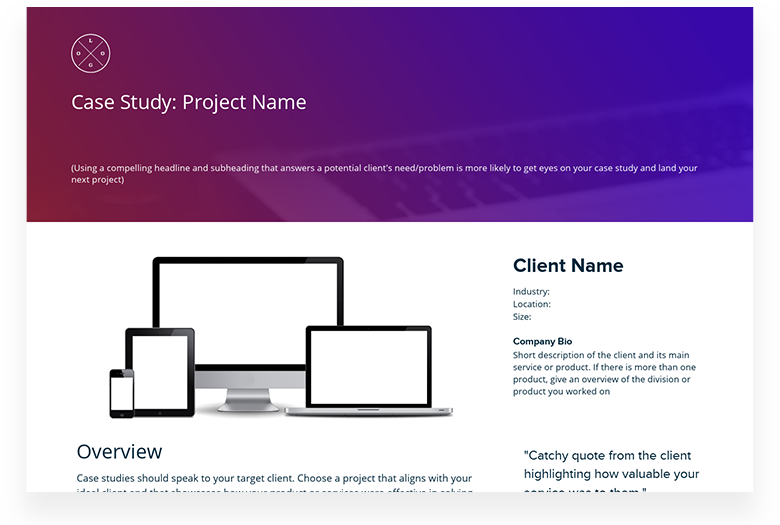
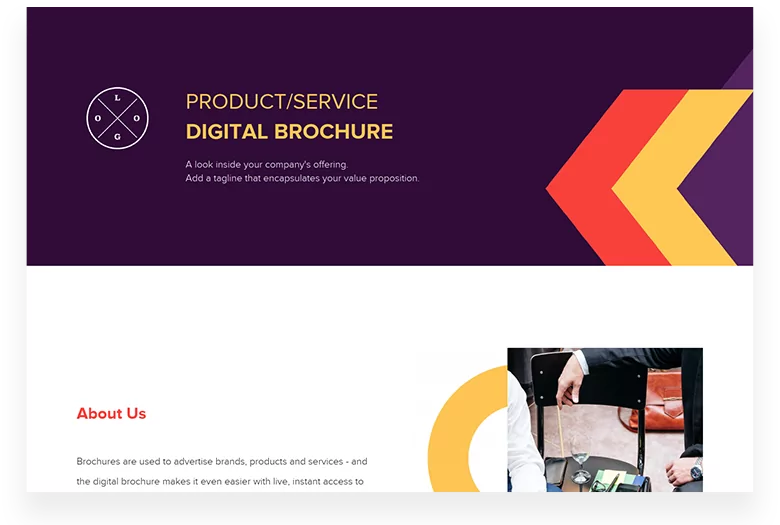
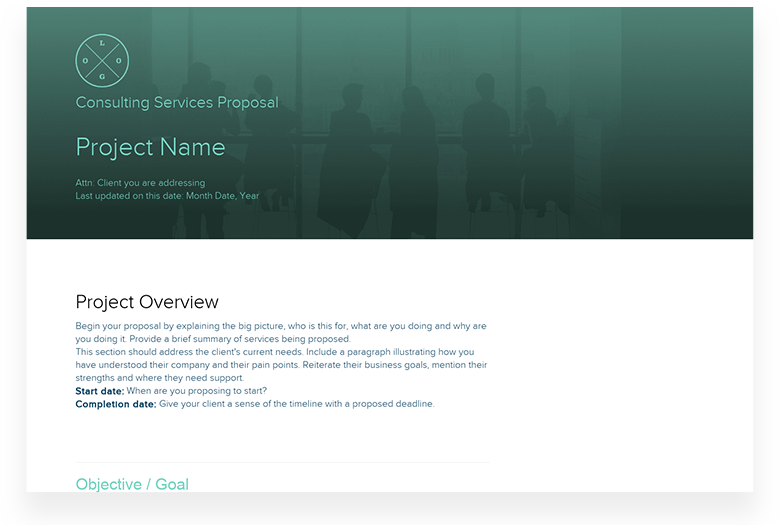
Fully customizable templates that you can make your own.
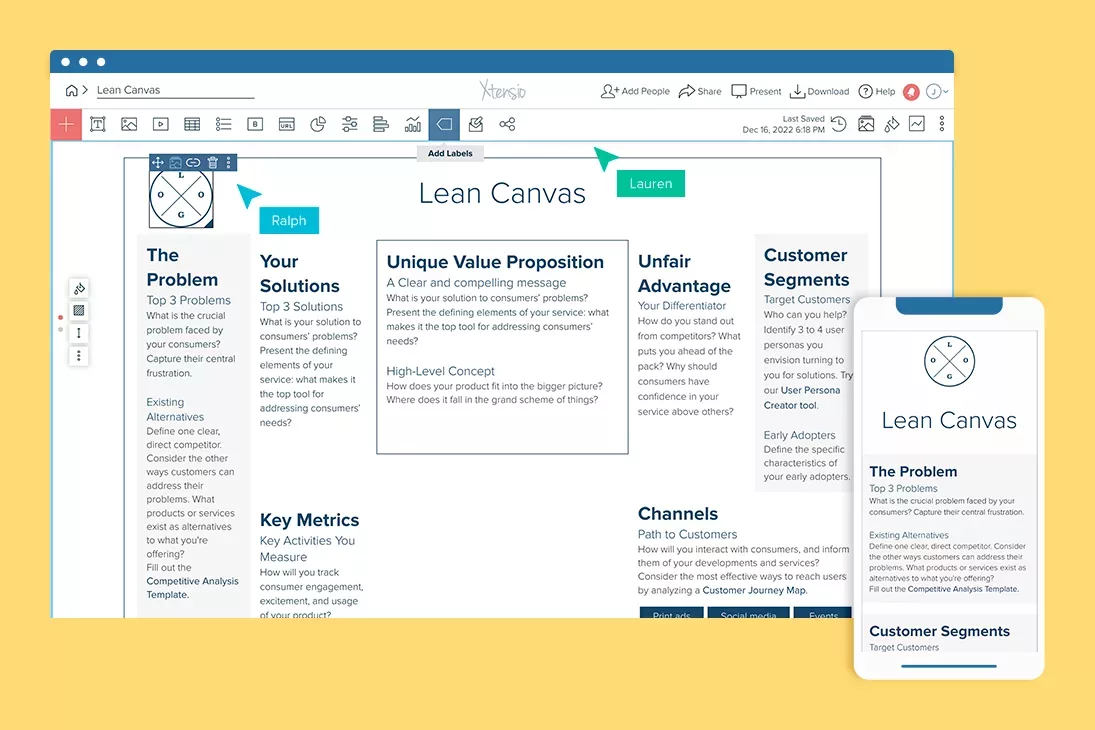
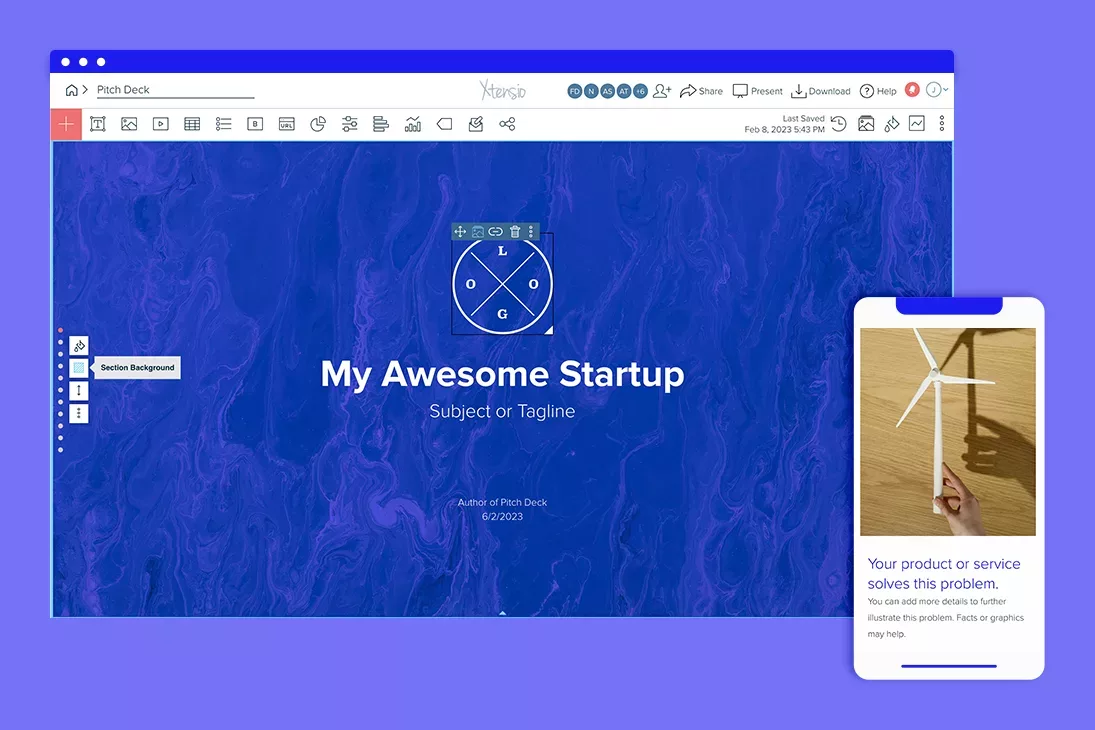
Check out Xtensio’s how to make a one-pager guide for step-by-step instructions and best practices.
What to Create Next
A one-pager is often the first touchpoint. Make sure the rest of your materials are ready.
What to Include in a Startup One Pager
A strong startup one pager fits on a single page but answers every question an investor or partner needs to decide if they want more. Here’s what to cover:
Problem and Solution
Open with the problem your target customer actually has — not the category, the specific pain. Follow immediately with how you solve it in one or two sentences. Avoid jargon. If someone outside your industry can’t understand it in 10 seconds, rewrite it.
Product or Service Overview
Describe what you built, not how you built it. Focus on what the customer experiences and what changes for them after they use your product. One short paragraph is enough — this isn’t a technical spec.
Target Market
Define who you’re building for. Be specific: “B2B SaaS companies with 10–50 employees scaling their client delivery” beats “businesses that need better documents.” Specificity builds credibility with investors and shows you know your customer.
Traction and Proof Points
If you have revenue, users, pilot customers, or notable partnerships — lead with your best number. If you’re pre-traction, show early signal: waitlist size, pilot commitments, letters of intent, or relevant press. Social proof matters even at the idea stage.
Business Model
How do you make money? Keep it to one or two sentences. Investors want to know if you charge subscription, transaction, or service fees — and roughly what customers pay. You don’t need a full pricing page, just clarity on the model.
Team
List the founders and any key hires with one-line bios. Highlight the specific experience that makes this team qualified to solve this problem. If you have relevant exits, domain expertise, or technical credentials, mention them.
The Ask
If you’re raising, state the amount and what you’ll use it for. If you’re not fundraising, replace this with your next milestone or a clear call to action — schedule a demo, request a pilot, explore a partnership.
Startup One Pager Examples and Use Cases
A startup one pager isn’t a single document — it adapts based on who you’re sending it to. Here are the three most common versions:
Investor One Pager
Sent ahead of a meeting or attached to a cold outreach email. Focuses on problem, solution, traction, team, and the ask. Should be dense with proof points and short on explanation — investors read dozens per week and scan fast. Xtensio’s template keeps this tight: two columns, six sections, no wasted space.
Partnership One Pager
Sent to potential partners, resellers, or co-marketing contacts. Focuses on product overview, market overlap, and what the partnership looks like in practice. Replace the “Ask” section with a clear description of what you’re proposing and what value you bring to the other side.
Sales One Pager
Handed to a prospect at the end of a meeting or attached to a follow-up email. Focuses on the problem you solve for them specifically, your key differentiators, and a clear next step. Swap team bios for customer logos or case study snippets. Keep it one page — if they read one thing after your meeting, it should be this.
How to Write a Startup One Pager
Most one pagers fail because founders try to say everything instead of the right things. Here’s how to get it right:
- Start with the reader, not yourself. What does this person need to know to take the next step? Write for that question, not for your ego.
- Lead with your strongest point. Traction beats everything. If you have revenue or notable customers, put it in the first third of the page.
- Cut by 30% after your first draft. Every sentence should earn its place. Remove anything that could go on a second page — because there is no second page.
- Use numbers wherever possible. “Saves 3 hours per week” beats “saves significant time.” Specificity builds trust.
- Design for scan, not read. Investors and prospects skim first. Use headers, bullet points, and whitespace so the key points land even if they don’t read every word.
- Get outside feedback. Show your one pager to someone outside your company. If they can explain your business back to you accurately in 30 seconds, it’s working.
Startup One Pager vs Pitch Deck
A startup one pager and a pitch deck serve different moments in the fundraising and sales process. The one pager is your door opener — it goes before a meeting, during an intro email, or as a leave-behind after a brief conversation. The pitch deck is your room-filler — built for a 20-minute presentation where you can talk through each slide.
Many founders use both: the one pager to get the meeting, the pitch deck to run it. If you only have time to build one, start with the one pager. It forces the clarity that makes every other document better.
For client work — proposals, capability statements, and service overviews — see the consulting proposal template and capability statement template.
Share Your One Pager as a Live Link
Xtensio lets you share your startup one pager as a live link, not a static PDF. That means when you update your traction numbers, add a new investor, or refine your positioning, everyone who has the link sees the latest version automatically. No re-sending attachments, no version confusion.
The live link also tracks views — you’ll know when an investor opened your one pager, how many times, and from what city. That signal tells you who’s actually engaged and when to follow up.
For longer investor documents, see the executive summary template for a structured overview format that sits at the front of business plans and investment memos.
If your business is past the startup stage and you need a client-facing overview rather than an investor pitch, see the company one pager template — designed for established SMBs, agencies, and consultants presenting their business to clients or partners.

Create and deliver beautiful work, professionally.
Build, brand, and deliver living documents your clients actually engage with.







Join 410,571 professionals delivering work with Xtensio.