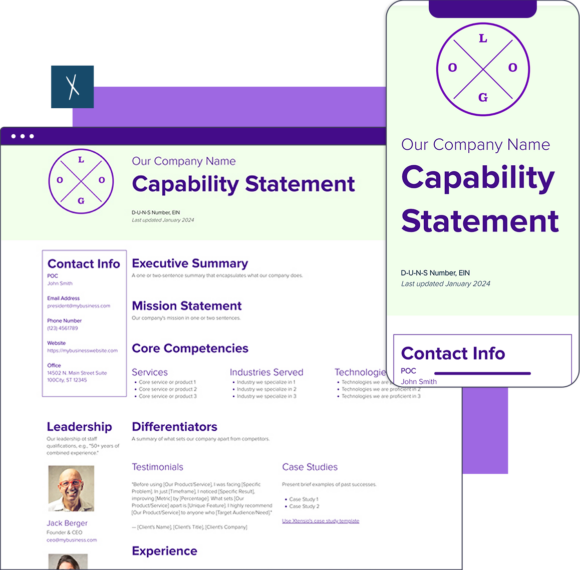
Capability Statement Template
A Capability Statement Template helps you outline your core competencies, differentiators, company details, and more. Think of it as your business’s ID card, but with a lot more information and flair.
Whether you’re in healthcare, technology, or manufacturing, a Capability Statement serves as a universal tool to establish credibility and showcase expertise. It’s not just a document; it’s a powerful marketing asset.
Beautiful living documents, built like web pages.
Join 410,571 professionals using Xtensio.
Xtensio is the workspace for professional deliverables.
Make one deliverable today—then build a repeatable system for every client and project.
This is where teams create, collaborate, organize, and deliver the documents that run their work.
Everything stays on-brand, current, and ready to share.

Organize every deliverable
Keep strategy, sales, marketing, and client docs together by workspace.
Create fast, stay consistent
Start from 200+ templates or AI drafts, then apply your brand kit.
Collaborate in the doc
No more “final_v7.pdf” loop.
Standardize across deliverables
Apply your brand kit + reusable modules so every deliverable matches.
Improve what you send
See engagement, iterate, and reuse what works across projects.
What is a Capability Statement?
A capability statement is a document that outlines your business’s skills, qualifications, and experiences. But why is it so important? Well, it’s often the first thing potential clients or partners see, and it can make or break their first impression of you.
The Anatomy of a Capability Statement
When it comes to crafting your capability statement, there are some core components you absolutely must include. These are your business details, the services or products you offer, your differentiators, past performance, and your team’s expertise.
Why Templates Matter
Xtensio’s templates aren’t just for making your document look pretty; they serve a functional purpose too. Xtensio’s well-designed templates ensure consistency across all your business documents, which is crucial for building a strong brand image.
Crafting the Perfect Introduction
The introduction of your capability statement serves as the handshake between you and your potential client. It should be warm, inviting, and most importantly, informative.
Detailing Your Services or Products
When detailing the services or products you offer, specificity is your best friend. The more specific you are, the easier it is for potential clients to understand what you can do for them.
Showcasing Your Differentiators
Your differentiators are what set you apart from your competitors. These could be anything from your unique approach to problem-solving, to a patented product that only you offer.
Highlighting Past Performance
Your past performance serves as proof of your capabilities. This is where you get to show off a bit, so don’t hold back! Include case studies, testimonials, or any other evidence that demonstrates your expertise.
Your Team’s Expertise
The people behind your business are just as important as the business itself. Highlight key team members, their qualifications, and what they bring to the table.
Financial Information
This is optional but including some financial information can go a long way in establishing trust. This could be as simple as mentioning your business’s financial stability or as detailed as including an income statement.
Compliance and Certifications
If your business holds any certifications or is compliant with industry standards, this is the section to mention it. It adds an extra layer of credibility to your capability statement.
Design and Layout
The design and layout of your capability statement shouldn’t be an afterthought. A well-designed document is easier to read and leaves a lasting impression. Xtensio’s template gives you a great starting point and you can still customize everything as you need.
The Role of Technology
Having a digital version of your capability statement is a must. Consider adding interactive features like clickable links or embedded videos to make it more engaging. you can share your folio in 9 different ways with Xtensio.
Tailoring for Different Audiences
Not all capability statements should be the same. Tailor yours depending on whether you’re targeting government contracts, the private sector, or something else entirely.
Xtensio makes it easy to duplicate your folio and personalize it depending on your audience.
Common Mistakes to Avoid
When crafting your capability statement, there are some pitfalls you should steer clear of. These include overcomplicating your document and being too vague in your descriptions.
Tips for Distribution
Once you’ve created your capability statement, the next step is to get it in front of the right people. Whether it’s through digital platforms or at networking events, we’ve got the tips to help you do just that: Xtensio helps you do the work once and get the most out of it. Your folio serves as a web page, a presentation, and a pdf in one. It is live, responsive, and interactive.
Measuring Effectiveness
How do you know if your capability statement is doing its job? By tracking certain KPIs, you can measure the effectiveness and make necessary adjustments. Xtensio gives you stats on how your shared folio is performing.
FAQs
How do you write a capability statement?
To write an effective capability statement, focus on presenting your business’s core competencies, differentiators, past performance, and contact information. Start by introducing your company, outlining your services or products, and providing evidence of your expertise. Use a clean, professional layout and include visuals like your company logo.
How do I create a capability statement template?
Start with Xtensio’s free template. Creating a capability statement template involves setting up a structured document that can be easily customized for different opportunities. Use Xtensio to create sections for your company’s overview, core competencies, differentiators, past performance, and contact details. Save the template on your dashboard for future repeat use.
What are the components of a capability statement?
A capability statement typically includes the following components: Company Overview, Core Competencies, Differentiators, Past Performance, NAICS/SIC Codes, and Contact Information. Each section should be concise and focused on showcasing your business’s strengths and qualifications.
Why is a capability statement important?
A capability statement is crucial for establishing credibility and attracting potential clients or partners. It serves as a marketing tool that succinctly presents your business’s strengths, making it easier for stakeholders to understand what you offer and why they should work with you.
How long should a capability statement be?
A capability statement should be concise, typically ranging from one to two pages. The aim is to provide essential information without overwhelming the reader, making it easier for decision-makers to quickly assess your business’s suitability for a project or contract.
Xtensio’s template is pageless. So you can make it as short or as long as you’d like. It will always look good on any device when shared. with a click, you can adopt it for printing, too!
Can I include testimonials in my capability statement?
Yes, including testimonials from satisfied clients or partners can enhance your capability statement by providing social proof of your expertise and reliability. Make sure to place them strategically within the document, preferably near relevant information.
What format should a capability statement be in?
Capability statements are commonly presented in PDF format for easy sharing and printing. However, you may also create digital versions optimized for web viewing or even interactive capability statements with clickable links and embedded videos. Xtensio is perfect for both use cases. You’ll do the work once and you can share in multiple formats.
How do I distribute my capability statement?
Distribute your capability statement through various channels such as email, your company website, and social media platforms. You can also hand out printed copies at networking events, trade shows, or meetings with potential clients and partners. With Xtensio, you can embed it on your website or present it in full screen as well.
Should I update my capability statement regularly?
Yes, it’s advisable to update your capability statement regularly to reflect any changes in your services, expertise, or achievements. Keeping it current ensures that you’re presenting the most accurate and compelling information to stakeholders.
Conclusion
Creating an effective capability statement is no small feat, but with the right approach and this template, it’s more than doable. Remember, your capability statement is often the first impression potential clients have of your business, so make it count.
Related to the Capability Statement Template
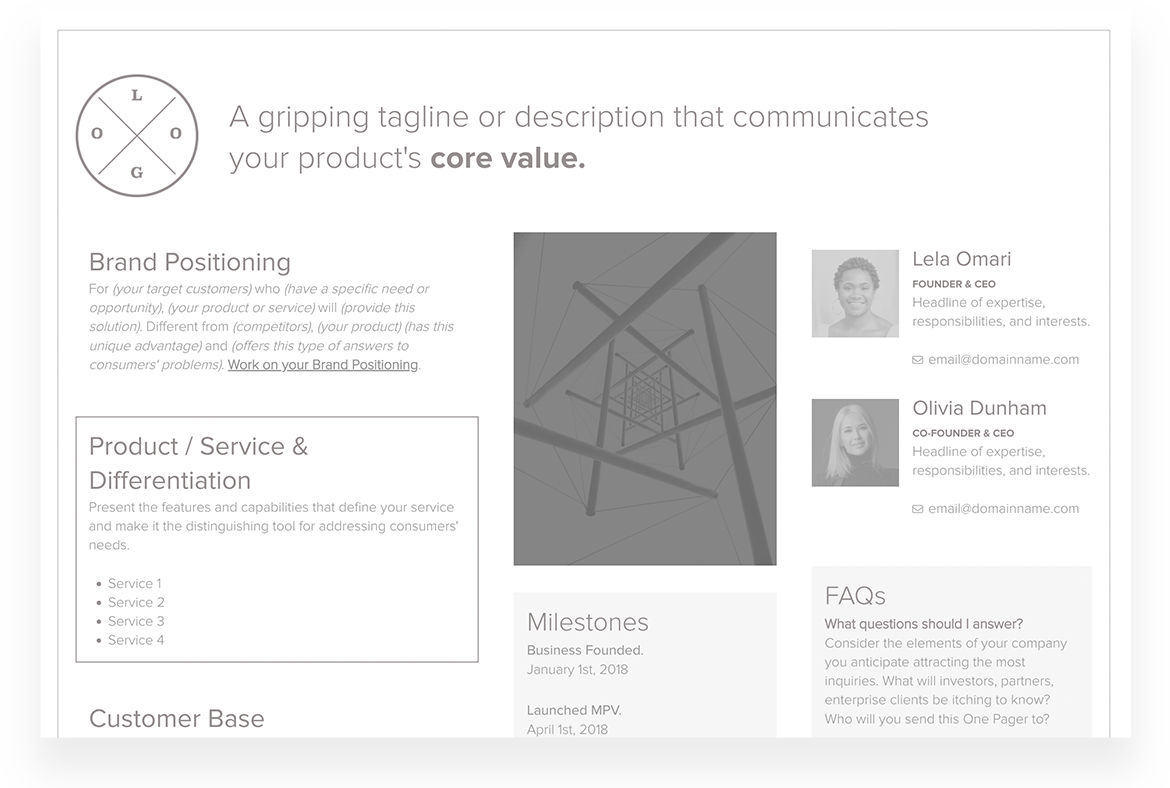
Fully customizable templates that you can make your own.


See how Xtensio can help your business

Build and launch products and services successfully.

Engage buyers more and close sales faster.


Capability Statement Use Cases: When and Who Requests One
A capability statement is most commonly associated with government contracting, but its use extends well beyond that context. Understanding who requests them — and what they are looking for — helps you build a document that works rather than one that merely exists.
Federal and State Government Contracting
Federal agencies, state governments, and municipalities frequently require a capability statement before considering a vendor for a contract. The document functions as a pre-qualification filter — agencies use it to assess whether your business has the certifications, past performance, and core competencies relevant to the work being solicited. For government contracting, your capability statement must include your NAICS codes, DUNS/SAM number, CAGE code, and any relevant small business designations (8(a), HUBZone, SDVOSB, WOSB). These are administrative requirements that eliminate you from consideration if missing.
Government-facing capability statements should be formatted to be skimmable in under two minutes. Contracting officers review dozens of these; dense paragraphs will not be read. Use bullet points for past performance and core competencies. Lead with your most relevant experience for the specific agency or contract type. Keep the document to one page — two at most.
Corporate Vendor Qualification
Large corporations often require a capability statement as part of a vendor qualification process. This version typically emphasizes insurance, liability, quality management systems (ISO certifications, for example), compliance history, and references from comparable corporate clients. The differentiators section should specifically address what separates you from the three or four other vendors on the shortlist — not why you are good in general, but why you are the better choice for a corporate procurement team with specific risk and compliance requirements.
Teaming and Partnership Agreements
Contractors pursuing large government or corporate opportunities often form teaming agreements — partnerships where multiple firms bid together, with one serving as the prime contractor and others as subcontractors. When approaching a potential teaming partner, your capability statement communicates what you bring to the team: specific certifications they lack, past performance in relevant areas, or geographic coverage they cannot provide alone. In this context, the capability statement is as much a sales document as a qualification document.
How to Write Each Section of a Capability Statement
Core Competencies
List six to eight specific capabilities — not general industry categories. “Program management” is too broad. “Program management for DoD IT modernization projects with budgets over $5M” is specific enough to be useful. Each competency should directly map to what the prospective client is trying to accomplish. Before finalizing this list, read the solicitation or the client’s stated priorities carefully and align your competencies with their language where possible.
Past Performance
Past performance is the section that earns trust. Include three to five relevant projects with: the client name (if permitted), contract value, a one-sentence description of the work, and the measurable outcome. Outcomes matter more than activities — “reduced procurement cycle time by 30%” is more compelling than “managed procurement activities.” If you are a newer company with limited past performance, include pilot projects, subcontract work, or relevant commercial experience that demonstrates the same capabilities in a comparable context.
Differentiators
This section is where most capability statements fail. Differentiators should be specific, verifiable, and actually different — not “commitment to quality,” “experienced team,” or “customer-focused approach” (every competitor claims the same). Real differentiators might include: a proprietary methodology you have developed, a technology platform you own, a specific certification no competitor holds, a unique combination of certifications that creates a cost advantage, or a performance track record in a specific context that is difficult to replicate.
Common Capability Statement Mistakes
- Generic differentiators. If your differentiators could apply to any company in your industry, they are not differentiators. Every bullet should survive the test: “Can a competitor say exactly this about themselves?” If yes, remove it.
- No measurable past performance outcomes. Listing what you did without saying what changed as a result of your work provides no evidence of effectiveness. Quantify outcomes wherever possible — percentages, dollar amounts, time savings, error rate reductions.
- Missing required administrative data. For government contracting, missing a CAGE code, NAICS code, or SAM registration can eliminate your submission from consideration before anyone reads it. Check requirements carefully for each specific agency or solicitation.
- Using a static PDF that goes stale. Company information changes: new certifications, new past performance, new leadership, updated revenue figures. A capability statement published as a living document at a permanent URL can be updated as your company grows — every prospect who has the link always sees your current credentials, without you having to chase down every previous distribution to send an updated file.
- One-size-fits-all approach. Sending the same capability statement to a federal agency, a corporate procurement office, and a potential teaming partner is a missed opportunity. Each context prioritizes different information. Maintain a master version and create tailored variants for your three primary use cases.

Jerome Katz
Professor of Entrepreneurship @

Jake Peters
CEO @

Robin Bramman
Founder and Chief Brand Mixologist @

Alix Han
VP Product Experience @

Marc Anthony Rosa
Product Manager @

Anna Yunker
Content Strategist @

Robin Eyre
Owner @

Adam Sher
CEO @

Humma Arshad
Salesforce Project Manager @
Prefer to start with AI? The AI Capability Statement Generator builds your core competencies, differentiators and past performance from a short description of your business.

Create and deliver beautiful work, professionally.
Build, brand, and deliver living documents your clients actually engage with.







Join 410,571 professionals delivering work with Xtensio.
How Does Xtensio Compare?
Wondering how Xtensio stacks up against other tools? Here’s the short version:
Xtensio vs Canva: Canva makes beautiful one-off designs, but capability statements need to be updated for each opportunity — a workspace lets you manage multiple versions.
Xtensio vs PowerPoint: PowerPoint slides get emailed as attachments and lost in inboxes. A live link means your capability statement is always current when prospects view it.
Xtensio vs Google Docs: Google Docs can hold the text, but a capability statement needs to look professional and branded — not like a draft document.
See the full comparison guide to find which tool fits your workflow best.
Capability Statements for Consulting Firms
Consulting firms present capability statements during RFP responses, conference introductions, and new business outreach. The emphasis is on past performance and methodology — clients want to know you’ve solved the exact problem before, not just that you exist.
A consulting capability statement typically leads with the industries served (HR, operations, supply chain, finance), then covers the firm’s methodology (how you approach engagements), past performance summaries (3-5 brief case studies with outcomes), and the principals’ credentials. Avoid generic descriptions like “trusted partner” or “innovative solutions” — replace them with specific numbers: “15 supply chain transformations across manufacturing and logistics clients in the past 3 years.”
For boutique consultancies where the founder is the brand, lead with the principal’s credentials and a signature framework before the company overview. Pair your capability statement with a consulting proposal template for deeper engagement scoping, or a monthly client report to stay visible after the engagement begins.
Capability Statements for IT and Technology Companies
IT companies and managed service providers (MSPs) use capability statements to differentiate in a commodity market. The challenge: every IT provider claims to be “reliable,” “responsive,” and “proactive.” Your capability statement needs to lead with specifics — platforms supported, client size served, average response SLA, certifications held (SOC 2, ISO 27001, Microsoft Gold Partner, AWS Partner), and verticals where you specialize.
A strong IT capability statement separates your core services (helpdesk, infrastructure, cybersecurity, cloud migration) from specialized offerings, includes a brief client retention or satisfaction metric, and ends with a clear next step — typically a free assessment or discovery call. Keep technical jargon minimal unless you know your audience is a CTO. Decision-makers are often procurement officers or operations directors who care about uptime, cost predictability, and compliance, not technical architecture.
For IT companies pursuing government contracts, combine this section with the government contracting guidance below. For private sector B2B, pair your capability statement with a one-pager for introductory outreach.
Capability Statements for Government Contracting
Federal, state, and local government agencies require capability statements as part of the procurement process. A compliant government capability statement typically includes your SAM.gov registration status, NAICS codes, small business designations (WOSB, SDVOSB, 8(a), HUBZone, etc.), DUNS or UEI number, and GSA schedule information if applicable.
Format matters in government contracting. Procurement officers review dozens of capability statements per opportunity — yours needs to be scannable, professional, and contain every required data point in an expected location. Xtensio’s capability statement template is structured for this: key credentials at the top, competencies and past performance in the body, contact information clearly at the bottom.
For private sector B2B proposals, pair your capability statement with a consulting proposal for deeper client-specific context, or a startup one-pager for introductory outreach. Once the engagement is underway, use the monthly client report template to communicate ongoing results to clients.