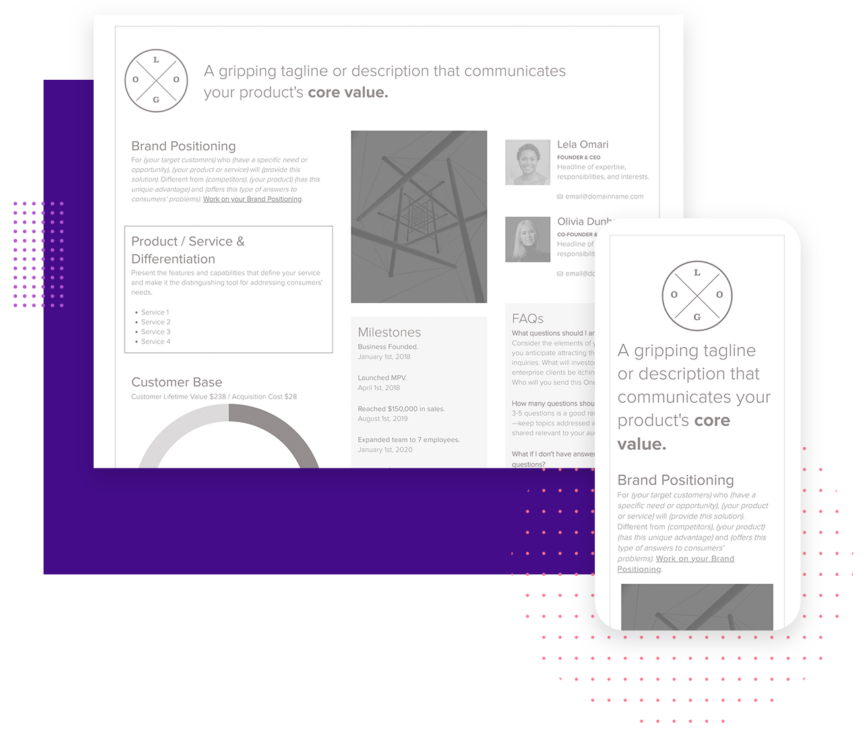
Business One Pager Template
Fast and to-the-point business facts on a single page. Use Xtensio’s fully customizable template for sales, investor relations, and business development efforts. No need to spend days on design.
- Create a free account and start editing. No credit card required.
- Apply your brand colors, fonts, and business facts in minutes.
- Start collecting new business leads.
Xtensio is your team’s deliverables workspace.
Create, collaborate, and deliver client-ready docs—then keep them current.
Join 410,083 using Xtensio.
Xtensio is the workspace for professional deliverables.
Make one deliverable today—then build a repeatable system for every client and project.
This is where teams create, collaborate, organize, and deliver the documents that run their work.
Everything stays on-brand, current, and ready to share.

Organize every deliverable
Keep strategy, sales, marketing, and client docs together by workspace.
Create fast, stay consistent
Start from 200+ templates or AI drafts, then apply your brand kit.
Collaborate in the doc
No more “final_v7.pdf” loop.
Standardize across deliverables
Apply your brand kit + reusable modules so every deliverable matches.
Improve what you send
See engagement, iterate, and reuse what works across projects.
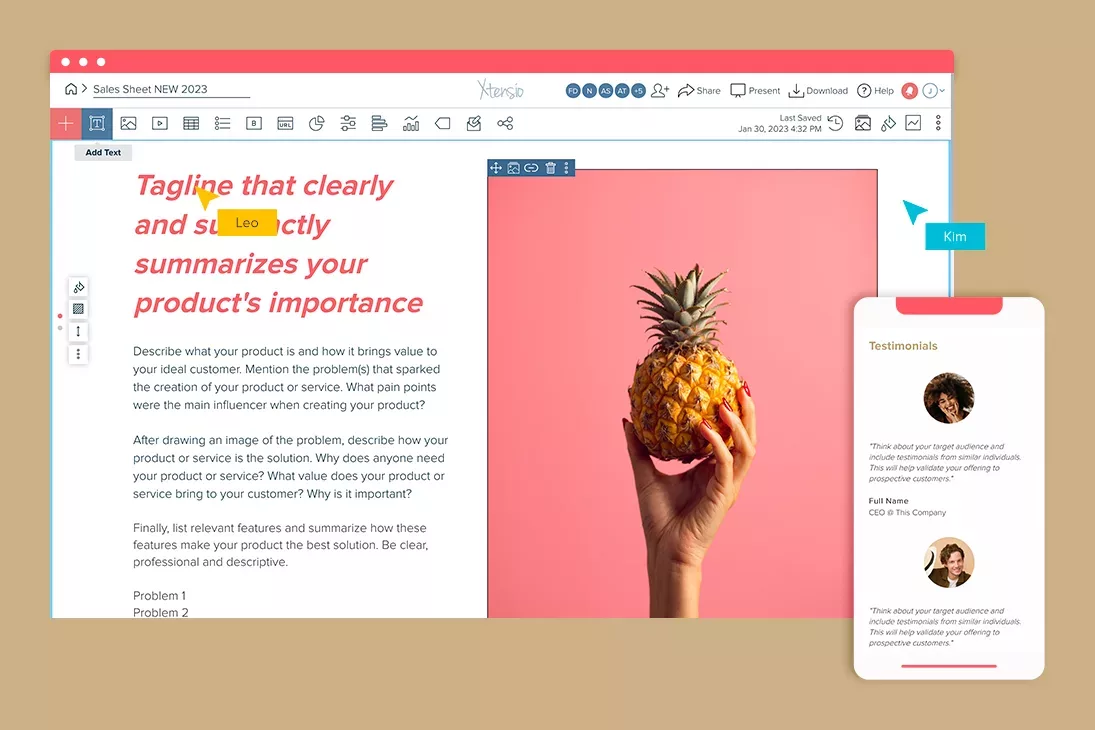
Click and start editing online.
Follow the simple instructions to populate.
Drag & drop. Resize. It’s super easy.
Customize with your fonts and colors.
Add graphs, charts, images, videos, web pages.
Save as a template to create many versions.
Share with a link. Customize your URL.
Collect emails. Track views.
Embed on your website.
Export as a PDF or PNG.
Edit together.
Why use Xtensio to create a Business One Pager?
You can make One-Pagers on a Word document or Google Docs which are easy to edit but not very design-friendly for this purpose. Alternatively, you can hire a designer to create a sleek business one-pager using design software, which might cost too much. The end result is often a PDF or a design file which isn’t practical to make frequent minor edits. You get the best of both worlds with Xtensio’s editor. Easy to keep up-to-date and design-friendly.
No credit card required.
What is a Business One-Pager?
Business or Company One-Pager is a single-page summary of key facts about a business or an organization. Frequently used by sales teams, business development efforts, public relations, or investor communications, it is an effective way to provide vital information at a quick glance.
Some variations on the Business One Pager are:
- Product or service fact sheets
- Brochures
- Sales one-pagers
- Investor intro for startups
- Organizational fact sheets for HR / Operations
- Monthly or annual reporting
- Various marketing collateral
- PR and media communications
How to create a Business One-Pager?
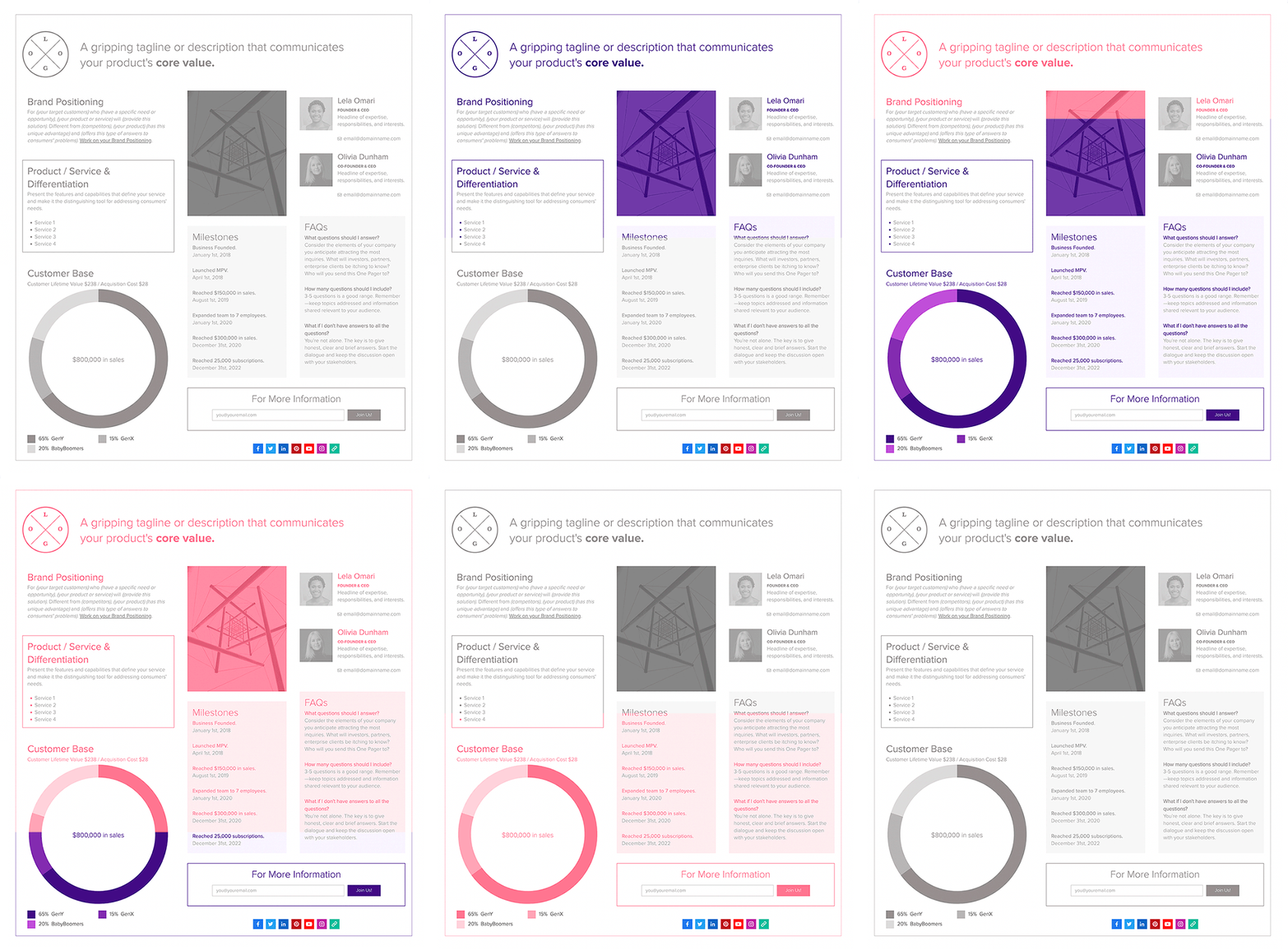
Start with any of Xtensio’s example templates below. Follow along with the instructional copy. For further help completing each section, you can also check out our fact sheet how-to guide.
The main pieces of content to include in your business one-pager are:
- An attention-grabbing tagline
- A hero image of your product or services
- Your brand positioning statement
- Description of your product and services
- An introduction to your team
- Key business metrics such as revenue information or customer profiles
- Important milestones
- Short FAQs
- Weblinks, social media profiles, contact information
The Business One-Pager is typically created so it’s ready to download and print on a single page. But you can also easily share a trackable live link. No more jumping from tool to tool or worrying about file format size and more focus on creating impressive and focused presentations to move your business forward.
No credit card required.
Related to the Business One Pager Template
Fully customizable templates that you can make your own.


What is a business one-pager?
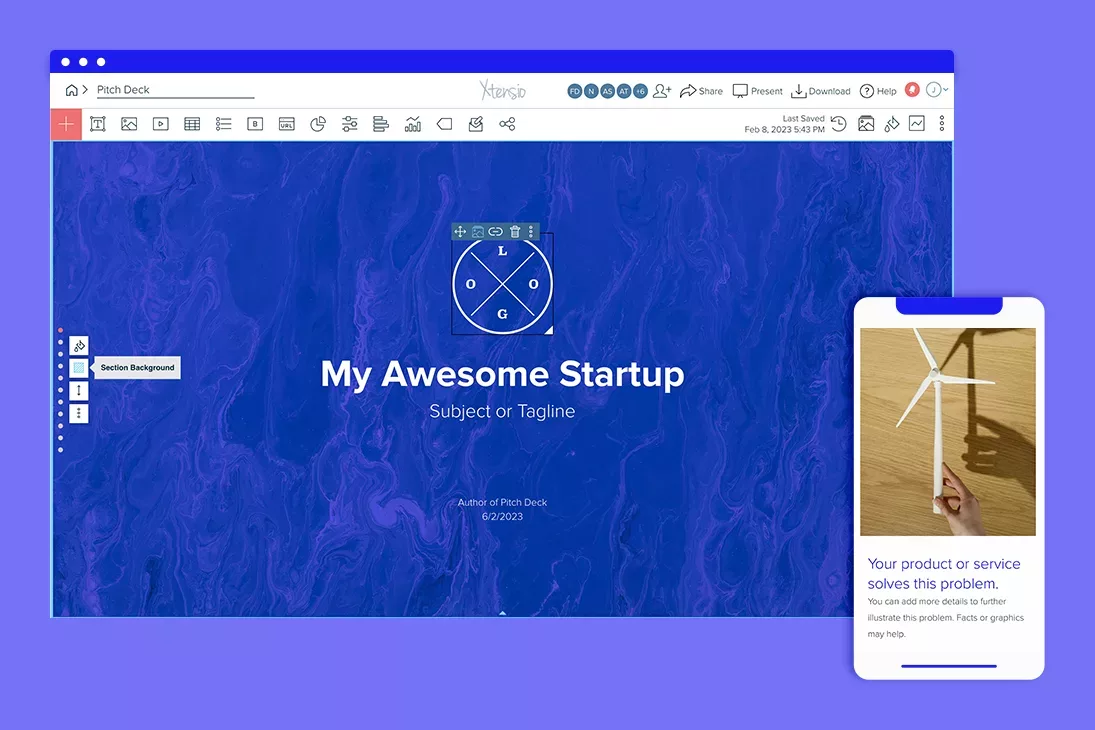
A business one-pager is a single-page document that summarizes your company, product, or service for a professional audience. Unlike a startup one-pager (which focuses on fundraising), a business one-pager is designed for sales conversations, partnership introductions, conference handouts, and client-facing communication. Want a first draft fast? Generate a one-pager with AI and edit it from there.
Think of it as your company’s calling card on paper. It should answer: what you do, who you serve, why you are different, and what the reader should do next.
What to include in a business one-pager
- Company overview — Name, logo, tagline, and a 2-sentence description of what you do.
- Products or services — Your core offerings, organized by category or audience segment.
- Key differentiators — What makes you different from competitors? Focus on 2-3 points, not a feature dump.
- Social proof — Client logos, testimonials, key metrics (revenue, users, awards), or case study snippets.
- Contact information — Website, email, phone, and a clear call to action.
When to use a business one-pager
- Sales meetings — Leave behind a polished summary after an initial conversation.
- Conferences and events — Hand out a branded one-pager instead of a generic business card.
- Partnership introductions — Send a link that explains your business quickly before a call.
- RFP responses — Include a company overview page as part of your proposal package.
- Internal communication — Help new hires, board members, or advisors understand the business at a glance.
Why share your one-pager as a live link
A PDF one-pager goes stale the moment your pricing changes, your team grows, or your product evolves. Sharing a live link means the recipient always sees the latest version of your business summary.
With Xtensio, your business one-pager is a living deliverable that you can:
- Update once, everywhere — Change your metrics or team info and every shared link reflects it instantly
- Brand professionally — Apply your brand colors, fonts, and logo with one click
- Track engagement — See who opened your one-pager, when, and how long they spent reading it
- Export when needed — Download as PDF for print or email attachment use cases
- Organize by client or project — Keep versions for different audiences in your workspace
Business One-Pager vs Executive Summary vs Pitch Deck
These three documents serve different purposes, and choosing the wrong format wastes both your time and your audience’s attention.
A business one-pager is a single-page snapshot designed for quick decisions. It distills your entire business into the essentials: what you do, who you serve, why it matters, and what you are asking for. The reader should understand your business within 60 seconds. One-pagers work best for networking events, partnership introductions, board updates, and any situation where attention is limited.
An executive summary is a detailed overview, typically two to five pages. It covers market opportunity, competitive landscape, financial projections, and team background in enough depth for an investor or partner to evaluate the opportunity. Executive summaries work best as the opening section of a business plan or as a standalone document for investors who want more detail before scheduling a meeting.
A pitch deck is a visual narrative designed for live presentations. It relies on slides with minimal text, compelling visuals, and a story arc that builds to a clear ask. Pitch decks are presentation tools, not reading documents. They lose most of their impact when emailed without a presenter to walk through them.
The practical difference: your one-pager is the document people forward. Your executive summary is the document people read carefully. Your pitch deck is the document people watch you present. Most businesses need all three, and they should tell a consistent story. Build them in the same workspace so your messaging stays aligned across all formats.
5 One-Pager Mistakes That Lose Attention
A one-pager only works if someone actually reads it. These five mistakes are the most common reasons a business one-pager fails to hold attention.
Too much text. If your one-pager requires scrolling or squinting, it has failed its primary purpose. Every sentence should earn its place. Cut any line that does not directly answer “what do you do?” or “why should I care?” Aim for 300 to 500 words maximum. If you cannot explain your business in that space, the problem is clarity, not word count.
No clear ask. Every one-pager needs to end with a specific next step. “Schedule a demo,” “Join our pilot program,” or “Reply to discuss partnership” are clear asks. “Learn more” or “Visit our website” are not. The reader should know exactly what action you want them to take and why it benefits them.
Generic value propositions. “We help businesses grow” describes every company that has ever existed. Your one-pager should name the specific problem you solve for a specific audience. Replace “innovative solutions” with “cut onboarding time from 3 weeks to 3 days for mid-market SaaS companies.” Specificity builds credibility.
Outdated numbers. Nothing undermines a one-pager faster than last year’s revenue figures or a team count that is six months old. If your one-pager lives as a static PDF, every metric is frozen at the moment you exported it. Share it as a live link instead, and update your numbers as they change. The recipient always sees the current version.
PDF-only sharing. Emailing a PDF attachment means you have no visibility into whether someone opened it, shared it, or glanced at it for two seconds. You also cannot update it after sending. A live link gives you engagement data and ensures the recipient always has the latest version of your one-pager.
One-Pager Templates by Use Case
Different audiences need different emphasis. Here is how to adapt your business one-pager for four common scenarios.
Investor update one-pager
Lead with metrics: monthly recurring revenue, growth rate, burn rate, runway, and key milestones hit since the last update. Investors want to see traction and trajectory, not a company overview they already know. Include one or two strategic priorities for the next quarter and any specific asks (introductions, hiring help, upcoming raise details). Keep the narrative to two or three sentences. The numbers tell the story.
Partnership proposal one-pager
Focus on mutual value. Lead with the partner’s problem, not yours. Describe what the partnership looks like in practice, what each side contributes, and what the expected outcomes are. Include your audience size or distribution reach so the partner can quickly assess fit. End with a concrete next step, such as a joint pilot or co-marketing campaign.
Product launch one-pager
Structure around the problem, the solution, and the proof. Name the specific customer pain point, show how your product addresses it, and provide one or two data points or early customer quotes that validate the claim. Include pricing and availability details. For internal launches, add go-to-market timeline and team responsibilities. For external launches, focus on the value to the buyer.
Internal project pitch one-pager
When pitching a new project to leadership, lead with the business impact. What revenue will this generate, what cost will it save, or what risk will it mitigate? Include a realistic timeline, resource requirements, and success metrics. Name the trade-offs honestly. Executives respect a one-pager that acknowledges what you are not doing in order to pursue this project. See our startup one-pager template for a more investor-focused format, or read the full guide on how to make a one-pager for step-by-step instructions.
Teams use Xtensio to create, share, and improve professional deliverables.
Trusted by 410,083 teams, founders, and consultants.



Jeff Schenck
Marketing Manager @

David Nason

Grace Ghunaim
Global Chief Strategy Officer (CSO) @

Ben Cary
Founder @

Leon Coe
Instructor @
Texas A&M University

Jennifer Alt
UI/UX Designer @

Zac Heisey
Director of Digital Marketing @

Jenny Johansson
UX Manager @

Ryan Dobson
Global Engineering Manager @

Create and deliver beautiful work, professionally.
Build, brand, and deliver living documents your clients actually engage with.







Join 410,083 professionals delivering work with Xtensio.
Related: Company One Pager Template