
More Resources
For a detailed walkthrough of what goes in each section of your executive summary, see the step-by-step guide: How to Write an Executive Summary. It covers the problem statement, recommendation, key evidence, financial impact, team credentials, and call to action — with practical advice for business plans, project proposals, and research reports.
BONUS: See the consulting proposal template for client-facing project proposals.
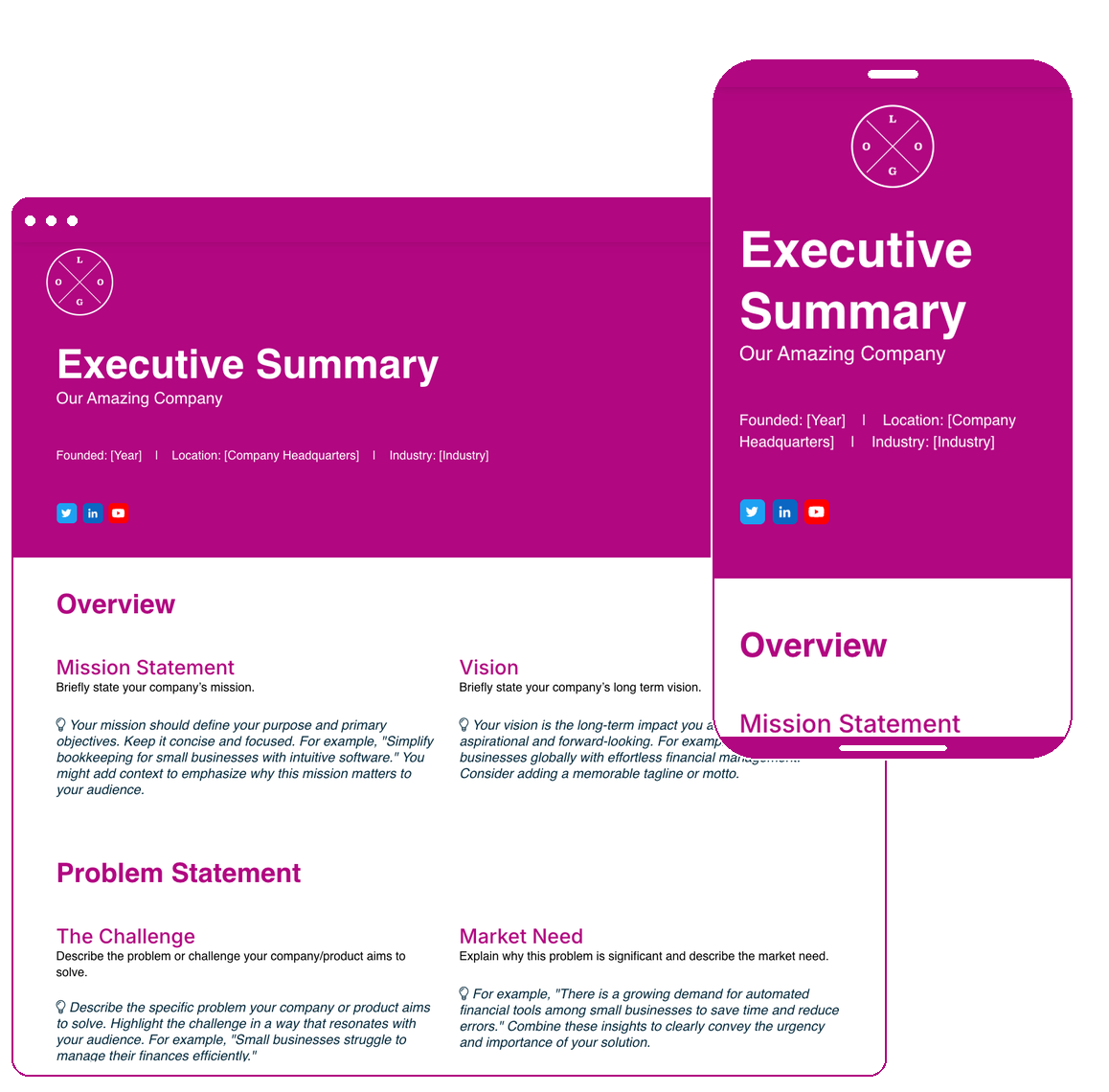
Free Executive Summary Template
Create concise, compelling executive summaries for business plans, project proposals, and investor decks — shareable as a live link, always current.
- Distill complex documents into decision-ready summaries.
- Customize sections for business plans, proposals, or research reports.
- Share as a live link — stakeholders always see the latest version.
Xtensio is your team’s deliverables workspace.
Create, collaborate, and deliver client-ready docs—then keep them current.
Join 409,446 using Xtensio.
An executive summary is a concise overview of a longer document — a business plan, project proposal, research report, or investment deck — designed for decision-makers who need the key points without reading everything. Xtensio’s executive summary template gives you a clean, professional format you can customize and share as a live link or export as PDF.
What Is an Executive Summary?
An executive summary distills a full document into its most important elements: the problem, the proposed solution, key evidence, and the recommended action. It’s typically one to two pages and written for a reader who may only have five minutes. If the summary convinces them, they’ll read the full document. If it doesn’t, the full document doesn’t matter.
Executive summaries appear in business plans, project proposals, research reports, grant applications, investment memos, and board presentations. In every context, the goal is the same: give the reader everything they need to make a decision or take a next step.
What to Include in an Executive Summary
Problem or Opportunity
Open with the situation that prompted the document. For a business plan, this is the market gap you’re addressing. For a project proposal, it’s the organizational problem you’re solving. For a research report, it’s the question you investigated. Be specific — the reader should immediately understand why this matters.
Proposed Solution or Recommendation
State clearly what you’re proposing. This is not the time for nuance — lead with your recommendation, then support it. Decision-makers read executive summaries to find out what you’re asking them to do or approve.
Key Evidence and Findings
Provide the 2-3 most compelling data points or findings that support your recommendation. Quantify wherever possible. For business plans, this might be market size and your revenue model. For project proposals, it might be the projected ROI or timeline. For research reports, it’s the most significant finding.
Financial Summary
If your document involves money — investment required, projected revenue, cost savings, budget needed — summarize it here. Decision-makers almost always want to know the financial picture before engaging with details.
Team or Author Credentials
For business plans and grant applications, a brief note on who is behind the recommendation and why they’re qualified. For internal reports, this section is often omitted.
Call to Action or Next Steps
End with one clear ask: approve the budget, schedule a meeting, move to the next phase, provide funding. Don’t make the reader figure out what to do — tell them.
Executive Summary Examples by Document Type
Business Plan Executive Summary
The most common format. Opens with the business concept and the problem it solves, covers the target market and size, describes the product or service, summarizes the business model and revenue streams, introduces the founding team, and closes with the funding ask and how it will be used. Typically one page for early-stage companies, up to two pages for established businesses seeking growth capital.
Project Proposal Executive Summary
Opens with the organizational problem or opportunity the project addresses, states the proposed approach in 2-3 sentences, summarizes the timeline and key milestones, provides the budget request, and identifies who owns the project. For internal proposals, the executive summary often replaces the full proposal for initial approval — only if approved does the detailed plan get reviewed.
Research Report Executive Summary
Opens with the research question or objective, briefly describes the methodology (so the reader can assess credibility), states the key findings in priority order, and closes with implications or recommended actions. Academic and policy research summaries often run longer (3-5 pages) because the audience expects more evidence before accepting conclusions.
Investment Memo Executive Summary
Used in private equity, venture capital, and M&A contexts. Covers the investment thesis (why this opportunity), the asset or company overview, key financial metrics, the deal structure and terms, and the investment rationale. Typically 1-2 pages for a first-round memo, more detailed for later-stage deals. Pair with a pitch deck for full investor outreach.
How to Write an Executive Summary
- Write it last. Even though the executive summary appears first, write it after the full document is complete. You can’t summarize what you haven’t finished writing.
- Lead with the recommendation, not the context. Most executive summaries bury the ask at the end. Experienced readers want to know what you’re proposing immediately, then evaluate the evidence.
- Use your strongest number in the opening paragraph. A specific figure — market size, projected ROI, cost savings — signals rigor and earns attention.
- Keep it to one page if possible. Every sentence should be necessary. If you find yourself explaining background that only matters to someone who will read the full document, cut it.
- Write for a reader who knows nothing about your project. Executive summaries are often forwarded. The second or third reader may have zero context — write for them.
- End with one ask, clearly stated. Ambiguous endings kill momentum. “We look forward to your feedback” is not a call to action. “We’re requesting approval of the $85,000 budget by April 30” is.
Executive Summary vs Abstract
An abstract is typically used in academic and scientific writing. It describes what the document contains — the research question, methodology, findings, and conclusions — so the reader can decide whether to read the full paper. An executive summary is used in business contexts and is prescriptive — it doesn’t just describe the document, it makes a case and asks the reader to do something.
For business documents, always use an executive summary. For academic papers and research reports, the convention depends on the field and publication requirements.
Share Your Executive Summary as a Live Link
Xtensio lets you share your executive summary as a live link instead of a static PDF. When your financial projections update, your team composition changes, or your ask evolves, you update the document once and everyone who has the link sees the latest version automatically. For board presentations and investor decks, this eliminates the version confusion that comes from emailing attachments. Pair your executive summary with a consulting proposal template or startup one-pager template for a complete business development package.
Related: Project Proposal Template