Consulting Services Proposal Template
Consultants, marketing professionals and agencies use the consulting proposal template to land a prospective client. Essentially, it’s a sales pitch. Your business proposal should include all the necessary components of a strategic game plan to detail how you would handle a specific project.
- Outline the project summary, scope and proposed solution.
- Demonstrate your company’s services, strategic framework and ability to succeed.
- Build upon your existing marketing strategies to showcase how you’re the best fit for the job.
Xtensio is your team’s deliverables workspace.
Create, collaborate, and deliver client-ready docs—then keep them current.
Join 410,837 using Xtensio.
Xtensio is the workspace for professional deliverables.
Make one deliverable today—then build a repeatable system for every client and project.
This is where teams create, collaborate, organize, and deliver the documents that run their work.
Everything stays on-brand, current, and ready to share.

Organize every deliverable
Keep strategy, sales, marketing, and client docs together by workspace.
Create fast, stay consistent
Start from 200+ templates or AI drafts, then apply your brand kit.
Collaborate in the doc
No more “final_v7.pdf” loop.
Standardize across deliverables
Apply your brand kit + reusable modules so every deliverable matches.
Improve what you send
See engagement, iterate, and reuse what works across projects.
How to create a consulting services proposal with Xtensio
- Create a free account and start editing, no credit card required.
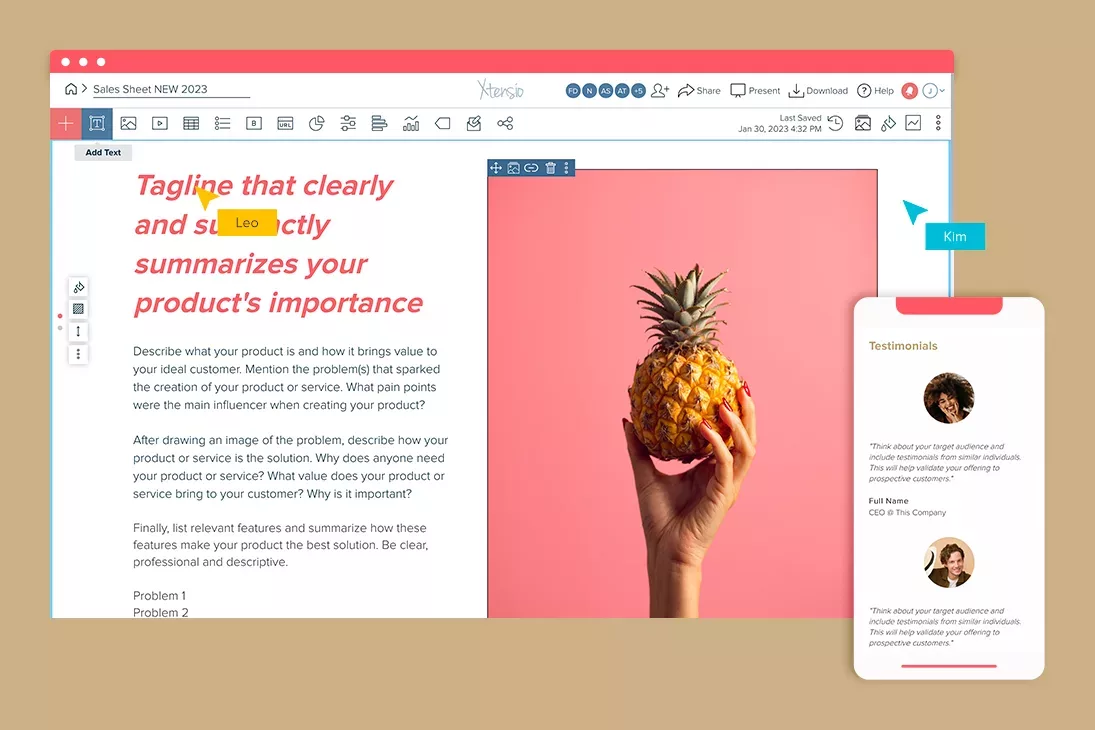
Follow along with the instructional consulting proposal details. Add charts, graphs, images, and videos to customize the proposal template and make it your own. Drag & drop. Resize. It’s the easiest editor ever.
- Customize everything in the consulting proposal template to match your brand.
Define your style guide. Add your (or your client’s) brand fonts and colors. You can even pull colors directly from a website to easily brand your business proposals and more.
- Work on your proposals together on the cloud.
Add colleagues (or clients) to collaborate on the consulting proposal template. Changes automatically save and sync across all devices, in real-time.
- Share a link. Present a slideshow. Embed. Download a PDF/PNG.
The consulting proposal template seamlessly adapts to your workflow. No more jumping from tool-to-tool to design different types of deliverables.
- Reuse and repurpose.
Save your own custom consulting proposal templates. Or copy and merge into other documents.
What is a consulting proposal?
A consulting business proposal is a document that consultants, marketing professionals and agencies send to potential clients; it acts as a sales pitch for a specific project. Consulting proposals are also marketing deliverables that demonstrate why and how the consultant’s experience and skills make them the best fit for the project. That being said, your proposals should be persuasive, personalized for the client’s needs and visually engaging.
How do I write a consulting services proposal?
The proposal itself won’t win the client. You should only send a project proposal once you’ve engaged the potential client and agreed that they have an issue or opportunity they’d like your help with. Before you get started creating a proposal, think about how you can add value to your client’s work.
- What is my brand identity? What kind of work does my consultancy do?
- What service will I be providing for this potential client?
- How do I compare to the competition?
Once you identify your value-add, get the potential client on the phone or schedule a meeting to talk about the prospect of working together in-person. This will add trust to your brand and give you the chance to plant the idea. Once it’s clear that you can add value for the client, simply ask them if you can create a project proposal and give them a specific date.

Xtensio Tip: If/when your proposal sparks interest, there is a good chance that your potential client will ask for a meeting. Be prepared with a well-structured meeting agenda:
Check out our meeting agenda templates.
Learn how to create an efficient meeting agenda.
Then it’s time to write a consulting proposal:
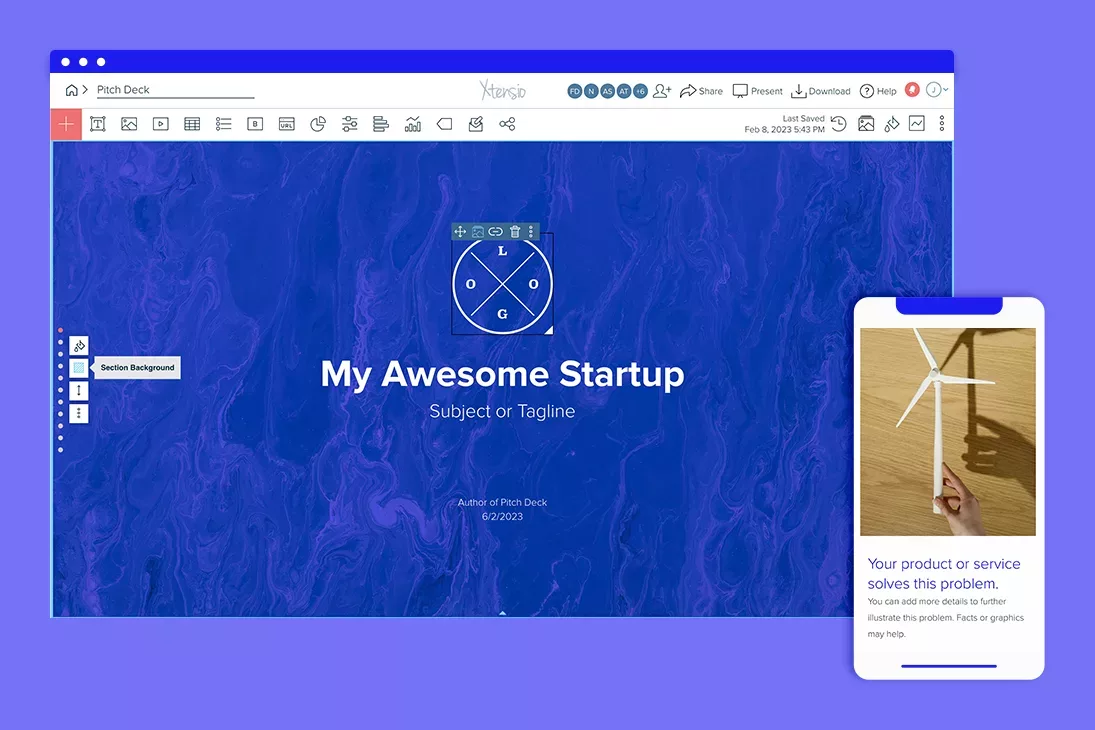
- Start by introducing yourself with a cover page: list your company and your name, the prospective client’s name and the date of submission. Add your branding with your colors, logo and a nice background image.
- Write an executive summary that gives an overview of the client’s problem, how you plan to tackle the challenge and a call-to-action.
- Describe your approach and process. What’s your strategy? How are you going to reach the objectives you outlined in the overview?
- Outline the scope and timetable of the project, including what you will (and will not) work on. Be explicit; clearly outline milestones, how you intend to carry out the project, and where resources will be allocated.
- List solutions and project deliverables. Whether you’re doing a website audit, creating a content marketing proposal or assisting the company in digital transformation, be clear about what deliverables are expected during the project. List out deliverables, formats and requirements.
- Outline budget, pricing, terms and conditions. Be transparent about the cost of your services and help your clients quickly determine if they can afford to work with you. Include how you wish to be compensated and describe any potential extra costs, such as outside tools, materials, or testing.
- Showcase related work and case studies. Sell yourself! Explain your background and experience related to the scope of this project. Add logos of bigger name companies that you’ve worked with.
Related to the Consulting Services Proposal Template
Fully customizable templates that you can make your own.


Consulting Proposal Structure That Wins Business
Most consulting proposals are organized around the consultant — the methodology, the credentials, the approach. The proposals that win are organized around the client — the problem, the cost of inaction, and the specific outcomes the engagement will produce. This shift in framing changes how every section is written.
1. Situation and Problem Definition
Open with a clear articulation of the client’s current situation and the specific problem they need to solve. Write this section as if you are explaining the problem back to the client — using their language, their framing, and their priorities. When a client reads your problem definition and thinks “exactly, that is precisely what we are dealing with,” your proposal is already more compelling than every competitor who opened with “our firm specializes in…”
Include the business impact of the problem where you can quantify it. “Your sales cycle is currently averaging 47 days, and you are losing an estimated 30% of deals to faster-moving competitors in the final week of the sales process” is more powerful than “you are experiencing sales efficiency challenges.” Specificity signals that you understand their business, not just their industry.
2. Objectives and Success Criteria
Before describing your approach, define what success looks like. List three to five specific, measurable outcomes the engagement should produce. This section serves two purposes: it aligns expectations upfront (reducing the risk of scope disagreements later), and it demonstrates that you are results-oriented rather than activity-oriented. Clients who can evaluate their consultant against explicit criteria are more likely to feel good about the engagement — and more likely to refer you.
3. Recommended Approach
Describe your methodology in terms of phases and deliverables, not just activities. Each phase should have a clear name, a duration, and a specific deliverable the client receives at the end. “Discovery and Assessment (Weeks 1–2): interviews with 8 stakeholders + current-state analysis report” is more credible than “Phase 1: Discovery.” Include a brief explanation of why you have structured the engagement this way — the rationale behind your approach signals experience and builds confidence that the methodology is not arbitrary.
4. Investment and Timeline
Present fees and timeline on the same page. Connect the investment to the value being delivered — if the engagement costs $40,000 and will reduce a process that currently costs $15,000 per month in staff time, say that. The investment section should never be presented in isolation from outcomes; fees are only sticker-shocking when there is no clear return attached to them.
Common Consulting Proposal Mistakes
- Leading with credentials instead of the client’s problem. Clients hire consultants to solve their problems, not to be impressed by credentials. Save the bio and client list for a later section. Open with the problem definition.
- Vague deliverables. “Strategic recommendations” and “actionable insights” are not deliverables — they are descriptions of what all consulting firms claim to produce. Name the specific documents, frameworks, workshops, or implementations the client receives.
- No defined success criteria. A proposal without measurable success criteria sets up a relationship where the client cannot evaluate whether the engagement succeeded. This creates ambiguity that damages trust even when the work is high quality.
- Sending it as a PDF. A consulting proposal sent as a PDF attachment can be forwarded, printed, and discussed — but it cannot be updated after sending. If you need to adjust scope, revise pricing, or respond to feedback after the first read, you must resend a new file. A live proposal link means you can refine it based on verbal feedback from the first conversation, and the client always sees the current version.
- No follow-up timeline. Every proposal should end with a specific follow-up plan: “I will reach out on [date] to discuss questions.” Leaving the next step undefined stalls decisions. Clients who need to act on a proposal need a reason to do so promptly.
Consulting Proposal vs. Statement of Work: What Comes When
A consulting proposal and a statement of work (SOW) are related but serve different purposes at different stages of the client relationship.
The consulting proposal is a sales document — it is designed to persuade a prospective client that you are the right choice. It is written before a project is approved and focuses on problem-solution fit, your approach, expected outcomes, and investment. It may be sent to multiple decision-makers and will likely be compared to competitor proposals. This document needs to be compelling, clear, and client-focused.
The statement of work is a contractual document — it formally defines the scope, deliverables, timeline, payment terms, and legal provisions of an approved engagement. It is written after a proposal is accepted and is designed to protect both parties by being precise rather than persuasive. SOWs are typically reviewed by legal or procurement teams and should use unambiguous language.
A practical workflow: use your proposal template to win the business, then convert the agreed scope into an SOW that becomes the binding agreement. Keeping these as separate documents prevents the common mistake of making your proposal so legally dense that it undermines its persuasive purpose — or making your SOW so sales-focused that it creates scope ambiguity.
For client communication after the proposal is accepted, see how to structure client deliverables as living documents — the same principle that makes a proposal more effective also applies to ongoing reporting and project updates.
Consulting Proposal vs Statement of Work vs Engagement Letter
Many consultants treat these three documents interchangeably, which creates confusion for clients and legal exposure for the consultant. Each serves a distinct purpose in a specific sequence.
The consulting proposal is the persuasion document. It sells your approach, demonstrates understanding of the client’s problem, and outlines expected outcomes. You send this before winning the work. Its job is to get a “yes.”
The statement of work (SOW) is the scope document. It details exactly what you will deliver, by when, and at what cost. You create this after the client accepts your proposal but before work begins. Its job is to prevent scope disagreements by defining boundaries, milestones, and acceptance criteria. A good SOW removes ambiguity that a good proposal intentionally left open.
The engagement letter is the legal agreement. It covers payment terms, intellectual property rights, confidentiality, termination clauses, and liability limitations. Some firms combine the SOW and engagement letter into one document, but separating them allows you to reuse the same legal terms across engagements while customizing the SOW for each project. If your firm does not have a standard engagement letter template, have a business attorney create one. Using it consistently protects both sides and speeds up project kickoff.
The three-document sequence matters. Sending a legal agreement before a proposal kills momentum. Sending a proposal without following up with a SOW creates scope ambiguity. Build all three as reusable templates in your workspace, then customize each for the specific engagement. Share each as a live link so clients always see the current version and you can track when they open it with engagement analytics.
5 Consulting Proposal Mistakes That Lose Deals
Beyond the structural errors that weaken proposals, certain mistakes actively push clients toward your competitors. These are the deal-breakers that cost consultants revenue.
1. Leading with methodology instead of the client’s problem. Opening with “Our proprietary 7-step framework” signals that you are more interested in selling your process than solving their specific challenge. Clients want to feel understood before they are sold to. Lead with their problem, then explain how your methodology addresses it.
2. Generic scope language. Phrases like “comprehensive assessment” and “strategic recommendations” could apply to any engagement in any industry. The client cannot distinguish your proposal from three other consultants using the same language. Name specific deliverables: “a customer retention audit covering your top 50 accounts by revenue, with a prioritized action plan for the 12 accounts showing churn signals.”
3. No clear pricing structure. Hiding fees at the end, bundling everything into one number, or using complex rate tables all create friction. Clients need to understand what they are paying for and how the fee relates to the value delivered. Present pricing in tiers when possible: a focused engagement, a standard engagement, and a comprehensive engagement. This gives the client a sense of control and increases the odds that at least one option fits their budget.
4. Missing timeline with milestones. A proposal that says “6 to 8 weeks” without week-by-week milestones leaves clients uncertain about what happens between kickoff and final delivery. Uncertainty delays decisions. Include a visual timeline showing each phase, its duration, and the specific deliverable produced at the end of that phase.
5. No social proof from similar engagements. Testimonials and case studies from clients in the same industry or with the same problem are more persuasive than general credentials. If you have helped three SaaS companies reduce churn by 15% or more, say that with specifics. If you cannot share client names, anonymize the details but keep the metrics. Numbers build credibility that claims alone cannot.
Teams use Xtensio to create, share, and improve professional deliverables.
Trusted by 410,837 teams, founders, and consultants.



Jeff Schenck
Marketing Manager @

David Nason
CEO/Founder @

Grace Ghunaim
Global Chief Strategy Officer (CSO) @

Ben Cary
Founder @

Leon Coe
Instructor @
Texas A&M University

Jennifer Alt
UI/UX Designer @

Zac Heisey
Director of Digital Marketing @

Jenny Johansson
UX Manager @

Ryan Dobson
Global Engineering Manager @
For smaller, scoped engagements, see the project proposal template as a starting point before moving to a full consulting proposal.
Consulting Proposal Examples
Marketing Strategy Consulting Proposal
A marketing consultant proposing a 90-day brand positioning engagement. The proposal opens with a diagnosis of the client’s current positioning gaps, proposes a research-driven rebranding strategy, outlines three phases (research, strategy, implementation), and closes with pricing options at different scope levels — allowing the client to choose their level of commitment. The tiered pricing approach typically reduces pushback on fees by 30-40% because the client retains control over scope.
IT Consulting Proposal
A technology consulting firm proposing a cloud migration project for a mid-size manufacturer. The proposal leads with the business risk of the current infrastructure (downtime cost, compliance exposure), proposes a phased migration over 12 weeks, includes a detailed timeline with milestones and acceptance criteria, and provides a fixed-price quote with a change order clause. Technical proposals benefit from specificity: vague deliverables (“improve the system”) invite scope disputes, while specific outputs (“migrate 3 production databases to AWS RDS with zero downtime”) create clear success criteria.
Management Consulting Proposal
A management consultant proposing an organizational restructuring assessment for a 200-person company. The proposal frames the engagement as a diagnostic — not a predetermined answer. It outlines the data collection methodology (interviews, survey, document review), the deliverable (a restructuring recommendation report), and the timeline (6 weeks). Management consulting proposals often omit pricing in the initial document, substituting a “next steps” section that leads to a scoping conversation. This approach works when your reputation can carry the first meeting.
Share Your Consulting Proposal as a Live Link
Xtensio lets you share your consulting proposal as a live link instead of a PDF attachment. When you update the timeline, adjust the pricing, or add a new team member, everyone who has the link sees the latest version automatically. For active proposals under discussion, this eliminates the version confusion that comes from emailing multiple PDF revisions — “are you looking at the April 3rd version or the April 5th version?”
You can also see who opened the proposal and when — a useful signal for knowing when to follow up. A prospect who opened your proposal four times in two days is ready for a call. A prospect who hasn’t opened it at all may need a different approach.

Create and deliver beautiful work, professionally.
Build, brand, and deliver living documents your clients actually engage with.







Join 410,837 professionals delivering work with Xtensio.
Related: Executive Summary Template, How to Write a Project Proposal, Monthly Client Report Template