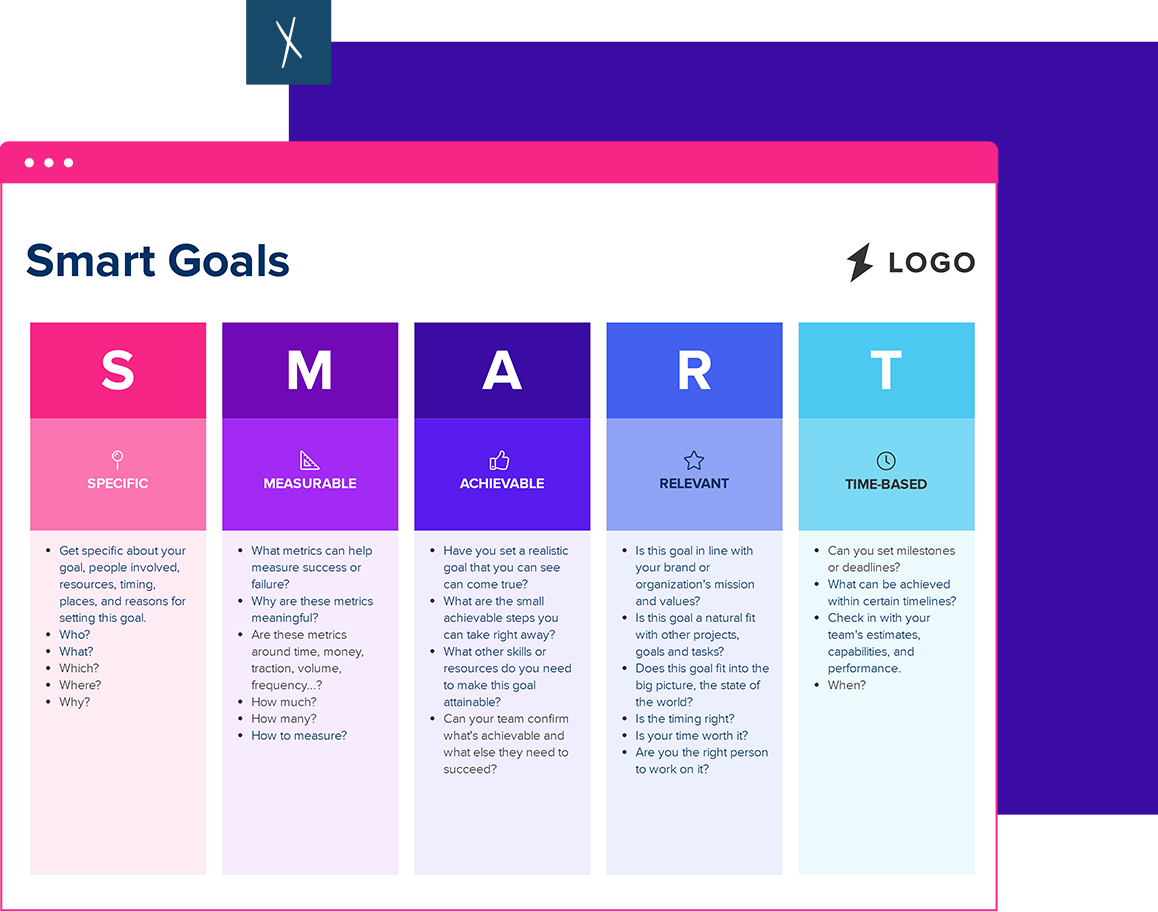
SMART Goals Template
Use the SMART Goals template to clarify what you want, stay focused on what you need to do, and see the results of your efforts. SMART Goals are Specific, Measurable, Achievable, Relevant, and Time-Bound.
Unlike static PDFs or spreadsheets, your SMART goals in Xtensio are a living document. Share them as a branded live link with your team or clients — update progress anytime, and everyone with the link sees the latest version. Export to PDF when you need a snapshot, or present full-screen during team meetings.
Beautiful living documents, built like web pages.
Join the 408,666 professionals using Xtensio.
Xtensio is the workspace for professional deliverables.
Make one deliverable today—then build a repeatable system for every client and project.
This is where teams create, collaborate, organize, and deliver the documents that run their work.
Everything stays on-brand, current, and ready to share.

Organize every deliverable
Keep strategy, sales, marketing, and client docs together by workspace.
Create fast, stay consistent
Start from 200+ templates or AI drafts, then apply your brand kit.
Collaborate in the doc
No more “final_v7.pdf” loop.
Standardize across deliverables
Apply your brand kit + reusable modules so every deliverable matches.
Improve what you send
See engagement, iterate, and reuse what works across projects.
What Does SMART Stand For?
SMART is a goal-setting framework where each goal must be Specific, Measurable, Achievable, Relevant, and Time-Bound. Teams use SMART goals to turn vague intentions into concrete targets with clear deadlines and success criteria. The acronym stands for:
- Specific
- Measurable
- Achievable
- Relevant
- Time-Bound
Why Use a SMART Goals Template?
A good reason to use SMART Goals in a business context is to obtain successful results out of the work you are doing.
- Solidify vague ideas, concepts, and desires into clearly identified objectives.
- Describe and communicate tasks, and responsibilities with certainty.
- Define quantifiable criteria for success and failure.
- Map a clear path toward achieving the goals.
Stop straying in open seas, take charge of your ship, pick a destination, and get there. For a complete walkthrough of writing effective SMART goals with examples for every team, see our step-by-step SMART goals guide.
But are these good enough reasons to stick to SMART Goals? Is the open sea the same? A counterargument is that goal-setting, vision-following, and leader-driven thinking as business philosophies have been shaken in the face of larger social, political, and environmental forces at play. In today’s reality, keeping an adaptive mindset may prevail over olympian and hyper-focused work. So use SMART Goals with a grain of salt, a hint of intuition, and flexibility.
Be your own judge.
How to use Xtensio’s SMART Goals Template?
- Click on Xtensio’s Smart Goals Template which is populated with instructional text to guide you through each section. Simply click and begin to edit each part.

QUICK TIP: You can collaborate and co-edit this document. Once completed you can share it as a live link, export it as PDF or PNG, or present it full screen or in person to discuss it. Update it as goals shift — your live link stays current for everyone you’ve shared it with.
- Next, go from goal setting to action. Jump over to a kanban board, Eisenhower Matrix or other to-do’s and checklists.
See how Xtensio compares
Wondering whether Xtensio is the right fit for your team? See how it stacks up:
QUICK TIP: Click the three dots and copy your SMART Goals into other strategic planning documents, such as your marketing plan, content strategy, customer success plan, and so on.
Breaking down each SMART criteria
Each letter in SMART represents a constraint that turns a vague intention into a concrete goal. Understanding the depth behind each criterion is what separates goals that drive action from goals that collect dust.
Specific: A specific goal answers: What exactly do I want to accomplish? Who is involved? Where will this happen? Why is this goal important? Instead of “increase sales,” a specific goal is “increase enterprise sales in the Northeast region by acquiring 15 new accounts through outbound prospecting.” The more precise you are, the easier it is to identify the exact actions needed and the people responsible for each task.
Measurable: If you can’t measure it, you can’t manage it. A measurable goal includes concrete criteria for tracking progress. Ask: How much? How many? How will I know when it’s accomplished? Quantify your goal with numbers — revenue targets, percentage increases, user counts, completion rates. “Improve customer satisfaction” becomes “increase NPS score from 32 to 45.” Without measurement, you’re guessing whether you’ve succeeded.
Achievable: Ambitious is good; impossible is counterproductive. An achievable goal stretches your team while remaining realistic given your current resources, constraints, and capabilities. Ask: Do we have the skills, budget, and time to accomplish this? What would need to change for this goal to be possible? Setting unattainable goals doesn’t motivate — it demoralizes. If your team has never grown revenue by more than 20% in a quarter, a 200% growth goal doesn’t inspire, it creates cynicism.
Relevant: Every goal should align with broader business objectives. A relevant goal matters to the team, the department, and the organization. Ask: Does this goal align with our strategic priorities? Is this the right time? Does this match our broader strategy? A marketing team setting a goal to increase TikTok followers while the company’s ICP is enterprise CFOs has a measurable, time-bound goal that’s completely irrelevant. Relevance is the filter that prevents busywork disguised as progress.
Time-Bound: Every goal needs a deadline. Without a target date, there’s no urgency and no way to measure whether you’re on pace. Ask: When will this be completed? What can I do today? What should be done in two weeks? Time-bound goals create accountability by establishing when results will be evaluated. “Launch the new product” could mean next month or next year — “Launch the new product by March 31” creates a countdown that drives daily decisions.
SMART goals examples by department
The best way to understand SMART goals is through concrete examples. Here’s how different teams apply the framework to their specific challenges.
Marketing
Vague: “Get more leads.” SMART: “Generate 200 marketing-qualified leads per month through organic search by June 30, increasing from the current baseline of 120 MQLs/month.” This goal is specific (MQLs from organic), measurable (200/month), achievable (67% increase over 6 months), relevant (feeds the sales pipeline), and time-bound (by June 30).
Sales
Vague: “Close more deals.” SMART: “Increase average deal size from $18K to $25K by the end of Q3 by implementing a tiered pricing model and training the team on value-based selling.” This isolates one lever (deal size, not volume), sets a specific target ($25K), connects it to concrete actions (pricing + training), and has a deadline (end of Q3).
Product
Vague: “Improve the product.” SMART: “Reduce average onboarding time from 14 days to 5 days by redesigning the first-run experience and adding in-app guidance, with the new flow live by April 15.” This targets a specific metric (onboarding time), has a measurable reduction (14→5 days), identifies the approach (UX redesign + guidance), and sets a clear ship date.
Customer success
Vague: “Reduce churn.” SMART: “Decrease monthly churn rate from 4.2% to 2.5% within 6 months by implementing a proactive health-score monitoring system and conducting at-risk account reviews every two weeks.” The target is specific and quantified, the approach is defined, and the timeline creates checkpoints for course correction.
HR and people ops
Vague: “Improve employee experience.” SMART: “Reduce voluntary turnover from 18% to 12% within 12 months by implementing quarterly stay interviews, launching a mentorship program by Q2, and achieving 80% participation in the annual engagement survey.” This goal targets a specific outcome (turnover), quantifies success (18% to 12%), identifies three concrete initiatives, and sets a deadline. HR teams that track SMART goals quarterly can spot retention risks before they become attrition crises.
Operations and finance
Vague: “Cut costs.” SMART: “Reduce operational expenses by 15% ($180K annually) by December 31 by renegotiating the top 5 vendor contracts, consolidating 3 redundant SaaS subscriptions, and automating the monthly reconciliation process.” This isolates specific cost levers (vendors, SaaS, automation), sets a dollar target alongside a percentage, and creates a clear deadline for measuring results against the baseline.
Common SMART goal mistakes
Even teams that understand the SMART framework make structural errors that undermine their goals. Recognizing these patterns helps you write goals that actually drive results.
Setting too many goals at once. When everything is a priority, nothing is. Teams that set 15 SMART goals per quarter achieve fewer of them than teams that set 3-5. Each goal requires attention, resources, and decision-making bandwidth. Limit yourself to the goals that will have the highest impact, and ruthlessly cut the rest. You can always add goals in the next cycle.
Making goals measurable but not actionable. “Increase website traffic by 40% in 6 months” is measurable and time-bound, but it doesn’t specify how. A better version connects the target to specific actions: “Increase organic traffic by 40% in 6 months by publishing 2 SEO-optimized guides per week and building 10 backlinks per month.” When the path to the goal is unclear, the goal becomes a wish.
Confusing outputs with outcomes. “Publish 50 blog posts by Q4” is a SMART goal — but it measures activity, not impact. Publishing 50 mediocre posts achieves the goal while creating zero business value. Frame goals around outcomes: “Generate 500 organic signups from blog content by Q4.” This keeps the team focused on what matters (signups) rather than what’s easy to count (posts).
Never revising goals when context changes. SMART goals are not set-and-forget. If your market shifts, a competitor launches something unexpected, or your team loses key members, your goals need to adapt. Build in monthly check-ins where you ask: Is this goal still relevant? Is the target still achievable? Do we need to adjust the timeline? Rigidly pursuing an outdated goal is worse than having no goal at all.
SMART goals vs OKRs: when to use which
SMART goals and OKRs (Objectives and Key Results) are both goal-setting frameworks, but they serve different purposes and work best in different contexts.
SMART goals are best for well-defined, tactical objectives where you know the target and the path. They excel at individual and team-level accountability: “Complete the CRM migration by March 15” or “Hire 3 senior engineers by Q2.” The strength of SMART is its specificity — you know exactly what success looks like and when to expect it.
OKRs are better for ambitious, strategic objectives where the goal is directional and the “how” needs to be discovered. An OKR might be: Objective: “Become the go-to platform for agency deliverables.” Key Results: “Reach 500 active agency accounts, achieve 40 NPS among agency users, publish 10 agency-specific templates.” OKRs encourage aiming higher (70% achievement is considered successful) while SMART goals expect 100% completion.
Many organizations use both: OKRs at the company and department level to set strategic direction, and SMART goals at the individual and project level to define the specific work that supports those OKRs. The two frameworks complement rather than compete with each other. Start with SMART if your team is new to structured goal-setting — it’s simpler to learn and provides faster feedback on whether goals are being met.
How to review and update your SMART goals
Setting SMART goals is step one. The ongoing discipline of reviewing and updating them is what separates teams that hit their targets from teams that abandon their goals by mid-quarter.
Weekly check-ins (15 minutes). Each week, do a rapid status update on each active goal: On track, at risk, or off track. Don’t analyze why at this level — just flag the status. This creates early warning signals that let you intervene before a goal becomes unreachable. If a goal has been “at risk” for three consecutive weeks, it needs immediate attention or restructuring.
Monthly reviews (60 minutes). Once a month, do a deeper assessment: What progress has been made? What obstacles have emerged? Do the assumptions behind the goal still hold? This is where you adjust targets, timelines, or approaches based on real data. Monthly reviews prevent the common pattern of ignoring goals for 11 weeks and then scrambling in the final week of the quarter.
Quarterly retrospectives. At the end of each goal cycle, evaluate: Which goals were met? Which were missed? Why? What did you learn about how your team sets goals? Use this retrospective to improve your goal-setting process itself. If you consistently miss goals by 30%, you may be setting targets that are aspirational rather than achievable. If you hit every goal at 100%, you may not be stretching enough.
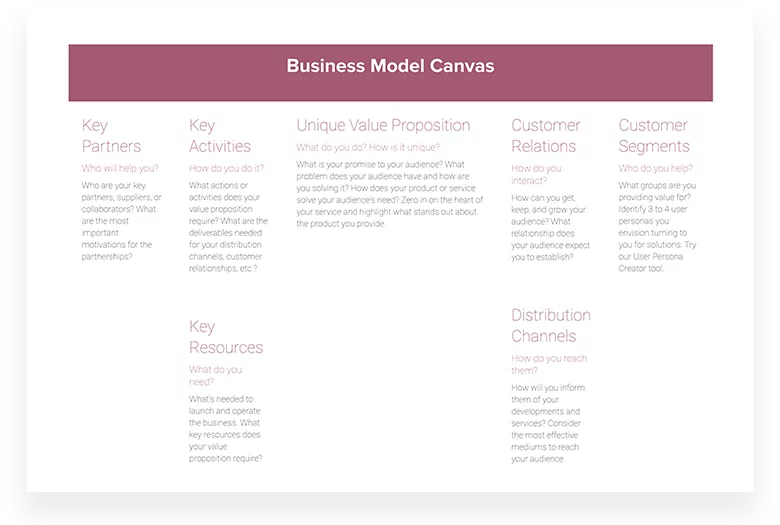
Keep all your SMART goals in a single, accessible workspace — not buried in a presentation slide from last quarter’s planning meeting. In Xtensio, your goals live as living documents that your team can reference, update, and track in real time. Connect your goals to the marketing plan, content strategy, or business model canvas they support — so every strategic document stays aligned as priorities evolve.
Build a quarterly review cadence
Structure your reviews around a consistent cycle. At the start of each quarter, set or refine your SMART goals. At the midpoint (6 weeks in), run a progress check against each measurable target. At the end of the quarter, conduct a full retrospective before setting the next cycle’s goals. This cadence creates a rhythm that keeps goals front-of-mind without demanding constant attention.
During each review, evaluate every goal against three questions: Is this goal still relevant to our current priorities? Are we on track to hit the target by the deadline? Have any external factors changed the feasibility of this goal? If the answer to any of these is “no,” the goal needs adjustment, not abandonment.
What to do when goals become irrelevant mid-cycle
Markets shift, priorities change, and team capacity fluctuates. When a goal no longer serves its original purpose, you have three options: Pivot the goal by keeping the same structure but changing the target or timeline. Replace it with a new goal that better reflects current priorities. Or retire it entirely and document why, so your next planning cycle benefits from the lesson.
The key is to make these decisions deliberately, not passively. A goal that quietly gets ignored creates confusion about what the team is actually working toward. A goal that gets formally retired with documented reasoning builds institutional knowledge about what works and what does not.
Cascading updates when team goals change
In organizations with layered goals (company-level OKRs feeding department SMART goals feeding individual targets), changes at one level need to cascade through the system. If the company pivots from “grow revenue” to “improve retention,” every downstream goal that was tied to acquisition needs to be re-evaluated. Without cascading updates, teams end up working toward objectives that no longer support the business.
This is where a shared workspace becomes essential. When your goals live in a place everyone can see and reference, cascading changes happen naturally. Update the company goal, and every team lead can immediately see whether their department goals still align. Store individual goals in the same workspace, and managers can spot misalignment during weekly check-ins rather than discovering it at the end of the quarter.
SMART Goals for Remote and Hybrid Teams
When your team is distributed across time zones and working schedules, the precision of SMART goals matters more, not less. In an office, you can gauge progress through hallway conversations and casual check-ins. Remote teams lack those ambient signals, so goals need to carry more of the communication weight.
Measure outputs, not hours
The biggest mistake remote teams make with goal-setting is tracking activity instead of results. “Spend 20 hours per week on product development” is not a useful goal when you cannot see what those hours produce. Instead, set goals around deliverables: “Ship the onboarding redesign with all 5 user flows tested by April 30.” Remote work gives people flexibility in how and when they work. Your goals should honor that flexibility by focusing on what gets delivered, not how much time it takes.
Set an async check-in cadence
Remote teams cannot rely on synchronous meetings for every goal update. Establish an async rhythm: weekly written status updates against each SMART goal, a monthly async review where team members record a brief assessment of their progress, and a quarterly synchronous retrospective for the full team. Written updates force clarity that verbal updates often skip. A team member who writes “pipeline coverage dropped from 3.2x to 2.1x this week because three late-stage deals pushed to next quarter” communicates more useful information than “pipeline is a bit behind.”
Create visibility through shared live links
The biggest risk for remote teams is goals becoming invisible. When your SMART goals live in a slide deck from last month’s planning meeting, they are functionally forgotten. Share your goals as live links that everyone on the team can access at any time. When a goal is updated, the change is immediately visible to everyone with the link. No attachments, no version confusion, no “which deck had the final version” conversations.
In Xtensio, each team member’s SMART goals document stays current as a living deliverable. Managers can check progress by opening the link. Team leads can cross-reference department goals with individual targets. And when goals shift mid-quarter, the updates are reflected everywhere the link is shared. For a complete walkthrough of writing effective SMART goals with examples for every team, see our step-by-step SMART goals guide.
SMART Goals by Role: Manager, Individual Contributor, and Executive
The same SMART framework works differently depending on where you sit in the organization. The scope, time horizon, and accountability structure of your goals should reflect your role.
Managers
Manager-level SMART goals bridge strategy and execution. A marketing manager’s goal might be: “Increase qualified demo requests from 40/month to 65/month by end of Q2 by launching 3 targeted landing pages and running A/B tests on the top 5 ad creatives.” Managers own the system, not just the output — their goals should reflect improvements to team processes and workflows, not just hitting a number. Track these goals in a shared workspace where your team can see how their individual targets feed into the department objective.
Individual contributors
IC goals should be specific enough to guide daily decisions. A content writer’s SMART goal might be: “Publish 8 SEO-optimized guides that collectively generate 2,000 organic sessions/month within 90 days of publication.” The key difference from manager goals: ICs own the direct output. Their goals should be entirely within their control — no dependencies on other teams or approval cycles that would make the “Achievable” criterion false. When ICs and managers share a workspace, alignment happens naturally because everyone can see how their piece fits.
Executives
Executive SMART goals operate at a longer time horizon and higher abstraction. A VP of Sales goal: “Grow annual recurring revenue from $2.4M to $3.1M by December 31 by expanding into the mid-market segment, hiring 2 enterprise AEs by Q2, and launching a partner channel generating 20% of pipeline by Q4.” These goals cascade downward — each component becomes a team-level SMART goal for someone reporting to the executive. Store executive goals alongside department goals in the same workspace so the cascade is visible, not assumed.
SMART Goals for Quarterly Planning: A 90-Day Framework
The most effective teams treat SMART goals as a quarterly discipline, not an annual exercise. A 90-day cycle is short enough to maintain urgency but long enough to achieve meaningful results.
Week 1: Set and align. Review last quarter’s results. What worked? What missed? Set 3-5 SMART goals per team, ensuring each one connects to a company-level objective. Document these in a shared workspace so everyone — from the executive sponsor to the newest team member — can reference the same source of truth.
Week 4 (30-day check): Are you on pace? Early signals matter. If a goal depends on hiring someone by week 6 and you haven’t posted the job by week 4, the goal is already at risk. Adjust targets or timelines now rather than discovering the gap at week 12.
Week 8 (60-day check): This is the course-correction checkpoint. You have enough data to know whether your approach is working. If a marketing goal to “generate 200 MQLs from paid ads” has only produced 60 MQLs by week 8, the strategy needs to change — not just the effort level. Decide now: pivot the approach, adjust the target, or reallocate resources.
Week 12 (90-day close): Evaluate results against each goal. Calculate hit rate. Document what you learned. The output of this review becomes the input for next quarter’s goal-setting. In Xtensio, duplicate your SMART goals template each quarter — you keep the structure and history while updating the targets. Every previous version stays accessible through your workspace, building an organizational memory of what your team set out to do and what actually happened.
How to Track SMART Goal Progress Over Time
Writing SMART goals is the easy part. Tracking them consistently across weeks and quarters is where most teams fail. The difference between teams that hit their goals and teams that abandon them is a system that makes progress visible without adding overhead.
Make the goal document the single source of truth. Your SMART goals should not live in a slide from last month’s planning meeting. They should live in a document that the entire team can access, update, and reference at any time. When goals are shared as live links, every update is immediately visible to everyone who has the link — no re-sending files, no version confusion.
Track status, not just outcomes. For each SMART goal, maintain a running status: green (on track), yellow (at risk), or red (off track). Update this weekly. The act of updating forces you to confront reality. A goal that has been yellow for three consecutive weeks is effectively red — and knowing that early gives you time to intervene.
Connect goals to the work they generate. A SMART goal like “launch 3 landing pages by Q2” should link to the content strategy, the marketing plan, and the project timeline where those landing pages are being built. When goals exist in isolation from execution documents, they become aspirations instead of drivers. In Xtensio, keep your goals alongside the deliverables they produce — all in one workspace, all connected, all current.
Use engagement analytics to verify alignment. When you share goals as live links, you can see who viewed them and when. If your team hasn’t opened the goals document in two weeks, that’s a signal — not that the goals are bad, but that they’re not integrated into daily work. Great goals get referenced constantly. If nobody’s looking at them, something is broken in the workflow.
SMART Goals for Agencies and Consultancies
Agencies and consultancies face a unique challenge with SMART goals: they need to set and track goals both internally (for their own business) and externally (for and with clients). The framework is the same, but the dynamics are different.
Client-facing goals require shared visibility. When you set SMART goals at the start of a client engagement — “Increase organic traffic by 35% within 6 months” or “Deliver 4 campaign concepts per month, with at least one approved for production within 5 business days” — the client needs to see progress without chasing you for updates. Share goals as a branded live link so clients always have access to the latest status. Update the document after each milestone, and your client relationships stay transparent without extra reporting overhead.
Internal agency goals compound across clients. An agency SMART goal like “Achieve 90% client retention rate by maintaining NPS above 50 across all accounts” requires tracking at both the individual client and portfolio level. Set per-client SMART goals for deliverable quality and timeline adherence, then roll them up into an agency-level scorecard. Keep everything in organized workspaces — one per client — so account managers can find and update goals without digging through email threads.
Consultancies: goal-setting workshops as a deliverable. Many consultancies facilitate SMART goal-setting as part of their engagement. Running a goal-setting workshop with a client and then handing them a polished, branded SMART goals document — shareable as a live link with their entire leadership team — is a tangible deliverable that demonstrates value from day one. Duplicate the template for each engagement, customize with the client’s branding, and the framework scales across your portfolio.

Design, manage and share beautiful living documents… easily, together. Explore Xtensio
- Click and edit anything… together.
- Customize to match your branding.
- Share with a link, present, embed or download.
Related to the SMART Goals Template
Fully customizable templates that you can make your own.
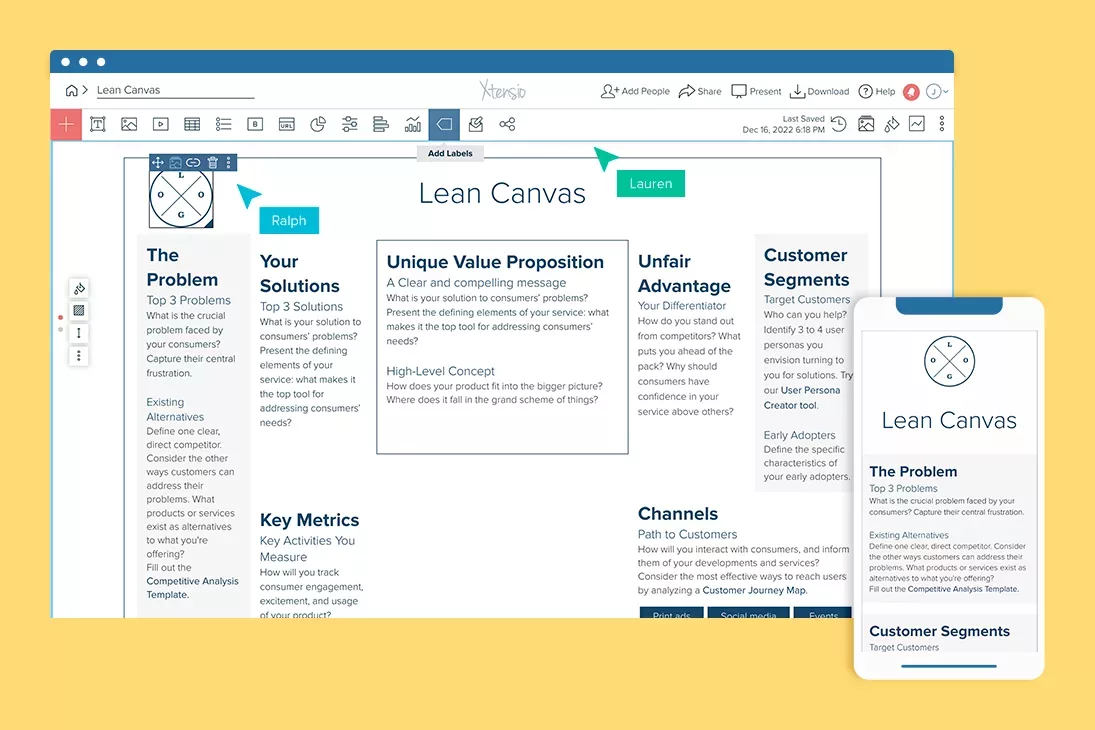
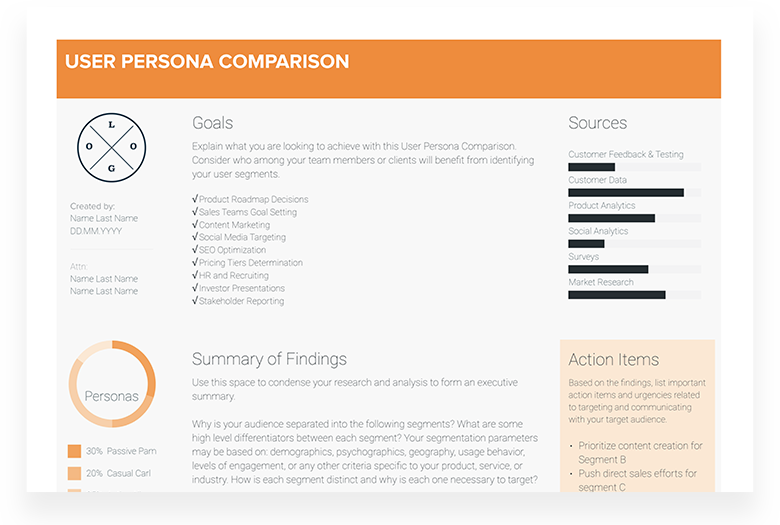
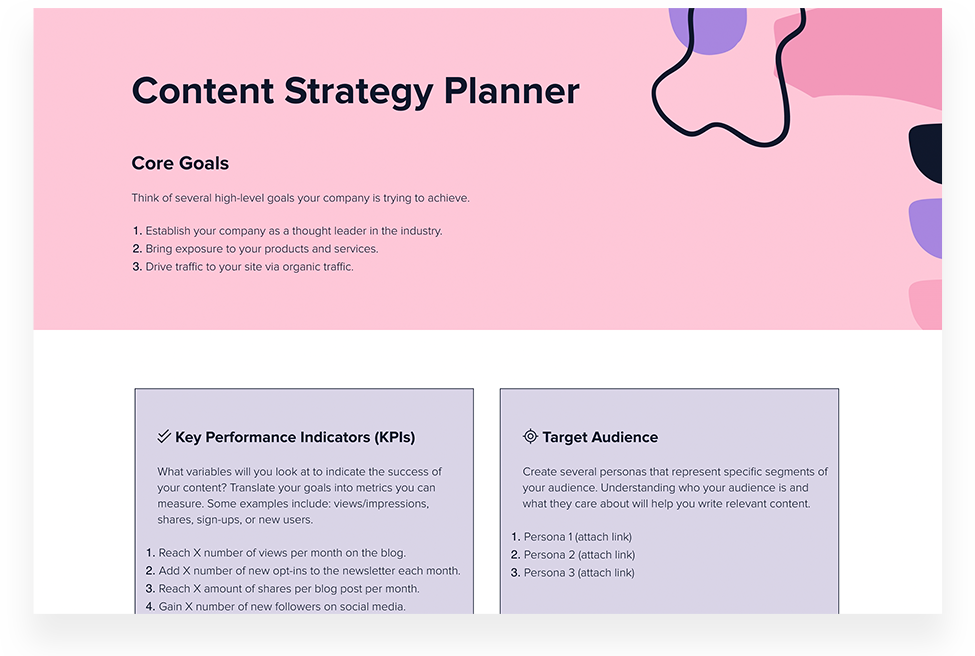


Jeff Schenck
Marketing Manager @

David Nason

Grace Ghunaim
Global Chief Strategy Officer (CSO) @

Ben Cary
Founder @

Leon Coe
Instructor @
Texas A&M University

Jennifer Alt
UI/UX Designer @

Zac Heisey
Director of Digital Marketing @

Jenny Johansson
UX Manager @

Ryan Dobson
Global Engineering Manager @

Create and deliver beautiful work, professionally.
Build, brand, and deliver living documents your clients actually engage with.








Join 408,666 professionals delivering work with Xtensio.