User Persona Comparison Template
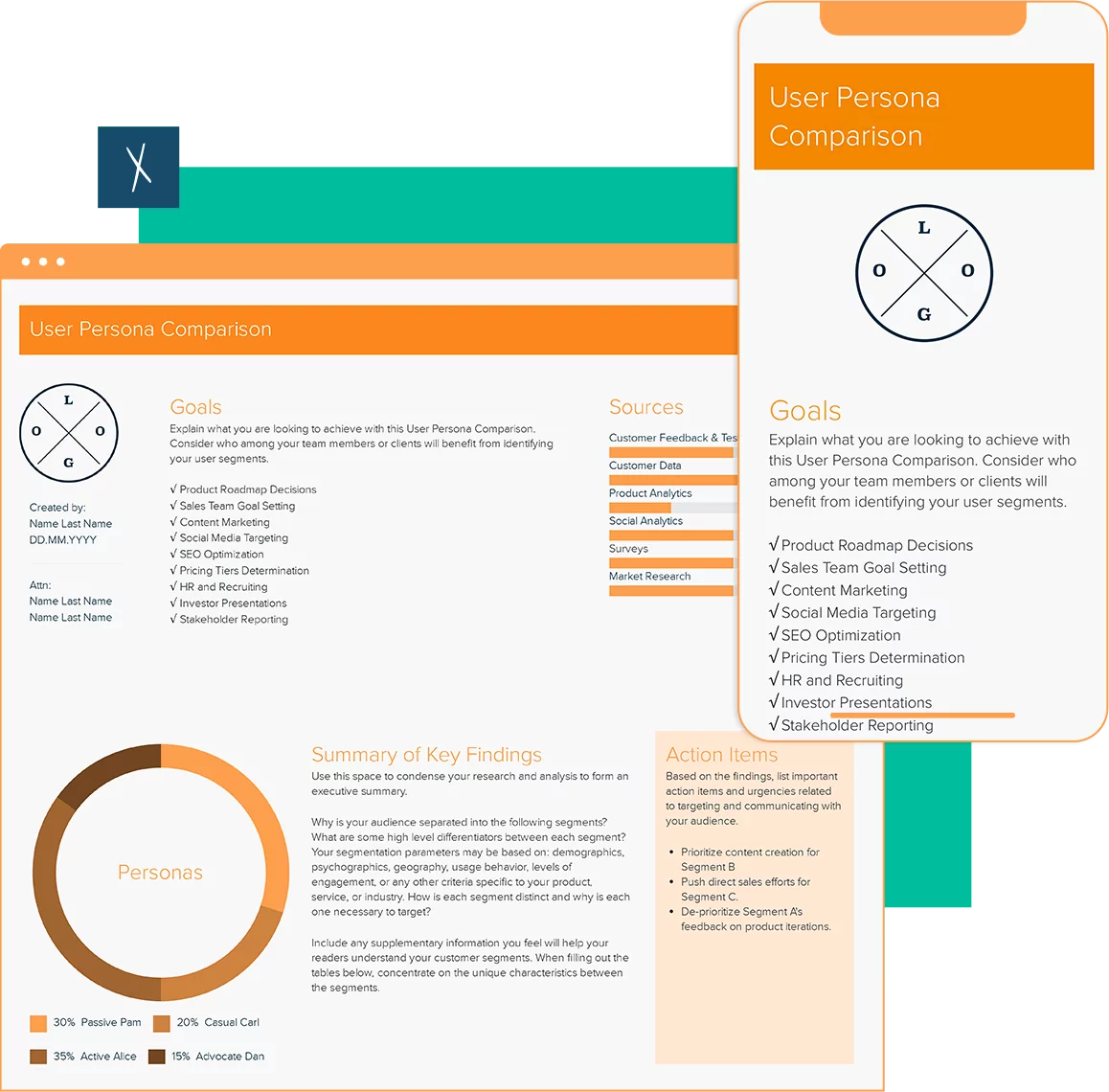
The user persona comparison template helps you understand your target audience by separating them into easily identifiable categories and revealing each persona’s unique needs and frustrations. For companies thriving in the digital age, segmenting the target audience has become common practice.
- Create a visual comparison of your ideal user personas to see a full overview of various users’ decision-making processes and their relationship to your brand.
- Uncover your ideal customer segments and customer needs.
- Achieve precision and efficiency in your marketing, business and design decisions.
Xtensio is your team’s deliverables workspace.
Create, collaborate, and deliver client-ready docs—then keep them current.
Join 410,837 using Xtensio.
Xtensio is the workspace for professional deliverables.
Make one deliverable today—then build a repeatable system for every client and project.
This is where teams create, collaborate, organize, and deliver the documents that run their work.
Everything stays on-brand, current, and ready to share.

Organize every deliverable
Keep strategy, sales, marketing, and client docs together by workspace.
Create fast, stay consistent
Start from 200+ templates or AI drafts, then apply your brand kit.
Collaborate in the doc
No more “final_v7.pdf” loop.
Standardize across deliverables
Apply your brand kit + reusable modules so every deliverable matches.
Improve what you send
See engagement, iterate, and reuse what works across projects.
Other User Persona Comparison templates
How to create a user persona comparison with Xtensio
- Create a free account and start editing, no credit card required.
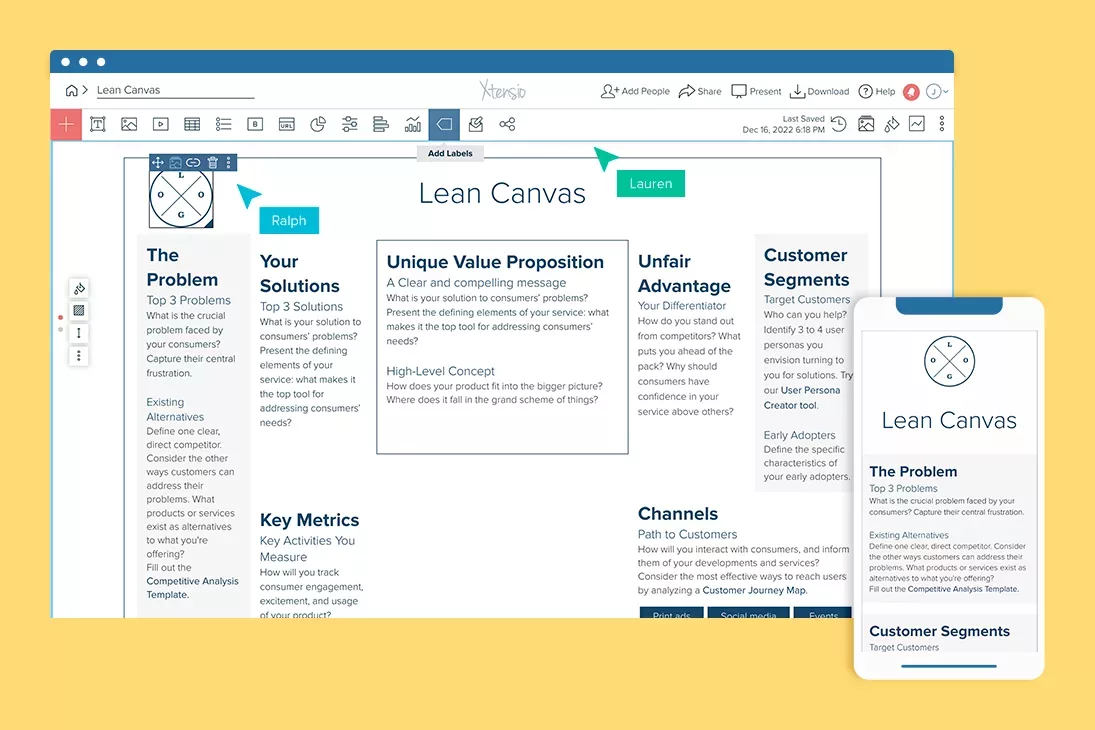
Follow along with the instructional persona comparison details. Add charts, graphs, images, and videos to customize the user persona template and make it your own. Drag & drop. Resize. It’s the easiest editor ever.
- Customize everything in the comparison user persona template to match your brand.
Define your style guide. Add your (or your client’s) brand fonts and colors. You can even pull colors directly from a website to easily brand your user personas and more.
- Work on the user persona comparison together on the cloud.
Add colleagues (or clients) to collaborate on the user persona template. Changes automatically save and sync across all devices, in real-time.
- Share a link. Present a slideshow. Embed. Download a PDF/PNG.
The segmented user persona template seamlessly adapts to your workflow. No more jumping from tool-to-tool to design different types of deliverables.
- Reuse and repurpose.
Save your own segmented user persona templates. Or copy and reuse in other documents.

What is a user persona comparison?
For companies thriving in the digital age, segmenting their target audience has become common practice. Marketing and UX design teams are among the firsts to adopt user personas in their process. But personas are not just a one time exercise. They help organizations achieve precision in decision-making across teams and stakeholders and you should continually analyze and optimize your customer segments using the user persona comparison.
How do you write a user persona comparison?
Consider a variety of segmentation methods (demographic information, industry, needs, usage, etc.) and determine which segments make the most sense for your business and its primary objective. Conduct user research to find pain points and similarities between groups of your user base. Then put your comparison together by employing as many segments as you think will be helpful.
Here are some steps you can take to segment your audience with multiple user personas to compare the wants and needs of your personas for better business decision-making:
- Understand the customer lifecycle for each of your persona segments.
- Define feature sets for your product or service based on each user persona’s needs.
- Identify the best channels to reach each customer segment.
- Allocate customer support time and resources for each target audience.
- Shape your financial model around your buyer personas’ needs and willingness-to-pay.
- Reconcile different user needs on the same platform.
When to Compare Personas (and When Not To)
Not every project needs a persona comparison. Comparing personas adds value in specific situations, and knowing when to skip it saves your team time.
Compare when you are targeting multiple segments with a single product. If your product serves both enterprise buyers and individual users, a side-by-side comparison reveals where their needs overlap and where they diverge. This is the foundation for feature prioritization, pricing tiers, and messaging strategy. Without a comparison, teams default to building for the loudest voice in the room rather than the most valuable segment.
Compare when allocating marketing budget across segments. A persona comparison makes budget conversations concrete. Instead of debating which audience “feels” more important, you can point to differences in lifetime value, acquisition cost, and conversion patterns. Put two personas side by side and the investment case becomes clear: Persona A converts at 3x but costs 2x to acquire, while Persona B has lower acquisition cost but higher churn.
Compare when prioritizing product features. Product teams that build feature lists without comparing persona needs end up with bloated products that serve nobody well. A comparison reveals which features satisfy multiple segments (build first) versus which serve only one (build later or never). This is the difference between a focused product roadmap and a wish list.
Do not compare when personas are too similar. If two personas share 80% or more of their attributes, goals, and pain points, they are not distinct segments. Merge them. Maintaining separate personas that are nearly identical creates confusion and leads to redundant marketing campaigns that cannibalize each other.
Do not compare when personas serve completely different strategies. A B2B SaaS persona and a consumer freemium persona may coexist in the same company, but comparing them yields little insight. When segments require fundamentally different go-to-market approaches, treat them as separate workstreams rather than comparison points.
How to Use Persona Comparisons to Prioritize Product Decisions
The real value of a persona comparison is not the document itself. It is the decisions the comparison enables. Here is how product and strategy teams use comparisons to move faster.
Map features to persona needs. Create a simple matrix: features on one axis, personas on the other. Mark which features each persona needs, wants, or does not care about. Features that satisfy all personas are table stakes. Features that light up one persona but leave others cold are differentiators. Features that nobody needs are candidates for removal.
Identify overlap versus unique needs. Overlap is where you find efficiency. If three personas all need onboarding support, invest heavily in that experience once rather than building three separate flows. Unique needs are where you find competitive advantage. The feature that only your power-user persona requires may be exactly what keeps them from switching to a competitor.
Use comparisons to justify resource allocation. When leadership asks why you are investing in Feature X over Feature Y, a persona comparison provides the answer. “Feature X serves our two highest-value personas and addresses their top pain point. Feature Y serves only our lowest-value segment.” Data-backed persona comparisons turn subjective feature debates into objective prioritization discussions.
Build your individual personas first. A comparison is only as strong as the underlying personas. If your individual persona profiles are thin or assumption-based, the comparison will amplify those weaknesses rather than reveal useful insights. Invest in research-backed personas before you start comparing.
Keeping Persona Comparisons Current
A persona comparison created during a product launch becomes outdated the moment your market shifts. Here is how to keep comparisons useful over time.
Set a quarterly review cadence. Every quarter, revisit your persona comparison with fresh data. Have conversion rates shifted between segments? Has a new competitor changed one persona’s behavior? Has customer feedback revealed a pain point that was not in the original comparison? Quarterly reviews catch drift before it becomes a strategic blind spot.
Let data drive updates, not opinions. The most common persona comparison mistake is updating based on what the team believes rather than what the data shows. Pull actual usage data, support ticket themes, and sales conversion rates before revising any persona attribute. Gut-feel updates compound into fictional personas over time.
Make it a living document. Static persona comparisons in slide decks get reviewed once and forgotten. When your comparison lives as a live link in a shared workspace, anyone on the team can reference the latest version. Product managers checking feature priorities, marketers planning campaigns, and designers building user flows all work from the same current comparison rather than outdated copies scattered across email threads.
The strongest persona comparisons are not documents that get created and filed. They are living deliverables that grow with your understanding of your audience, inform every product and marketing decision, and stay current as your market evolves.
More templates related to the user persona comparison
Related to the User Persona Comparison Template
Fully customizable templates that you can make your own.

Teams use Xtensio to create, share, and improve professional deliverables.
Trusted by 410,837 teams, founders, and consultants.



Jerome Katz
Professor of Entrepreneurship @

Jake Peters
CEO @

Robin Bramman
Founder and Chief Brand Mixologist @

Olakunle Oladehin
Executive Director @
Everybody Dance Now!

Aaron Friedland
Executive Director @
The Walking School Bus

Robin Eyre
Owner @

Adam Sher
CEO @

Stephen Paterson
Chief Product Officer @

Create and deliver beautiful work, professionally.
Build, brand, and deliver living documents your clients actually engage with.







Join 410,837 professionals delivering work with Xtensio.