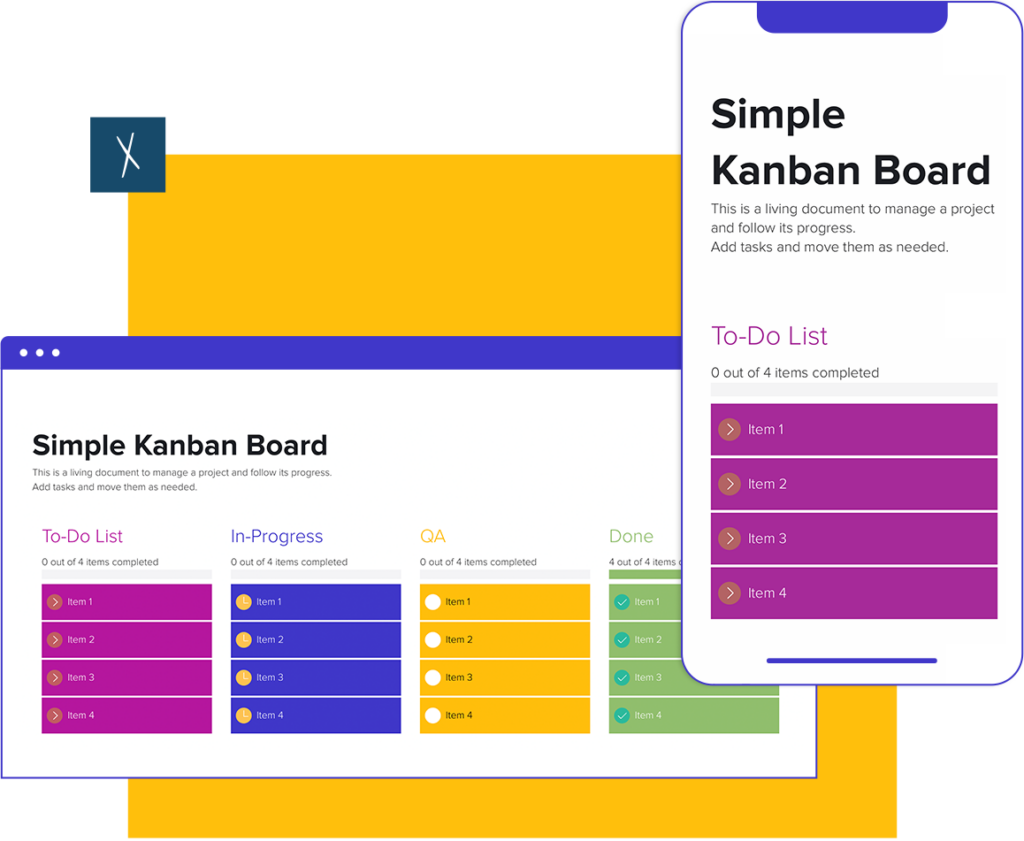
Simple Kanban Board Template
A Kanban board is a visual project management tool that helps Agile and Lean Teams get efficient and transparent. It uses columns and cards to help track progress. Use Xtensio’s simple kanban board template to manage your team’s internal or client projects.
- Create planning flexibility, easily reprioritize by moving tasks between different columns.
- Visualize your team’s workflow and limit bottlenecks in your team’s process by allowing people to focus on tasks at-hand.
- Promote a continuous workflow to deliver faster while ensuring high quality work.
Xtensio is your team’s deliverables workspace.
Create, collaborate, and deliver client-ready docs—then keep them current.
Join 407,368 using Xtensio.
Xtensio is the workspace for professional deliverables.
Make one deliverable today—then build a repeatable system for every client and project.
This is where teams create, collaborate, organize, and deliver the documents that run their work.
Everything stays on-brand, current, and ready to share.

Organize every deliverable
Keep strategy, sales, marketing, and client docs together by workspace.
Create fast, stay consistent
Start from 200+ templates or AI drafts, then apply your brand kit.
Collaborate in the doc
No more “final_v7.pdf” loop.
Standardize across deliverables
Apply your brand kit + reusable modules so every deliverable matches.
Improve what you send
See engagement, iterate, and reuse what works across projects.
How to create a kanban board with Xtensio
- Save the simple kanban board template with one click and start editing.
Follow along with the instructional placeholder copy. Add additional charts, graphs, images, and videos to customize and make it your own. Drag & drop. Resize. It is the easiest editor ever.
- Customize everything in the kanban board template to match your brand.
Add your (or your client’s) brand fonts and colors. You can even pull colors directly from a website to easily brand your kanban boards.
- Work on your kanban boards together on the cloud.
Add colleagues (or clients) to collaborate on the kanban board. Changes automatically save and sync across all devices, in real-time.
- Share a responsive link. Present a slideshow. Embed. Download a PDF/PNG.
The kanban board seamlessly adapts to your workflow. When ready share in any format you need.
- Reuse and repurpose.
Save your own custom kanban board templates. Or copy and merge into other documents.

What is the kanban method?
The Kanban method was created in the 1940s by Toyota Automotive employee Taiichi Ohno as a workflow management system to optimize production stages. In 2004, David J. Anderson used the concept for Scrum and LEAN Software Development when he published the book “Agile Management for Software Engineering: Applying the Theory of Constraints for Business Results”. Now the Kanban framework is one of the most popular methodologies within Agile and LEAN frameworks that provides value by giving teams a real-time visualization of work capacity and transparency on the progress of work being done. It includes a timeline with tasks created as cards where teams can see the task status, track progress and easily tackle roadblocks.
When should I use a kanban board?
Agile and LEAN teams use the Kanban method to track the progress of work from start to finish. It gives teams a powerful way to show progress across cross-functional teams and can be used to manage workflows and provide transparency on project workflows.
How do I create a kanban board?
It’s super easy to create a kanban board with Xtensio’s simple kanban template, and it’s the perfect was to easily collaborate and share the workflow with your team.
- Customize your Kanban board
You can rename the title of the task lists and task cards according to your needs. David Anderson’s original method established that Kanban boards are divided into these:
- Visual signals
- Columns
- Work-in-progress limits
- Commitment point
- Delivery point
We’ve simplified this by creating four columns (lists) to track “To-do”, “In Progress”, “QA (review)” and “Done”
- Add task cards
Each list has cards that you can add details for each task. You can add additonal tasks and move them bewteen lists as they’re moving through your workflow. Add additional cards by selecting the + icon on the menu at the top left of each list and change task status by clicking on the status option on the left of each card.
- Start working on tasks
As tasks are being working on and completed, you can change the task item status and move the cards through your workflow so everyone on your team can see the workflow from start to finish. Make sure you check and update the kanban board regularly so everyone is up-to-date on the project at hand.
Check out other checklists and kanban board templates. Customize them to make your own.
Related to the Simple Kanban Board Template
Fully customizable templates that you can make your own.

See how Xtensio can help your business
Build and launch products and services successfully.

Engage buyers more and close sales faster.


Teams use Xtensio to create, share, and improve professional deliverables.
Trusted by 407,368 teams, founders, and consultants.



Grace Ghunaim
Global Chief Strategy Officer (CSO) @

David Nason
CEO/Founder @

Jeff Schenck
Marketing Manager @

Ryan Dobson
Global Engineering Manager @

Arthur van de Graaf
Founder @

Apurva Pathak
Technical Product Manager @

Jenny Johansson
UX Manager @

Zac Heisey
Director of Digital Marketing @

Jacklyn Swiecicki
Marketing Manager @
What is a kanban board?
A kanban board is a visual workflow management tool that organizes tasks into columns representing stages of work — typically “To Do,” “In Progress,” and “Done.” The concept originated in Toyota’s manufacturing system in the 1940s and was adapted for knowledge work by David Anderson in the 2000s.
The power of kanban is its simplicity. Every task is a card. Every column is a stage. You move cards left to right as work progresses. The board gives you a real-time snapshot of where everything stands — no status meetings required.
When to use a kanban board vs other methods
- Kanban vs Scrum: Scrum works in fixed sprints with defined commitments. Kanban is continuous — new work enters as capacity opens up. Use Scrum when you need predictable delivery cadences. Use kanban when work is ongoing and priorities shift frequently.
- Kanban vs Gantt charts: Gantt charts map dependencies and timelines. Kanban maps status and flow. Use Gantt when the project has many dependencies and a fixed deadline. Use kanban when tasks are relatively independent and you care more about throughput than timeline.
- Kanban vs to-do lists: A to-do list tracks what needs to be done. A kanban board tracks what needs to be done AND where it is in the process. If your to-do list has more than 20 items, upgrade to a kanban board.
How to set up an effective kanban board
Define your columns. Start with three: To Do, In Progress, Done. As you use the board, add columns for stages that need visibility — “In Review,” “Waiting on Client,” “QA.” Keep it under 6-7 columns or the board becomes harder to read than a spreadsheet.
Set WIP limits. WIP (work in progress) limits cap how many cards can sit in a column at once. If your “In Progress” limit is 3, you cannot start a fourth task until you finish one. This is the most important kanban practice and the one most teams skip. Without WIP limits, your kanban board is just a decorated to-do list.
Write clear card titles. “Marketing” is not a card. “Write Q2 email campaign for enterprise launch” is a card. Each card should describe one piece of work that one person can complete.
Review the board daily. A 5-minute daily scan replaces the 30-minute status meeting. Look for bottlenecks (columns with too many cards), stale cards (tasks that haven’t moved in days), and blocked items that need help.
Common kanban mistakes
- No WIP limits. Without limits, everything is “in progress” and nothing finishes. Start with a limit of 3 per person and adjust.
- Too many columns. Every column adds cognitive overhead. If cards pass through a stage in 10 minutes, merge it into another column.
- Not grooming the backlog. A To Do column with 200 cards is not useful. Review and prioritize weekly. Archive anything that has been sitting untouched for 30+ days.
- Using kanban for everything. Kanban works best for repeating workflows with similar-sized tasks. For complex projects with deep dependencies, pair it with a Gantt chart or project plan.
Kanban board FAQ
What is the ideal number of columns?
3-5 columns. Start with To Do, In Progress, Done. Add columns only when you need visibility into a specific bottleneck.
Can I use a kanban board for personal tasks?
Yes. Personal kanban with three columns and a WIP limit of 3 is one of the most effective productivity methods.
How is a kanban board different from a project tracker?
A kanban board shows workflow stages and current status. A project tracker shows tasks, assignees, deadlines, and dependencies. Kanban is better for ongoing work; trackers are better for deadline-driven projects.
Digital or physical kanban board?
Physical boards work well for co-located teams. Digital boards are essential for remote teams and when you need history, card details, or stakeholder sharing.
See how Xtensio compares
Wondering whether Xtensio is the right fit for your team? See how it stacks up:

Create and deliver beautiful work, professionally.
Build, brand, and deliver living documents your clients actually engage with.







Join 407,368 professionals delivering work with Xtensio.