How To Write SMART Goals (With Template and Examples)
SMART goals turn vague intentions into concrete outcomes. In this guide, you’ll learn the SMART framework step by step, see real examples across teams, and build your own goals using a free editable SMART goals template.
Xtensio is your team space for beautiful living documents.
Create, manage and share business collateral, easily.
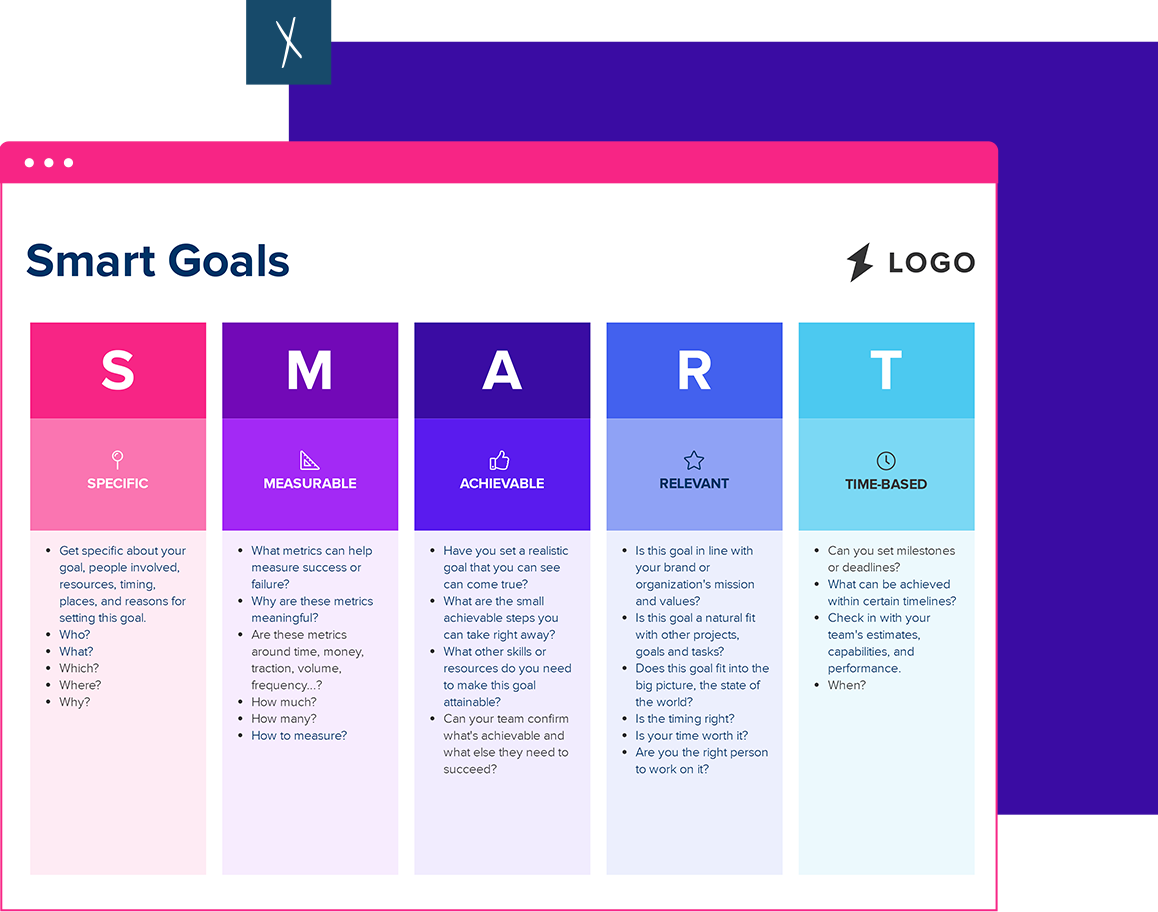
Table of Contents
What are SMART goals?
SMART is an acronym that defines five criteria every well-formed goal should meet: Specific, Measurable, Achievable, Relevant, and Time-bound. The framework was first introduced by George T. Doran in a 1981 management paper and has since become the standard approach for goal-setting across business, education, and personal development.
The power of SMART goals lies in what they prevent: vague aspirations that no one can act on, measure, or be held accountable for. “Grow the business” is a wish. “Increase monthly recurring revenue by 15% within Q3 by launching two new pricing tiers and running targeted email campaigns to existing free users” is a SMART goal. The difference is the difference between hoping and planning.
Why use SMART goals?
Teams that use structured goal-setting frameworks consistently outperform those that don’t. Here’s why SMART goals work:
Clarity drives alignment. When a goal is specific and measurable, everyone on the team understands what success looks like. There’s no room for interpretation. The marketing team and the sales team can’t have different definitions of “grow revenue” when the goal says “increase MRR by 15% by September 30.”
Measurability enables accountability. A goal you can’t measure is a goal you can’t manage. SMART goals define the metric upfront, so progress reviews become data conversations rather than opinion debates. Either you hit the number or you didn’t — and if you didn’t, you can diagnose why.
Deadlines create urgency. Goals without timelines expand to fill whatever time is available — or never get done. The time-bound element forces prioritization: if this needs to happen by Q3, what has to happen this month? This week?
Achievability prevents burnout. Stretch goals have their place, but consistently setting unachievable targets demoralizes teams. The achievable criterion forces an honest assessment: given our resources, constraints, and current trajectory, is this realistic? If not, either the goal or the resources need to change.
The SMART framework: each element explained
S — Specific
A specific goal answers five questions: What do we want to accomplish? Who is involved? Where will it happen? Why does it matter? Which resources or constraints are relevant? The more precise your goal, the easier it is to build a plan around it.
Weak: “Improve customer satisfaction.”
Specific: “Reduce average customer support response time from 4 hours to under 1 hour for all Tier 1 tickets by hiring two additional support agents and implementing a ticketing priority system.”
M — Measurable
Every SMART goal needs a number. Not a direction (“increase,” “improve,” “grow”) but a specific metric and target value. Measurable goals answer: How much? How many? How will we know when it’s accomplished? Define the baseline (where you are now), the target (where you want to be), and the data source you’ll use to track progress.
Weak: “Get more website traffic.”
Measurable: “Increase organic search traffic from 8,000 to 12,000 monthly sessions, measured in Google Analytics, by publishing 8 new SEO-optimized guides.”
A — Achievable
An achievable goal stretches your capabilities without being unrealistic. This requires an honest assessment of your current resources, skills, budget, and timeline. The question isn’t “Would we like to achieve this?” but “Can we actually achieve this given what we have?” If the answer is no, either reduce the target, extend the timeline, or secure additional resources before committing.
Unrealistic: “Triple revenue in 30 days with no additional budget or headcount.”
Achievable: “Increase revenue by 20% over 6 months by expanding into two adjacent market segments where we already have product-market fit.”
R — Relevant
A relevant goal aligns with broader business objectives, team priorities, and current market conditions. The relevance check prevents teams from pursuing goals that are achievable and measurable but ultimately don’t move the needle on what matters. Ask: Does this goal support our quarterly or annual strategy? Is this the right time to pursue it? Does this align with what our team is uniquely positioned to accomplish?
Irrelevant: “Launch a TikTok channel” (for a B2B enterprise SaaS company whose buyers are CFOs).
Relevant: “Publish 4 case studies featuring enterprise customers to support the sales team’s Q3 pipeline goal of 15 qualified demos.”
T — Time-bound
Every SMART goal needs a deadline. Not “soon” or “this year” — a specific date. The deadline should be aggressive enough to create urgency but realistic enough to be achievable. Break longer timelines into milestones: if the goal is due in 90 days, set 30-day and 60-day checkpoints so you can course-correct early rather than discovering problems at the deadline.
Open-ended: “Eventually redesign the onboarding flow.”
Time-bound: “Ship the redesigned onboarding flow by March 31. Design review complete by February 15. User testing complete by March 15.”
SMART goal examples by team
The SMART framework applies to every function. Here are concrete examples showing how different teams use it.
Marketing
“Increase organic blog traffic from 15,000 to 25,000 monthly sessions by December 31 by publishing 12 new long-form guides targeting keywords with 1,000+ monthly search volume and updating 8 existing posts with current data.”
Sales
“Close $450,000 in new annual contract value by September 30 by converting 15 of the 40 qualified opportunities currently in the pipeline, with a focus on mid-market accounts in the healthcare and financial services verticals.”
Product
“Reduce new user onboarding drop-off from 65% to 40% by June 30 by redesigning the first-run experience with an interactive product tour, reducing required signup fields from 8 to 3, and adding contextual tooltips on the three most-used features.”
Customer Success
“Improve Net Promoter Score from 32 to 45 by Q4 by implementing a proactive check-in program for accounts in their first 90 days, creating a self-service knowledge base covering the top 20 support topics, and reducing average first-response time from 4 hours to 1 hour.”
Personal development
“Complete the Google Analytics certification by April 30 by studying 3 hours per week, completing all 4 module assessments, and passing the final exam with a score of 80% or higher.”
Common SMART goal mistakes and how to fix them
The SMART framework is simple to understand but surprisingly easy to misapply. Here are the most common mistakes teams make.
Setting too many goals. When everything is a priority, nothing is. Most teams and individuals should work on 3-5 SMART goals per quarter. More than that dilutes focus and makes progress tracking overhead greater than the value of the goals themselves. If you have 12 goals, you have a wish list, not a strategy.
Confusing activities with outcomes. “Publish 10 blog posts” is an activity. “Increase organic traffic by 30% through content marketing” is an outcome. SMART goals should describe the result you want, not the work you’ll do to get there. Activities belong in the action plan beneath the goal, not in the goal itself.
Making goals achievable but not ambitious. The achievable criterion isn’t permission to set easy targets. If every goal is comfortably within reach, your team isn’t growing. The best SMART goals require effort, creativity, and commitment — they’re achievable, but not automatic.
Writing goals in isolation. A SMART goal created by one person and handed to a team rarely generates buy-in. The most effective approach is collaborative goal-setting: the leader sets the direction, the team helps define the specific metrics and timelines. When people help set their own targets, they’re more committed to hitting them.
Setting and forgetting. A SMART goal written in January and reviewed in December is a filing exercise, not a management tool. Build review cadences into your goals: weekly check-ins on progress metrics, monthly assessments of whether the goal is still relevant, and quarterly recalibrations based on what you’ve learned.
Beyond SMART: when to adapt the framework
SMART goals work best for goals with clear, predictable outcomes. But not every situation fits neatly into the framework. Here’s when to adapt.
Exploration and innovation. When you’re exploring a new market, testing a new product concept, or running experiments, rigid metrics can be counterproductive. In these cases, use SMART goals for the experiment itself (“Run 3 customer interviews per week for 6 weeks”) rather than for the outcome (“Validate product-market fit by March 15”). You can’t set a measurable target for something you’re still learning about.
OKRs vs. SMART goals. OKRs (Objectives and Key Results) and SMART goals serve different purposes. OKRs set ambitious, directional objectives with measurable key results — the objective is intentionally aspirational (achieving 70% is considered success). SMART goals are designed to be fully achievable. Use OKRs for strategic direction-setting and SMART goals for operational execution. Many teams use both: OKRs at the company/team level, SMART goals at the individual/project level.
Connecting SMART goals to your broader strategy. SMART goals work best when they cascade from strategic priorities. Start with your company’s quarterly objectives, then ask each team: “What SMART goals, if achieved, would move us toward this objective?” This top-down alignment ensures every goal contributes to what matters most. In Xtensio, you can document your strategic goals, team goals, and individual goals in a shared workspace so everyone sees how their work connects to the bigger picture.
How to review and update SMART goals
Setting SMART goals is the easy part. The hard part is maintaining them as living commitments rather than static documents. Here’s a review cadence that keeps goals actionable.
Weekly: Check progress metrics. Are you on track? If not, what’s blocking progress? Quick 5-minute scans prevent small issues from becoming missed deadlines.
Monthly: Review each goal’s relevance. Has anything changed in your market, resources, or strategy that makes this goal more or less important? Adjust timelines or metrics if the underlying assumptions have shifted.
Quarterly: Full goal reset. Evaluate what was achieved, what wasn’t, and why. Carry forward unfinished goals only if they’re still the highest priority. Set new SMART goals for the next quarter based on what you’ve learned.
When your goals live in a tool that supports live sharing and engagement tracking, you can see who’s reviewing goals and who isn’t. This visibility turns goal-setting from a top-down exercise into a shared accountability system.
Frequently Asked Questions
What does SMART stand for in goal setting?
SMART stands for Specific, Measurable, Achievable, Relevant, and Time-bound. Each criterion ensures your goal is clear, trackable, realistic, aligned with priorities, and has a defined deadline.
How many SMART goals should I set at once?
Most individuals and teams should focus on 3-5 SMART goals per quarter. Setting more than 5 dilutes focus and makes progress tracking overhead greater than the value of the goals themselves.
What is the difference between SMART goals and OKRs?
SMART goals are designed to be fully achievable and focus on specific, measurable outcomes. OKRs (Objectives and Key Results) set intentionally ambitious objectives where achieving 70% is considered success. Many organizations use OKRs for strategic direction and SMART goals for operational execution.
How often should you review and update SMART goals?
Review SMART goals on three cadences: weekly progress checks (5 minutes, flag on-track vs at-risk), monthly deep reviews (assess whether the goal is still relevant given changing priorities), and quarterly retrospectives to evaluate results and set new goals for the next cycle. Goals that sit unreviewed become filing exercises, not management tools.
Can I use a SMART goals template for my whole team?
Yes. A shared SMART goals template keeps the entire team aligned on objectives, metrics, and deadlines. In Xtensio, you can duplicate the template for each team member or project, then share everything in a workspace so managers and contributors see the same goals. Live links mean updates are visible instantly without resending files.
SMART Goals Worksheet: Fill-in-the-Blank Framework
Use this quick worksheet to draft your SMART goal before entering it into your template. Answer each question in one sentence, then combine them into a complete goal statement.
1. Specific — What exactly will you accomplish?
Define the outcome in concrete terms. Who is involved? What will change?
2. Measurable — How will you know you succeeded?
Name the metric, the baseline (where you are now), and the target (where you want to be).
3. Achievable — Is this realistic with your current resources?
List the resources, budget, and team capacity you have. If the goal requires something you don’t have, note what needs to change.
4. Relevant — Why does this goal matter right now?
Connect this goal to your team’s or company’s top priority for the quarter.
5. Time-bound — When will this be done?
Set a specific deadline and at least one mid-point checkpoint.
Your SMART goal statement: “We will [specific outcome] by [deadline], measured by [metric] moving from [baseline] to [target], because [relevance to strategy].”
Once you have your statement, drop it into Xtensio’s SMART goals template to track progress as a living document your team can reference anytime.
Written by

Xtensio’s FREE SMART Goals Template and Editable Examples
Your starting point to set and track SMART goals, without any design experience.
Design, manage and share beautiful living documents… easily, together. Explore Xtensio
- Click and edit anything… together.
- Customize to match your branding.
- Share with a link, present, embed or download.

Create and deliver beautiful work, professionally.
Build, brand, and deliver living documents your clients actually engage with.







Join 409,446 professionals delivering work with Xtensio.