Eisenhower Matrix Template
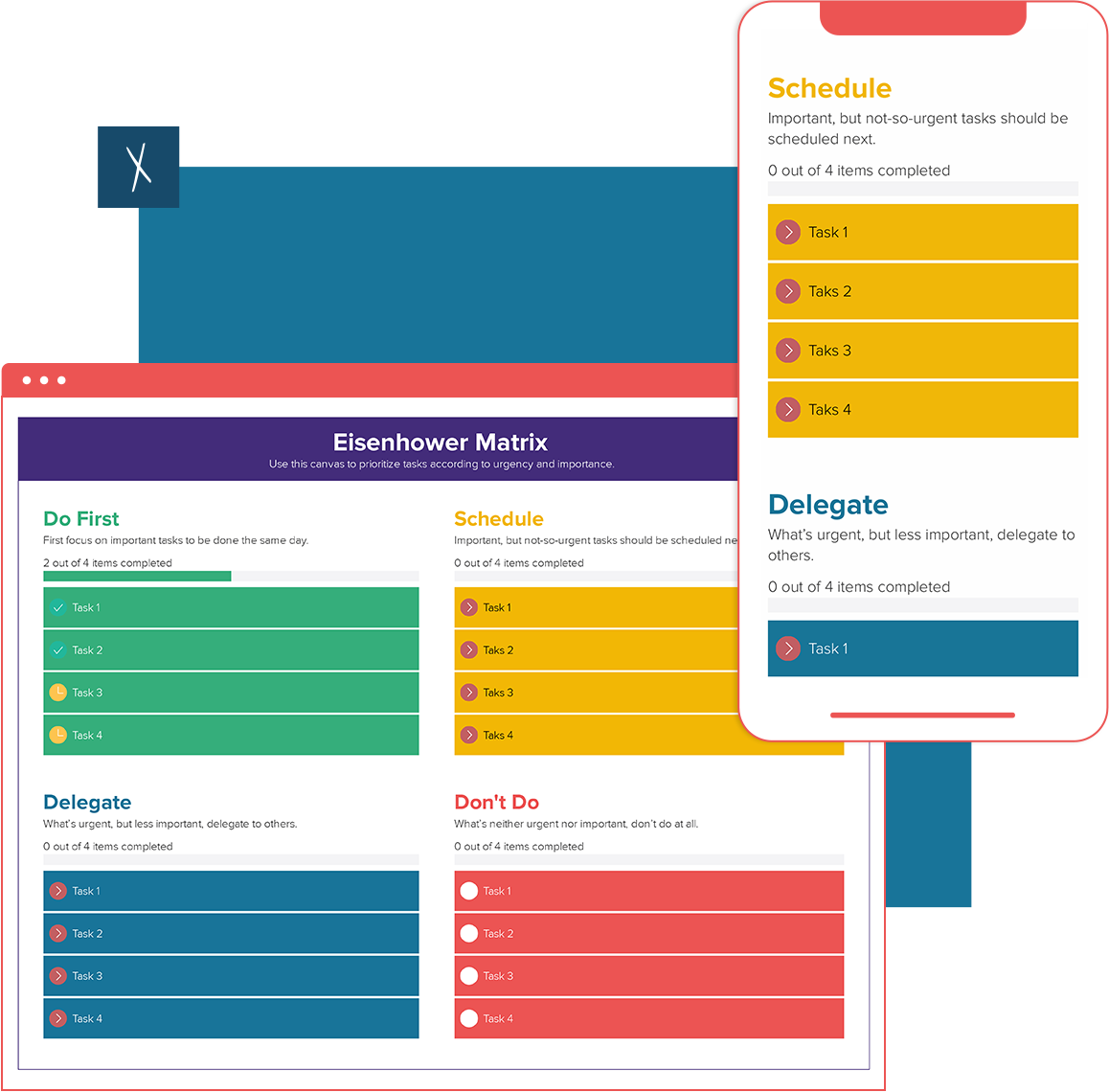
The Eisenhower Matrix is a simple decision-making tool to organize and prioritize tasks to ensure that you (or your team) work on what’s important and not just what’s urgent. Use Xtensio’s Eisenhower matrix template to effectively manage your time by prioritizing tasks based on urgency and importance.
- Easily prioritize tasks and allocate your time and resources to get work done.
- Ensure that your tasks align with larger goals.
- Quickly estimate urgency and importance with your team.
Xtensio is your team’s deliverables workspace.
Create, collaborate, and deliver client-ready docs—then keep them current.
Join 407,368 using Xtensio.
Xtensio is the workspace for professional deliverables.
Make one deliverable today—then build a repeatable system for every client and project.
This is where teams create, collaborate, organize, and deliver the documents that run their work.
Everything stays on-brand, current, and ready to share.

Organize every deliverable
Keep strategy, sales, marketing, and client docs together by workspace.
Create fast, stay consistent
Start from 200+ templates or AI drafts, then apply your brand kit.
Collaborate in the doc
No more “final_v7.pdf” loop.
Standardize across deliverables
Apply your brand kit + reusable modules so every deliverable matches.
Improve what you send
See engagement, iterate, and reuse what works across projects.
What is the Eisenhower Matrix?
The Eisenhower Matrix is a time management tool that helps individuals and teams prioritize tasks by categorizing them into one of four possible quadrants. The matrix is divided into a 2×2 grid, with each quadrant representing a different level of urgency and importance.
Importance of Time Management
Imagine having a personal assistant that helps you focus on what really matters. That’s the Eisenhower Matrix for you. By being your own time management guru, you can achieve more with less stress.
Origin of the Eisenhower Matrix
Who Created It?
Dwight D. Eisenhower, the 34th President of the United States, is the mastermind behind this framework. Hence the name, folks!
The Concept Behind It
Think of it like a four-room house. Each room serves a specific purpose. Same with The Eisenhower Matrix, it sorts tasks into four categories to help you decide what to do first.
Components of the Eisenhower Matrix
Quadrants Explained
The matrix consists of four quadrants:
- Urgent and Important
- Important but not Urgent
- Urgent but not Important
- Not Urgent and not Important
Labels and What They Mean
These quadrants aren’t just fancy names; they’re a roadmap for prioritizing tasks. What’s in quadrant one needs your immediate attention, while quadrant four might as well be your “later or maybe never” list.
How to Create Your Own Eisenhower Matrix
Use Xtensio to create, manage, and share your Eisenhower matrix. Simply list your tasks and drag them into the quadrants.
How to Use the Eisenhower Matrix
Filling in the Quadrants
It’s as easy as pie. Place tasks where they belong, and voila! Your life is now organized—or at least it’s a step closer to it.
Prioritizing Tasks
Conquer quadrant one tasks first and then work your way down. It’s that simple, yet incredibly effective.
Common Mistakes and How to Avoid Them
Overcomplicating Things
Keep it simple. Overthinking can turn this easy-to-use tool into a procrastination device.
Neglecting Quadrant 2
Don’t underestimate the power of long-term planning. Ignoring the important but not urgent tasks can come back to bite you.
Benefits of Using the Eisenhower Matrix
Improved Time Management
This isn’t just a fancy to-do list; it’s a catalyst for change. With better time management, you’ll find you have more time for the things you love.
Stress Reduction
Less clutter equals less stress. Knowing what to focus on makes tackling your to-do list less overwhelming.
Drawbacks and Criticisms
Rigidity
The matrix isn’t always flexible, and life often is. You might find that some tasks don’t neatly fit into any quadrant.
Overthinking
Paralysis by analysis is a real thing. Don’t let the matrix become another chore.
Customizing the Eisenhower Matrix
Incorporating Deadlines
Got a deadline? Stick a date on that item. Adding time frames can help add another layer of priority.
Adding Task Details
A little context goes a long way. Adding brief descriptions can help clarify tasks and make execution easier.
Real-World Applications
Business Setting
In the corporate world, this matrix is often used in project management and team collaboration.
Personal Life
From planning a vacation to juggling household chores, the Eisenhower Matrix is versatile enough for personal use.
Alternatives to the Eisenhower Matrix
ABCDE Method
Prioritize tasks from A to E based on their importance and urgency. Learn the ABCDE Method.
The Pomodoro Technique
A time-management method that encourages working in short bursts to improve focus. Learn the Pomodoro Technique.
Design, manage and share beautiful living documents… easily, together. Explore Xtensio
- Click and edit anything… together.
- Customize to match your branding.
- Share with a link, present, embed or download.
Related to the Eisenhower Matrix Template
Fully customizable templates that you can make your own.


Used by the world’s top businesses.
407,368 users and counting.


Eisenhower Matrix Examples: Applying the Framework in Practice
The hardest part of using the Eisenhower Matrix is calibrating what counts as urgent versus important. Most people initially classify too many things as urgent — often because urgent items trigger anxiety and important items require more difficult thinking. Here are concrete examples across common professional contexts:
Example: Marketing Manager
- Do First (Urgent + Important): Campaign brief due today for a launch happening this week; responding to a crisis about a misfire in yesterday’s email send.
- Schedule (Not Urgent + Important): Building the Q3 content strategy; analyzing which blog posts drove the most qualified leads last quarter; developing the annual brand guidelines update.
- Delegate (Urgent + Not Important): Pulling performance screenshots for a weekly report someone else will write; booking a conference room for next week’s planning session; responding to a vendor follow-up email.
- Eliminate (Not Urgent + Not Important): Reformatting a slide deck that is only used internally; attending a standing meeting where your role is to listen, not contribute; updating a social media bio that sees minimal traffic.
Example: Startup Founder
- Do First: Responding to a potential enterprise customer who asked for a demo today; fixing a payment flow bug reported by multiple users; closing a hire who has a competing offer expiring this week.
- Schedule: Writing the product roadmap for next quarter; developing the fundraising narrative; planning a customer advisory board; documenting processes before they become tribal knowledge.
- Delegate: Scheduling social media posts; handling vendor contract renewals; coordinating logistics for an upcoming event.
- Eliminate: Attending conferences with no clear pipeline outcome; responding to cold outreach from vendors not needed right now; tweaking website copy that is not part of an active A/B test.
Using the Eisenhower Matrix for Team Prioritization
The Eisenhower Matrix is most commonly described as a personal productivity tool, but it is equally powerful for team prioritization sessions. Running the exercise as a group produces alignment on what is actually important — which often differs from what each individual assumed the team’s priorities were.
A team prioritization session using the Eisenhower Matrix works like this: each participant independently classifies a list of current initiatives or tasks into the four quadrants, then the team compares. Disagreements reveal misalignment — a project one person considers Quadrant 2 (schedule) that another considers Quadrant 1 (do first) indicates either unclear strategic priorities or different information about urgency. These disagreements are more valuable than the matrix itself, because they surface assumptions that otherwise drive conflicting work and resource allocation.
For quarterly or sprint planning, teams can use the matrix to audit the existing backlog before adding new items. Run through the current list and ask: “Which of these items would we eliminate if we applied the Not Urgent + Not Important filter honestly?” The items that survive this filter are your real priorities. The items that do not survive reveal accumulated scope creep, relationship-driven commitments, or work carried forward from previous plans that no longer serves current strategy.
Eisenhower Matrix vs. Other Prioritization Frameworks
The Eisenhower Matrix is one of several prioritization frameworks in common use. Understanding how it compares to the alternatives helps you choose the right tool for your context.
- Eisenhower vs. MoSCoW (Must/Should/Could/Won’t). MoSCoW is better for project-level scoping, where you are deciding which features to include in a specific release or sprint. The Eisenhower Matrix is better for ongoing personal or team task management, where you are managing a continuous stream of requests and responsibilities rather than a fixed project scope.
- Eisenhower vs. RICE (Reach/Impact/Confidence/Effort). RICE is a quantitative scoring framework that requires estimates of reach, impact, confidence, and effort for each item. It works well when you have reliable data and are prioritizing a product roadmap. The Eisenhower Matrix requires no quantification — it works on qualitative judgment and is faster to apply, making it better for day-to-day task management than for roadmap planning.
- Eisenhower vs. Time Blocking. Time blocking is an implementation method — you allocate specific calendar slots to categories of work. The Eisenhower Matrix tells you what to work on; time blocking tells you when. They are complementary: use the matrix to classify your tasks, then block time on your calendar based on the results. Quadrant 2 items — important but not urgent — consistently get neglected without a scheduled block.
For strategic prioritization at the project or initiative level — rather than task management — the business model canvas and competitive analysis template provide frameworks that complement the Eisenhower Matrix’s task-level focus.
Why Quadrant 2 Is the Most Important Quadrant
Quadrant 2 — tasks that are important but not urgent — is where strategic value is created. It is also the quadrant most consistently neglected. Understanding why, and how to protect time for it, is the core skill the Eisenhower Matrix develops.
Quadrant 1 tasks demand attention because they are both important and urgent — they produce immediate consequences if ignored. Quadrant 2 tasks produce no immediate consequence if skipped today, which makes them easy to defer. The problem is that consistently skipping Quadrant 2 work is exactly how organizations end up with everything in Quadrant 1. Neglected strategy becomes a crisis. Deferred maintenance becomes an emergency. Skipped relationship-building leaves teams without the trust and alignment needed when a real crisis hits.
Highly effective people and teams protect Quadrant 2 time deliberately — scheduling it on the calendar before reactive work fills the week. A simple approach: identify your top three Quadrant 2 priorities each Monday and block time for each before looking at email or Slack. These blocks are treated as non-negotiable unless a genuine Quadrant 1 emergency arises. Over time, investing consistently in Quadrant 2 reduces the volume of Quadrant 1 fires that need fighting.
How to Use the Delegate Quadrant Effectively
Quadrant 3 — urgent but not important — is where delegation lives. The challenge is that many people either avoid delegating (believing it is faster to do it themselves) or delegate poorly (handing off work without sufficient context, leading to results that require rework). Here is how to delegate Quadrant 3 tasks in a way that actually reduces your workload:
- Delegate the outcome, not the task. Instead of “please format this report,” say “please produce a formatted report that matches our standard template by 3pm, including the executive summary on the first page.” The delegate knows what success looks like without needing you to supervise each step.
- Provide the context once. Most Quadrant 3 tasks are recurring. Invest time once in writing a clear process or checklist for the recurring task. This makes future delegation faster and reduces the risk of errors that bring the task back to your Quadrant 1.
- Create a feedback loop. Ask for a brief summary of completed delegated tasks. This lets you catch errors before they compound, and gives the person you delegated to a chance to ask clarifying questions early rather than at delivery.
- Resist the urge to reclaim. The most common delegation failure is taking tasks back when they are not done exactly as you would do them. If the outcome is achieved and the quality is acceptable, resist perfectionism. Reclaiming delegated work trains people that delegation to you is temporary, reducing their initiative over time.
Using the Eisenhower Matrix as a Living Document
A printed or static Eisenhower Matrix becomes outdated the moment something changes — a new task is added, a deadline shifts, or a priority is re-evaluated after new information. Using a digital, editable version of the matrix allows you to maintain a real-time view of your priorities rather than a snapshot that is accurate for one morning.
For team use, a shared digital matrix is significantly more powerful than individual copies. When everyone on the team can see what is in each quadrant — and update it as circumstances change — alignment on priorities becomes continuous rather than something that has to be re-established in a weekly meeting. A Quadrant 1 item that one person assumed was handled can be flagged immediately when the matrix shows it as unassigned.
Building your Eisenhower Matrix in a workspace you can share as a live link means stakeholders always see the current state of your priorities — not the version from last Tuesday’s export. For a related framework that helps you evaluate strategic priorities at the business level rather than the task level, see the SWOT analysis template.

Jerome Katz
Professor of Entrepreneurship @

Jake Peters
CEO @

Robin Bramman
Founder and Chief Brand Mixologist @
Brandtini

Alix Han
VP Product Experience @

Marc Anthony Rosa
Product Manager @

Anna Yunker
Content Strategist @

Robin Eyre
Owner @

Adam Sher
CEO @
AccuTennis

Humma Arshad
Salesforce Project Manager @
Bugendai Tech

Create and deliver beautiful work, professionally.
Build, brand, and deliver living documents your clients actually engage with.







Join 407,368 professionals delivering work with Xtensio.