
How to Write a Project Proposal (Step-by-Step Guide + Free Template)
A project proposal is a formal document that makes the case for a project — what it involves, why it matters, how it will be done, and what it will cost. Writing one that gets approved requires balancing completeness with clarity. This guide walks through every section, with practical advice for each.
What Is a Project Proposal?
A project proposal is a persuasion document. Its job is to convince a decision-maker — a client, manager, board, or funder — to approve a project before work begins. It’s different from a project plan (which governs execution after approval) and different from a statement of work (which is a contractual document). The proposal exists to answer one question: should this project happen?
Project proposals are used in consulting, agency client work, internal business initiatives, construction and engineering bids, research and academic projects, and grant applications. The format varies by context, but the core logic is the same.
Before You Write: What to Do First
The most common proposal mistake is writing before listening. Before you draft a single word:
- Understand the decision-maker’s priorities. What do they actually care about — speed, cost, risk reduction, competitive advantage? Write for that, not for your own framework.
- Clarify what “approval” looks like. Some decision-makers approve verbally in a meeting. Others need a written sign-off. Some need committee approval. Know the process before you structure your proposal around the wrong output.
- Identify the real constraints. Budget ceiling, deadline, team capacity, regulatory requirements — surface these early. A proposal that ignores a known constraint gets rejected, or approved and then re-negotiated, which is worse.
How to Write a Project Proposal: Each Section
1. Executive Summary
Write this last, even though it appears first. In 2-4 sentences: the problem, your recommended approach, the expected outcome, and the cost. Decision-makers often read only this section before deciding whether to review the details. Make every word count.
Strong: “We propose a 12-week brand audit and repositioning project to address the 23% decline in qualified inbound leads since Q2. The recommended approach — competitive analysis, customer interviews, and a revised messaging framework — is budgeted at $48,000 with delivery in September.”
Weak: “This proposal outlines our plan to help your organization improve its marketing outcomes through a comprehensive strategic review process.”
2. Problem Statement
Describe the current situation specifically. What is happening that shouldn’t be, or not happening that should? Include data if you have it. The problem statement establishes why this project is worth the investment — if the problem isn’t clearly defined, the solution has no anchor.
Common mistake: describing the symptom instead of the cause. “Sales are declining” is a symptom. “Qualified lead volume dropped 23% after the Q2 pricing change” is a problem you can propose to solve.
3. Proposed Solution and Scope
Describe what you’re proposing to do, specifically. This section should make clear what’s included and — critically — what’s not. Scope creep begins here: a vague proposal creates false expectations that become expensive to manage later.
For each major deliverable, state: what it is, what it contains, who produces it, and when it’s delivered. For each area that’s explicitly out of scope, say so clearly. “This proposal does not include implementation of the recommended changes — that would be addressed in a separate phase.”
4. Timeline and Milestones
Show a realistic schedule. Break the work into phases with specific dates or week numbers. Name the milestones — not “Phase 1” but “Stakeholder interviews complete” or “Draft messaging framework delivered.” Decision-makers want to understand when they’ll see progress, not just when the project ends.
Be honest about dependencies. If milestone 3 depends on the client providing access to their CRM data, say so. If approval delays change the timeline, say that too. Surprises in execution damage trust; surprises in the proposal damage credibility.
5. Budget Breakdown
An itemized budget is more credible than a lump sum. Break costs by phase, workstream, or resource type. Show your reasoning: “Strategy phase: 40 hours × $200/hr = $8,000.” If there are variable costs (travel, third-party tools, subcontractors), flag them separately with estimates.
Include a note on what happens if scope changes: “Changes to scope beyond what’s defined in Section 3 will be quoted separately before work begins.” This prevents the proposal from becoming an open-ended commitment.
6. Team and Qualifications
Introduce the people doing the work. For each key team member: their role on this project, relevant experience (not a full bio — the specific experience that makes them right for this work), and any credentials or past clients that build confidence.
For solo consultants: lead with the client problem you’ve solved before that’s most similar to this one. For agencies: lead with a brief relevant case study, not your capabilities overview. For internal proposals: identify who owns each workstream and confirm they have the capacity.
7. Risk Assessment
Acknowledge the top 2-3 risks and how you’ll manage them. This signals maturity. Every project has risks — a proposal that ignores them looks naive; one that addresses them looks competent.
Format: Risk → Likelihood → Impact → Mitigation. Keep it short. Three bullets is usually enough.
8. Next Steps
Close with one action. Not “we look forward to discussing further” — something specific: “To proceed, please sign the attached engagement letter by April 30. We’ll schedule a kickoff call within 5 business days of receipt.” Make it easy to say yes.
Project Proposal Best Practices
- Mirror the client’s language. If their brief calls it a “digital transformation initiative,” use that phrase. Decision-makers read dozens of proposals — alignment with their vocabulary signals attention and reduces friction.
- One proposal, one recommendation. Don’t offer Option A ($40K), Option B ($25K), and Option C ($15K) unless you’ve been asked to. Multiple options diffuse focus and signal that you don’t know what the client actually needs. Present your recommendation, then offer to discuss alternatives if they have concerns.
- Get outside eyes before submitting. Ask someone who hasn’t worked on the project to read it and tell you: what’s the problem, what are we proposing, what does it cost, what do they need to do next? If they can’t answer those questions accurately, the proposal needs revision.
- Follow up within 48 hours. Proposals sent without follow-up are proposals forgotten. Schedule the follow-up before you hit send.
Free Project Proposal Template
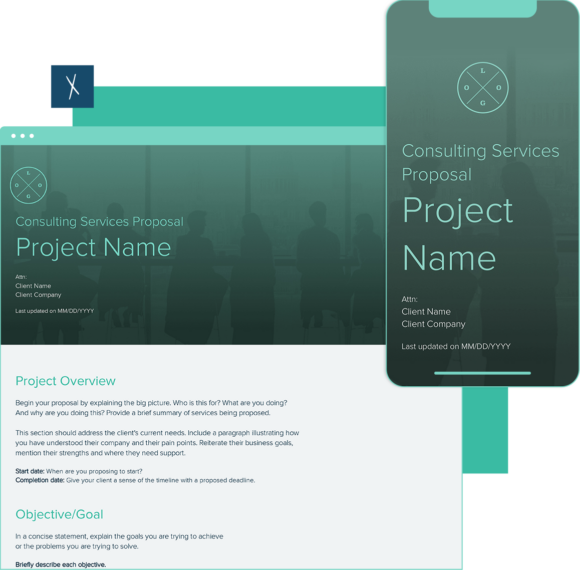
Xtensio’s free project proposal template gives you a structured, professional starting point for all of these sections. Customize with your scope, timeline, and budget, then share as a live link with your client or submit as PDF. When the scope changes during negotiation, update the document once — everyone with the link sees the latest version automatically.
For related documents, see the consulting proposal template for more detailed client-facing engagements, and the startup one-pager template for high-level business introductions.
Related: Executive Summary Template, How to Write an Executive Summary