
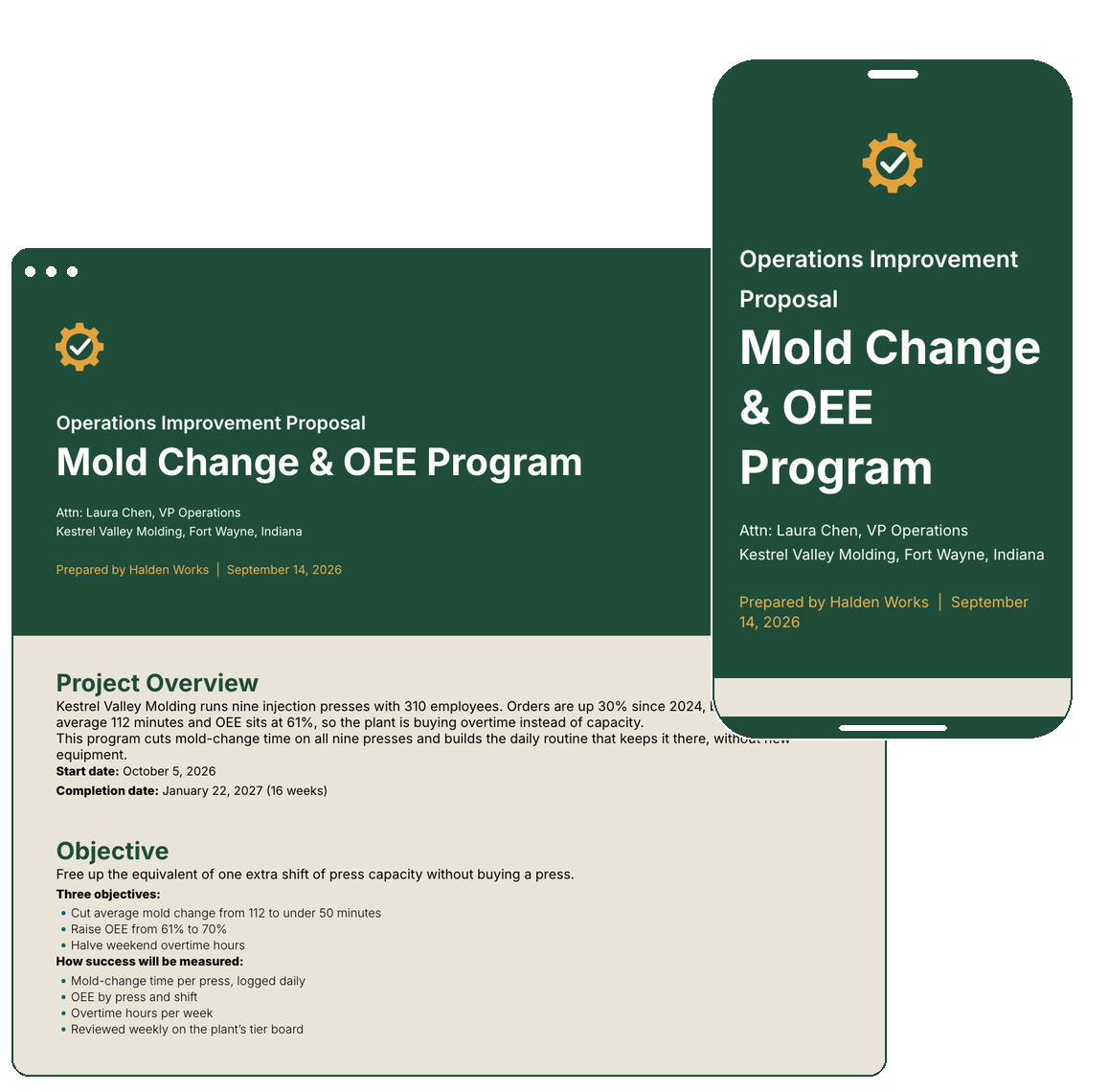
Free Project Proposal Template
Create professional project proposals that win approvals — customizable, shareable as a live link, and always up to date.
- Outline project goals, scope, timeline, and budget clearly.
- Customize with your branding, team details, and deliverables.
- Share as a live link — stakeholders always see the latest version.
Xtensio is your team’s deliverables workspace.
Create, collaborate, and deliver client-ready docs—then keep them current.
Join 409,446 using Xtensio.
A project proposal is a formal document that outlines a proposed project — its goals, scope, timeline, budget, team, and deliverables — to get approval or funding from a client, manager, or stakeholder. Xtensio’s project proposal template gives you a professional, customizable starting point you can share as a live link or export as PDF.
What Is a Project Proposal?
A project proposal communicates the why, what, how, and how much of a project before work begins. It’s used in consulting, agency client work, internal business projects, grant applications, and construction or engineering bids. The goal is to get a decision — approval, funding, or a green light to proceed.
A strong project proposal answers five questions every decision-maker has: Why is this project worth doing? What exactly will be delivered? How will it be done? Who will do it? And what will it cost?
What to Include in a Project Proposal
Executive Summary
A 2-3 sentence overview of the project: the problem you’re solving, your recommended approach, and the expected outcome. Write this last — it’s the hardest section to get right but the most important one. Many decision-makers read only the executive summary.
Problem Statement
Define the problem or opportunity the project addresses. Be specific about the current state, the cost of inaction, and why now is the right time to act. If you’re responding to an RFP, mirror the language of the brief — decision-makers look for alignment.
Proposed Solution and Scope
Describe what you’re proposing to do. Be clear about what’s included and — critically — what’s not. Scope creep begins with a vague proposal. List specific deliverables, milestones, and any exclusions.
Timeline and Milestones
Show a realistic project schedule. Break the work into phases with clear milestones and deliverable dates. Use weeks or dates rather than “Phase 1, Phase 2” abstractions. Clients and managers want to know when they’ll see progress.
Budget and Pricing
Break down the cost by phase, resource, or deliverable. Include any assumptions that affect the budget (e.g., “assumes client provides all source assets by week 2”). If the scope changes, the budget changes — make this explicit upfront.
Team and Qualifications
Introduce the people doing the work. For each key team member, include their role and the specific experience that makes them right for this project. For agencies, this section builds confidence that you can deliver. For internal proposals, it shows you’ve thought about resourcing.
Risks and Mitigation
Acknowledge the top 2-3 risks and how you’ll manage them. This signals maturity and builds trust. Decision-makers know every project has risks — a proposal that pretends otherwise looks naive.
Next Steps
End with a clear action: approve the proposal by a certain date, schedule a kickoff call, sign the contract, or provide access to required materials. Don’t leave the reader to figure out what happens next.
Project Proposal vs Statement of Work
A project proposal is a persuasion document — it makes the case for why a project should happen and is typically written before a contract. A statement of work (SOW) is a contractual document that formally defines the agreed scope, timeline, and deliverables after approval. Many projects use both: the proposal gets the green light, the SOW governs execution.
If you need a detailed client-facing engagement document, see the consulting proposal template. For high-level business overview documents, the startup one-pager and capability statement template are related tools.
How to Write a Winning Project Proposal
- Research before you write. Talk to the decision-maker before drafting. Understand their real priorities, constraints, and definition of success — then write a proposal that maps to those specifically.
- Lead with their goals, not your process. The first half of a proposal should be about them: their problem, their situation, their desired outcome. Your methodology comes second.
- Be specific about deliverables. “Strategic recommendations” is not a deliverable. “A 10-page strategy document covering X, Y, and Z, delivered by April 30” is. Specificity builds trust and prevents disputes.
- Show your work on the budget. A lump sum looks like a guess. An itemized budget shows you’ve thought through the work and gives the client something to negotiate if needed.
- Make it easy to say yes. Clear next steps, a simple approval process, and a well-organized document reduce friction. Every extra question the client has to ask is a reason to delay.
- Follow up within 48 hours. A proposal sent without follow-up is a proposal forgotten. Schedule your follow-up call or email before you hit send.
Share Your Project Proposal as a Live Link
Xtensio lets you share your project proposal as a live link instead of a static PDF. When you update the timeline, adjust the budget, or add a new team member, everyone who has the link sees the latest version automatically. You can also track who opened the proposal and when — a useful signal for knowing when to follow up.
For teams working on multiple client proposals simultaneously, each Xtensio workspace keeps proposals organized and brand-consistent. Every document shares your logo, colors, and fonts without manual reformatting.
More Project Proposal Resources
For a complete step-by-step walkthrough of each section, read our guide on how to write a project proposal — covering executive summaries, scope definition, budget breakdowns, and best practices for getting approval.
Project Proposals for Consultants and Agencies
Consultants and agencies send more project proposals than any other type of professional — and they face a specific challenge: proposals have to be high quality and fast. A template that captures the standard structure (scope, timeline, budget, team) and can be quickly customized per client is essential at any billing rate above $50/hour.
- Solo consultants need a proposal that signals credibility without looking overbuilt. A clean, professional document with clear scope and pricing — not a 40-page PDF — gets approved faster.
- Boutique agencies (2-10 people) often send proposals for fixed-fee engagements: brand strategy, market research, product design sprints, or fractional executive retainers. The proposal needs a team section, clear deliverables, and milestone-based payments.
- Larger consulting firms working on enterprise projects use proposals for governance — SOW addenda, change orders, and phase 2 scoping. These teams need version control and the ability to share an always-current document without re-sending files.
Xtensio’s live-link sharing is particularly useful for consultants. When a client asks you to adjust scope mid-negotiation, you update the live document and they see the change immediately — no “final_proposal_v7_FINAL.pdf” confusion.
Project Proposal FAQ
- What is the difference between a project proposal and a statement of work? A project proposal is persuasive — it makes the case for why you should be hired. A statement of work is contractual — it defines what you have agreed to do. Most client engagements need both: proposal to win the work, SOW to lock in the terms.
- How long should a project proposal be? For most consulting engagements, 2-4 pages is ideal. Enterprise proposals for complex multi-phase projects can run longer, but only if each section earns its place. Padding a proposal with generic methodology slides reads as inexperience.
- Should you include pricing in a project proposal? Yes. Omitting price slows the process and invites sticker shock later. Present the budget clearly with a breakdown: retainer vs. deliverable fees, expense allowances, and what is out of scope. Clear pricing communicates confidence.
- How do you follow up after sending a project proposal? Confirm receipt within 24 hours if you have not heard back. Schedule a follow-up call 3-5 business days after sending. Proposal reviews often get deprioritized — a direct ask (“Does Thursday at 2pm work to walk through it together?”) moves things faster than a passive check-in.
Related: Executive Summary Template