Project Brief Template
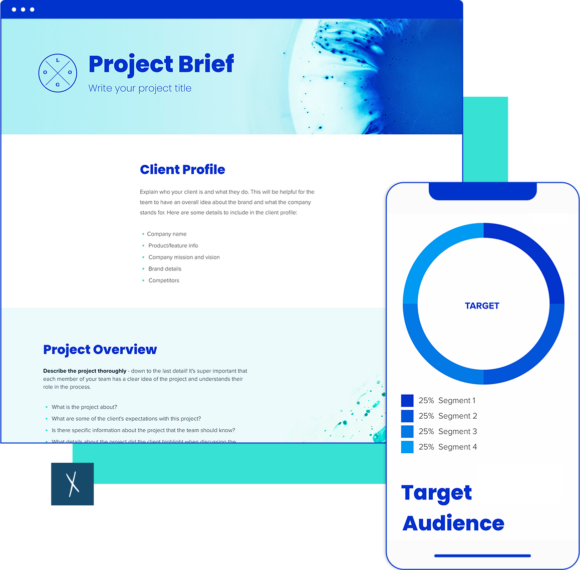
The project brief template is a must-have tool for effective project management. Whether you’re planning an internal website update, organizing a client campaign or outlining a school project, the project brief will allow you to communicate your project in detail, set (SMART) goals, identify the project scope, know your budget and schedule, and measure success.
- Create a visually-engaging summary of your project to focus on high-level goals and objectives.
- Align different teams on a unified project goal and individual responsibilities.
- Make important project decisions quickly and effectively.
Xtensio is your team’s deliverables workspace.
Create, collaborate, and deliver client-ready docs—then keep them current.
Join 409,632 using Xtensio.
Xtensio is the workspace for professional deliverables.
Make one deliverable today—then build a repeatable system for every client and project.
This is where teams create, collaborate, organize, and deliver the documents that run their work.
Everything stays on-brand, current, and ready to share.

Organize every deliverable
Keep strategy, sales, marketing, and client docs together by workspace.
Create fast, stay consistent
Start from 200+ templates or AI drafts, then apply your brand kit.
Collaborate in the doc
No more “final_v7.pdf” loop.
Standardize across deliverables
Apply your brand kit + reusable modules so every deliverable matches.
Improve what you send
See engagement, iterate, and reuse what works across projects.
Other Project Brief templates
How to create a project brief with Xtensio
- Create a free account and start editing, no credit card required.
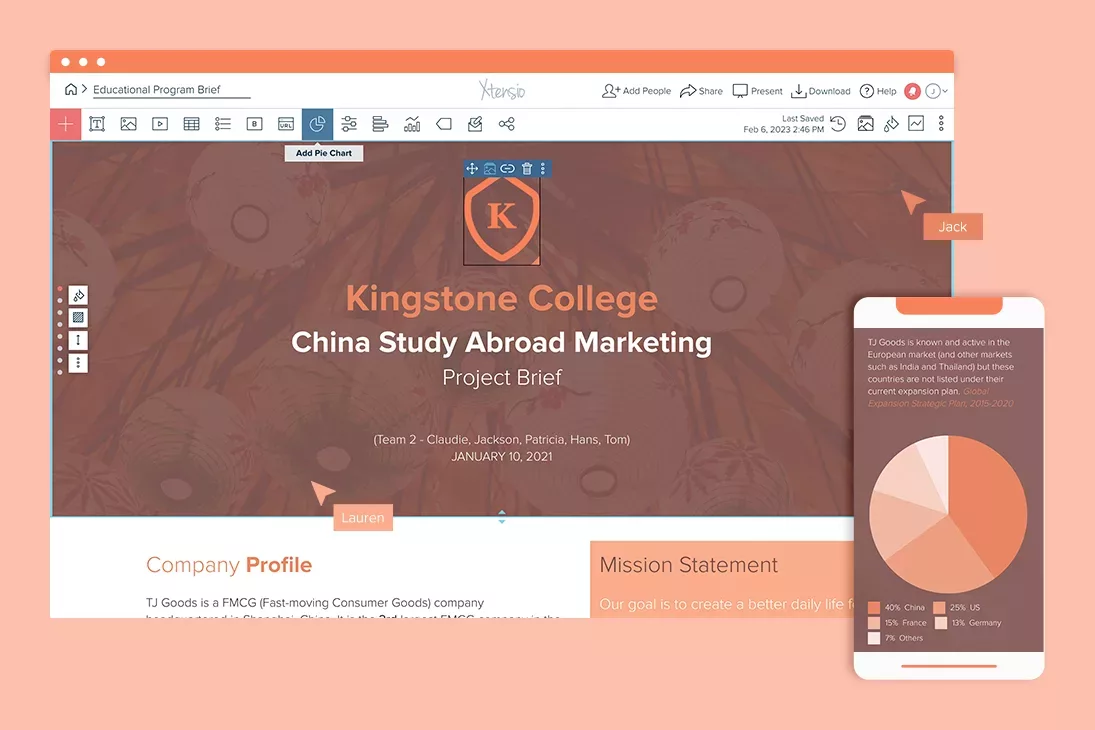
Follow along with the instructional project brief details. Add charts, graphs, images, and videos to customize the brief template and make it your own. Drag & drop. Resize. It’s the easiest editor ever.
- Customize everything in the project brief template to match your brand.
Define your style guide. Add your (or your client’s) brand fonts and colors. You can even pull colors directly from a website to easily brand your project briefs and more.
- Work on your project brief together on the cloud.
Add colleagues (or clients) to collaborate on your brief sales templates. Changes automatically save and sync across all devices, in real-time.
- Share a link. Present a slideshow. Embed. Download a PDF/PNG.
The project seamlessly adapts to your workflow. No more jumping from tool-to-tool to design different types of deliverables.
- Reuse and repurpose.
Save your own brief templates. Or copy and reuse in other documents.

What is a project brief?
Simply put, a project brief (project proposal, creative brief, design brief or project plan) is a starting point for any project – whether it’s to plan an internal website update, organize a full-blown client campaign or outline a school project. In project management, the project plan is a key document that outlines the scope, scale and detailed requirements of the project, helping you reach your goals faster and more efficiently.
An effective creative brief emphasizes the project’s essence and focuses on results and outcomes. The who, what, when, where, and why of your project should be identified in your briefs. The decision on how to approach the project should be left to the graphic design team or the team in charge of the project’s tasks and deliverables.
How do you write a project brief?
The length of your project brief is determined by the scope and size of your project. The longer the brief, the more intricate the job. Don’t be concerned with formatting or adhering to a specific outline; a project brief can and should evolve depending on the goal.
In general, you can use the project brief template as an outline for creating your own creative briefs.
- Explain who this project is being created for.
- Describe the project. Give a project overview by defining the what and the why.
- Define SMART project objectives (specific, measurable, achievable, realistic and timely).
- Identify your target audience.
- Set the schedule and budget, including the final due date and important milestones.
- Detail the project scope: project deliverables, features, tasks, objectives.
- Determine how your team will define project success.
Related to the Project Brief Template
Fully customizable templates that you can make your own.
What is a project brief?
A project brief is a concise document that defines a project’s objectives, scope, stakeholders, timeline, and success criteria before work begins. It is the agreement between the team doing the work and the stakeholders requesting it. A strong project brief prevents scope creep, aligns expectations, and gives the team a clear reference point when questions arise mid-project.
Unlike a full project plan with Gantt charts and resource allocations, a project brief stays at the strategic level. It answers “what are we doing and why?” rather than “how exactly will we do it?” The brief comes first. The detailed plan follows once the brief is approved.
Key sections of a project brief
- Project overview — A one-paragraph summary of what the project is, why it matters, and what success looks like. This is what leadership reads when they have 30 seconds.
- Objectives and goals — Specific, measurable outcomes the project should achieve. Distinguish between primary objectives (must achieve) and secondary objectives (nice to have).
- Scope — What is included and, equally important, what is explicitly excluded. Scope creep starts when boundaries are not defined upfront.
- Target audience — Who benefits from this project. For product work, this is the user segment. For internal projects, this is the team or department.
- Stakeholders and roles — Project sponsor, project lead, team members, and approvers. Clarify who makes decisions and who provides input.
- Timeline and milestones — Key dates, phases, and checkpoints. Not a detailed schedule, but the high-level cadence of the project.
- Budget and resources — Estimated cost, team allocation, and any external resources (contractors, tools, licenses) required.
- Risks and constraints — Known risks, dependencies on other teams, technical constraints, and regulatory requirements that could affect delivery.
- Success metrics — How you will measure whether the project achieved its objectives. Define these before the project starts, not after.
Project brief vs. project plan vs. project charter
- Project brief — Strategic overview. Defines what and why. Used to get alignment and approval before detailed planning begins. Usually 1-3 pages.
- Project plan — Tactical roadmap. Defines how, when, and by whom. Includes task breakdowns, dependencies, resource assignments, and timelines. Can be dozens of pages.
- Project charter — Formal authorization document. Often required in enterprise environments. Includes governance structure, budget approval, and executive sponsorship. More bureaucratic, less practical.
For most teams, the project brief is the most useful of the three. It is detailed enough to align stakeholders and prevent misunderstandings, but concise enough that people actually read it. Start with a brief. Expand into a plan if the project’s complexity requires it.
Tips for writing a strong project brief
- Write the brief before the kickoff meeting — The brief should be a pre-read, not a meeting output. Use the kickoff to discuss and refine, not to draft from scratch.
- Define scope by exclusion — Listing what is out of scope is often more valuable than listing what is in scope. It prevents assumptions.
- Get sign-off from the decision-maker — An unsigned brief is a suggestion. A signed brief is a commitment. Make approval explicit.
- Keep it to one or two pages — If the brief is longer than that, you are writing a project plan. Brevity forces clarity.
- Share it as a living document — Share the brief as a live link so updates to scope, timeline, or objectives are visible to everyone. Reference it throughout the project when scope questions arise.
Why use Xtensio for project briefs
Project briefs are shared deliverables. They are created by one person, reviewed by stakeholders, and referenced by the team throughout the project. Xtensio makes this workflow seamless: create the brief from a template, share it as a live link for review and approval, and update it as scope evolves. The brief stays current without re-sending documents or managing file versions. Engagement analytics show you who read the brief before the kickoff meeting. And when the next project starts, clone the template and carry forward the structure that works.
Teams use Xtensio to create, share, and improve professional deliverables.
Trusted by 409,632 teams, founders, and consultants.



Jerome Katz
Professor of Entrepreneurship @

Jake Peters
CEO @

Robin Bramman
Founder and Chief Brand Mixologist @

Olakunle Oladehin
Executive Director @
Everybody Dance Now!

Aaron Friedland
Executive Director @
The Walking School Bus

Robin Eyre
Owner @

Adam Sher
CEO @

Stephen Paterson
Chief Product Officer @
What is a project brief?
A project brief is a short document that outlines the purpose, scope, timeline, and key deliverables of a project before work begins. Think of it as the handshake between the person requesting work and the team doing it — a shared understanding of what success looks like, documented before anyone opens a design tool or writes a line of code.
Unlike a full project plan (which maps every task, dependency, and milestone), a project brief stays high-level. It is typically 1-3 pages and answers five questions: What are we doing? Why does it matter? Who is involved? When does it need to be done? How will we know it worked?
What to include in a project brief
- Project name and owner: Who requested the project and who is accountable for delivery. This prevents the “I thought you were handling it” conversation that derails projects week three.
- Background and context: Why this project exists now. What business problem, customer need, or strategic initiative triggered it. Two to three sentences — enough for someone outside the project to understand the motivation.
- Objectives: What measurable outcomes should the project deliver? “Redesign the onboarding flow” is a task. “Reduce onboarding drop-off by 25%” is an objective. Objectives should tie to a business metric.
- Scope: What is included and — just as important — what is explicitly excluded. The exclusions section prevents scope creep better than any process. If a stakeholder asks “can we also add X?” you point to the brief.
- Deliverables: The specific outputs the project will produce. A landing page, a report, a feature release, a campaign — name them. Abstract descriptions lead to misaligned expectations.
- Timeline and milestones: Key dates including kickoff, major checkpoints, and delivery. Do not plan in days — plan in weeks. Day-level precision on a brief creates false confidence.
- Budget and resources: What people, tools, and money the project requires. Even if the budget is “internal team time only,” state it. Unspoken resource assumptions kill projects.
- Success criteria: How the team will evaluate whether the project delivered what it promised. This forces the requester to define “done” before work starts.
Project brief vs project plan vs creative brief
- Project brief: High-level alignment document. Answers what, why, and when. Written before planning begins. Audience: everyone involved in the project. Length: 1-3 pages.
- Project plan: Detailed execution roadmap. Maps tasks, owners, dependencies, milestones. Written after the brief is approved. Audience: project team and managers. Length: varies, often 5-20 pages.
- Creative brief: Direction for creative work (design, copy, campaigns). Includes tone, audience, brand guidelines, competitive references. Written for designers and writers. Length: 1-2 pages.
A common mistake is skipping the brief and jumping straight to the plan. Plans without briefs answer “how” without agreeing on “what” — which leads to teams executing efficiently on the wrong thing.
Project brief examples by context
Agency project brief
When an agency kicks off a client engagement, the brief captures the client’s goals, brand guidelines, target audience, and approval process. It protects both sides: the client knows what they are getting, and the agency can point to the brief when feedback strays beyond the agreed scope. Include the client’s review cadence (weekly check-ins? async feedback?) and who has final approval authority.
Product launch brief
A product launch brief coordinates marketing, sales, engineering, and support around a release date. It covers positioning, launch channels, enablement materials, support documentation, and rollback criteria. The key section most teams skip: “what does success look like at 30/60/90 days post-launch?” Without this, nobody knows when to declare victory or pivot.
Internal initiative brief
Internal projects (process improvements, tool migrations, team restructuring) benefit from briefs even more than external work because they lack the natural accountability of a paying client. An internal brief with executive sign-off gives the project team cover to say no to scope expansion and authority to request resources.
Common project brief mistakes
- Writing it alone. A brief written by one person reflects one person’s assumptions. The brief should be drafted by the project owner and reviewed by all key stakeholders before work starts. The review process is where misaligned expectations surface — which is exactly when you want them to surface.
- Skipping the “out of scope” section. Scope creep is the number one project killer. If the brief does not explicitly state what is NOT included, every stakeholder will assume their pet feature is part of the deal.
- Vague objectives. “Improve the customer experience” is not a project objective. “Reduce support ticket volume by 30% within 90 days of launch” is a project objective. If you cannot measure it, you cannot declare success.
- Not revisiting it. Projects evolve. If the scope, timeline, or objectives change significantly, update the brief and get re-alignment from stakeholders. Working from an outdated brief is worse than having no brief.
- Making it too long. A project brief is not a project plan. If your brief exceeds 3 pages, you are either planning too granularly or combining the brief with the plan. Keep the brief tight — it should be something anyone can read in 5 minutes.
Project brief FAQ
Who should write the project brief?
The project owner or requestor — the person who understands the business need. This is typically a product manager, marketing lead, agency account director, or department head. The project manager may help structure it, but the business context should come from the person closest to the problem.
How long should a project brief be?
1-3 pages. One page for small projects (a campaign, a feature update). Three pages for complex initiatives (a platform migration, a multi-quarter program). If it is longer than three pages, you are probably writing a project plan.
Do I need a project brief for small projects?
For anything involving more than two people or lasting more than a week, yes. A brief does not need to be formal — even a half-page Slack message that covers scope, timeline, and success criteria qualifies. The format matters less than the alignment it creates.
How is a project brief different from a business requirements document?
A project brief describes the project (goals, scope, timeline). A BRD describes the requirements (what the system or process must do). The brief comes first. The BRD comes from the brief. Small teams sometimes combine them; larger organizations keep them separate.
Should I use a template for project briefs?
Yes. Templates enforce consistency and prevent you from forgetting critical sections (like the out-of-scope list). Customize the template per project type — client briefs, product briefs, and internal initiative briefs need slightly different sections — but start from a shared structure.
See how Xtensio compares
Wondering whether Xtensio is the right fit for your team? See how it stacks up:

Create and deliver beautiful work, professionally.
Build, brand, and deliver living documents your clients actually engage with.







Join 409,632 professionals delivering work with Xtensio.