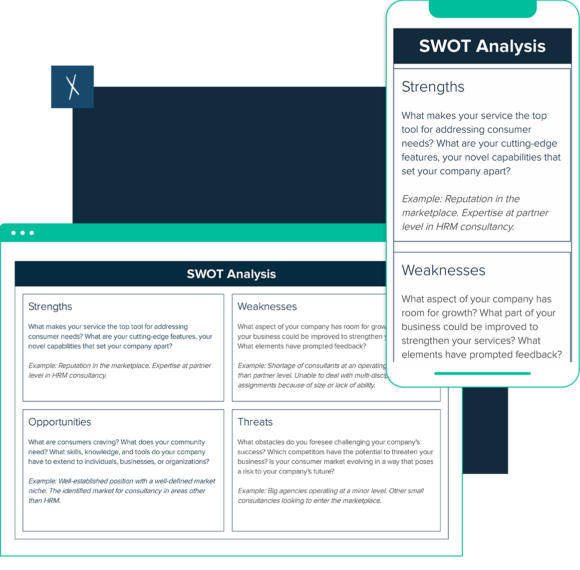
SWOT Analysis Template
Build consultant-level SWOT analyses — automatically.
Xtensio’s AI SWOT Builder helps you uncover your company’s strengths, weaknesses, opportunities, and threats in minutes — not hours.
AI researches your market, identifies key insights, and applies your branding automatically, so you can focus on strategy, not formatting.
Create a clear, collaborative SWOT you can share with your team, clients, or investors — all editable, visual, and on-brand.
👉 Try it free and get instant clarity on your next move.
Xtensio is your team’s deliverables workspace.
Create, collaborate, and deliver client-ready docs—then keep them current.
Join 409,687 using Xtensio.
Xtensio is the workspace for professional deliverables.
Make one deliverable today—then build a repeatable system for every client and project.
This is where teams create, collaborate, organize, and deliver the documents that run their work.
Everything stays on-brand, current, and ready to share.

Organize every deliverable
Keep strategy, sales, marketing, and client docs together by workspace.
Create fast, stay consistent
Start from 200+ templates or AI drafts, then apply your brand kit.
Collaborate in the doc
No more “final_v7.pdf” loop.
Standardize across deliverables
Apply your brand kit + reusable modules so every deliverable matches.
Improve what you send
See engagement, iterate, and reuse what works across projects.
Table of Contents
What is a SWOT Analysis?
A SWOT analysis helps in identifying internal strengths and weaknesses, as well as external opportunities and threats. It’s commonly used to assess a company’s alignment with its growth and success goals.
Components of a SWOT Analysis
Strengths
- What your company does well
- Unique selling propositions
- Internal resources
Weaknesses
- Areas needing improvement
- Competitive disadvantages
- Resource limitations
Opportunities
- Market gaps
- Emerging trends
- Potential growth areas
Threats
- Competitors
- Regulatory changes
- Market volatility
How to Conduct a SWOT Analysis
- Gather your team.
- Set up quadrants.
- Identify strengths, weaknesses, opportunities, and threats.
- Document and share findings.
- Develop action items.
Please read the how-to guide for more detailed instructions, best practices, and tips.
Benefits of a SWOT Analysis
- Provides a comprehensive view of your business.
- Helps in strategic planning.
- Identifies growth opportunities and potential risks.
Why Use This Template?
Completely Free
Dive in without worrying about fees.
Team collaboration enabled
Bring your team together right inside the template. work together in real time.
Fully customizable
Just click and edit everything. Change it up to reflect your style or match your company’s colors and fonts. It’s all just drag-and-drop easy.
Includes guidance
Not sure where to start? We’ve got your back with handy tips, how-to guides, and prompts right where you need them, guiding you through each step.
Easy to share
Share with a simple link, your stakeholders can see what you’re up to, anytime and anywhere. You can also present, embed, or download as PDF and PNG.
Accessible from any device
On the go or at your desk, your work is always ready for you. It’s all online, so you can pick up right where you left off from any device. It is responsive so it will look everywhere.
Comes with analytics
Get detailed insights on who is viewing your work and how they are consuming it.
Very simple and Intuitive
Jump right in without the steep learning curve. We’ve kept everything straightforward, so you can focus on what matters.
Secure and private
We take your privacy very seriously. Brainstorm in peace, knowing your ideas are protected.
Great support
Stuck on something? Reach out! We’re here to help with tips, tricks, and friendly advice whenever you need it.
Design, manage and share beautiful living documents… easily, together. Explore Xtensio
- Click and edit anything… together.
- Customize to match your branding.
- Share with a link, present, embed or download.
Teams use Xtensio to create, share, and improve professional deliverables.
Trusted by 409,687 teams, founders, and consultants.



Jeff Schenck
Marketing Manager @

David Nason
CEO/Founder @

Grace Ghunaim
Global Chief Strategy Officer (CSO) @

Ben Cary
Founder @

Leon Coe
Instructor @
Texas A&M University

Jennifer Alt
UI/UX Designer @

Zac Heisey
Director of Digital Marketing @

Jenny Johansson
UX Manager @

Ryan Dobson
Global Engineering Manager @
What’s Next?
A SWOT analysis is a starting point. Use it to drive your strategy and positioning.
See how Xtensio compares
Wondering whether Xtensio is the right fit for your team? See how it stacks up:
Related to the SWOT Analysis Template
Fully customizable templates that you can make your own.
When to Use a SWOT Analysis
A SWOT analysis is useful at several key decision points, but it’s most powerful when you’re about to commit resources — budget, headcount, or a new direction. Use it at the start of annual planning to pressure-test strategic assumptions before they’re baked into OKRs or a roadmap. Use it before entering a new market to understand whether your current strengths actually apply, or whether you’re walking into a competitive environment your team isn’t equipped to navigate.
Startups should run a SWOT before each funding round — not for the investor deck, but for internal clarity on what the team actually believes is true about the business. Investors will probe the same questions anyway, and founders who have thought them through in advance come across as more credible and prepared.
Established teams benefit from a SWOT when facing a disruptive competitive move — a new entrant, a platform change, or a technology shift. Rather than reacting, a structured SWOT helps separate signal from noise: what does this change actually affect, and what parts of our business remain stable?
One thing to avoid: running a SWOT as a post-hoc justification for a decision already made. The exercise only adds value when participants are genuinely open to the possibility that the analysis might change the plan.
SWOT Analysis Examples by Use Case
The questions you ask in a SWOT analysis change significantly depending on your context. Here’s how different teams typically approach the same framework:
SWOT for a Startup
For an early-stage company, strengths and weaknesses are almost entirely about the founding team and product-market fit hypothesis. Relevant questions include: Does the team have domain expertise competitors lack? Does the product solve a problem customers currently pay money to address, even imperfectly? Weaknesses at this stage are often things like: no brand recognition, thin customer base, dependency on a single distribution channel. Opportunities should be tied to timing — what has changed in the market recently that makes this the right moment? Threats typically include larger incumbents who could add a competing feature, regulatory changes, or the possibility that the problem is real but the customer segment is too small to build a sustainable business.
SWOT for an Agency or Consultancy
Agency SWOTs tend to be relationship-heavy. Strengths often come down to a specific expertise or industry niche, a roster of referral clients, or a proprietary process that produces consistent results. Weaknesses are frequently about over-reliance on a few key clients, difficulty productizing service delivery, or high dependence on specific individuals whose departure would create delivery risk. Opportunities in this context often involve adjacent services — agencies strong in strategy consulting, for example, may see an opportunity to add implementation support. Threats include commoditization of their core service by AI tools, clients bringing work in-house as teams grow, and offshore competition on cost.
SWOT for a Product Team
Product teams often run SWOTs at the feature or initiative level, not just the company level. A SWOT on a specific product bet helps a PM articulate why this initiative deserves prioritization over alternatives. Strengths for a product team might include: unique data assets, platform integrations competitors can’t replicate, or a community that drives organic adoption. Weaknesses often involve technical debt that slows iteration, or a user base loyal to an existing workflow the new feature disrupts. Threats include platform dependencies (an API partner who could become a competitor) and competitor features shipping before internal development completes.
Common SWOT Analysis Mistakes to Avoid
A well-run SWOT produces actionable insight. A poorly run one produces a list of vague statements that generates false confidence. Here are the most common failure modes:
- Being too vague. “Our team is talented” is not a strength. “Our engineering team has shipped three enterprise SaaS products, averaging $2M ARR each” is a strength. Specificity makes the analysis defensible and useful.
- Conflating internal and external factors. Strengths and weaknesses are internal — things you control. Opportunities and threats are external — things happening in your market or environment. Mixing them up (e.g., treating “our product roadmap is unclear” as a threat) undermines the structure.
- Using the SWOT as a vanity exercise. Teams sometimes list only strengths they’re proud of and opportunities that validate their existing plan, while understating real weaknesses and threats. If your SWOT doesn’t reveal at least one uncomfortable truth, it probably isn’t honest enough.
- Running it in a vacuum. A SWOT done by a single person or a homogeneous team reflects one perspective. The most useful SWOTs involve multiple stakeholders — sales, product, customer success — who have direct exposure to market feedback the leadership team might not hear.
- Stopping at the analysis. The biggest failure mode: completing the SWOT, presenting it, filing it away, and never connecting it to actual decisions. A SWOT should end with a prioritized list of strategic actions, not just a quadrant of observations.
How to Turn Your SWOT Into a Strategy
A SWOT analysis is a diagnostic tool, not a strategy. The strategy comes from what you do with the output. Once you’ve completed the four quadrants, the next step is to map intersections across them:
- Strengths + Opportunities (SO strategies): Where can you use your existing strengths to capture the opportunities you’ve identified? These are your aggressive growth plays — the things you should be doing more of.
- Strengths + Threats (ST strategies): How can your strengths help you defend against the threats you’ve identified? This is where differentiation strategy lives — making it harder for competitors to replicate what you do best.
- Weaknesses + Opportunities (WO strategies): What weaknesses do you need to address in order to capture the opportunities available to you? These often become hiring plans, partnership discussions, or product roadmap priorities.
- Weaknesses + Threats (WT strategies): These are your risk mitigation plays. What’s your plan if a threat materializes and you’re currently exposed due to a weakness? Contingency planning lives here.
After mapping these intersections, prioritize. Not every quadrant combination will produce an actionable insight. Focus on the 2-3 strategic moves with the highest potential impact given your current resources. Then connect those moves to your planning cycle — OKRs, a quarterly roadmap, or a team-level sprint plan — so the SWOT actually changes what you work on.
For a structured walkthrough of how to build a full competitive picture alongside your SWOT, see the competitive analysis guide — it covers how to move from strategic assessment to competitive positioning.
SWOT Analysis by Company Stage
A SWOT analysis at a 5-person startup looks fundamentally different from one at a 500-person enterprise. The framework is the same four quadrants, but the inputs, the blind spots, and the strategic conclusions change dramatically depending on company maturity. Here is how to adapt your SWOT to the stage you are actually in.
Early-stage startup (pre-product-market fit). At this stage, most of the SWOT is hypothetical. You have limited data, few customers, and a team that wears multiple hats. Strengths are typically speed, founder expertise, and willingness to pivot. Weaknesses are everything else: no brand recognition, thin resources, unproven product. Opportunities should focus on specific underserved segments rather than broad market trends. Threats are existential: runway, a well-funded competitor launching a similar product, or key-person risk if a co-founder leaves. The most important thing a startup SWOT can do is surface the 2-3 assumptions that, if wrong, would kill the business. Validate those first.
Growth stage (post-product-market fit, scaling). Growth-stage companies have real data, which makes the SWOT both more grounded and more complex. Strengths now include proven product-market fit, revenue traction, and a growing team. But weaknesses shift too: processes that worked at 10 people break at 50. The strengths quadrant should ask “What got us here?” and the weaknesses quadrant should ask “What will break if we 3x?” Opportunities typically involve market expansion (new segments, new geographies, adjacent products). Threats come from competitive response: now that you have proven the market, larger players may enter. A growth-stage SWOT should produce a hiring plan (which weaknesses require new roles?) and a competitive moat analysis (which strengths are defensible?).
Enterprise (mature, defending market position). Enterprise SWOTs deal with market saturation, organizational complexity, and innovation inertia. Strengths include brand, customer base, distribution, and data. Weaknesses are often internal: bureaucracy, legacy technology, slow decision-making, or talent retention in key roles. Opportunities for mature companies tend to be incremental rather than transformational: adjacent markets, partnerships, or efficiency gains. Threats include disruption from below (a startup solving the same problem with a simpler, cheaper product), regulatory shifts, and customer concentration risk. The enterprise SWOT should produce a risk register (threats with probability and impact scores) and an innovation pipeline (opportunities ranked by strategic fit). Run it quarterly, not annually. Markets move too fast for a once-a-year analysis to stay relevant.
Regardless of stage, keep your SWOT as a living deliverable that your leadership team revisits on a set cadence. Share it as a live link so everyone references the same current version. When the SWOT from Q1 informs the OKRs for Q2, the framework stops being an academic exercise and starts driving decisions. Use a workspace to keep your SWOT, competitive analysis, and strategic plan connected so insights flow between documents instead of living in isolation.
How to Turn SWOT Findings Into a 90-Day Action Plan
The step most teams skip after completing a SWOT is translating findings into time-bound actions with owners and measurable outcomes. Here is a structured process for going from four quadrants of observations to a 90-day plan your team will actually execute.
Prioritize by impact, not by quadrant. Teams often give equal weight to all four quadrants, which produces a scattered action plan. Instead, score each item across all quadrants on two axes: potential impact on your primary business goal (1 to 5) and current ability to act on it (1 to 5). Multiply the scores. The top 3 to 5 items become your 90-day priorities. A strength you can leverage immediately for high impact (score: 25) matters more than a threat that is low-probability and hard to address (score: 4).
Assign a single owner per initiative. “The marketing team will work on competitive positioning” is not ownership. “Sarah Chen will improve competitive win rate from 22% to 28% by June 30” is ownership. Every priority needs one person who reports progress, removes blockers, and makes decisions when the team disagrees. Without a named owner, strategic priorities become orphans that everyone assumes someone else is handling.
Set a review cadence, not just a deadline. A 90-day plan with a single check-in at day 90 is a plan that fails silently for 89 days. Build in monthly reviews where the owner presents progress, surfaces blockers, and requests resource adjustments. At day 30, you should know whether the plan is on track, behind, or needs to be reframed. At day 60, you should have enough data to decide whether to double down or pivot. At day 90, run the SWOT again with fresh data and compare.
Connect to your existing planning system. If your team uses OKRs, each SWOT priority should map to an objective. If you use quarterly roadmaps, each priority should appear as a roadmap item. If you use sprint planning, each priority should decompose into backlog items. The SWOT is the diagnostic; your planning system is the execution layer. Keep both in the same workspace so the connection is visible and auditable. When someone asks “Why are we working on this?”, the answer should trace back to a specific SWOT finding.
The most effective teams treat the SWOT not as a deliverable to complete but as a recurring input to their operating rhythm. Run it quarterly. Use the same template every cycle so progress is visible. Share the how-to guide with new team members so everyone uses the same methodology. And connect your SWOT to complementary frameworks: a SOAR analysis for aspiration-focused planning, or a competitive analysis for deeper competitive intelligence.
SWOT not the right fit? Explore alternative strategic analysis frameworks that might work better for your business.
Prefer to start with AI? The AI SWOT Analysis Generator fills in all four quadrants automatically from your business description.
What to Create Next
A SWOT analysis is a starting point. Use it to drive your strategy and positioning.

Create and deliver beautiful work, professionally.
Build, brand, and deliver living documents your clients actually engage with.






Join 409,687 professionals delivering work with Xtensio.