How To Create a Pitch Deck (With Template and Examples)
Updated by Xtensio
The pitch deck is a necessary tool to raise funding from investors for your startup. The quality of your pitch deck (both content and visuals) has a big impact on what investors will think about your company and if they see it as worthy of investment. A successful pitch deck covers all the key elements of your business idea on 8 to 10 slides. Explore this template.
Xtensio is your team space for beautiful living documents.
Create, manage and share business collateral, easily.
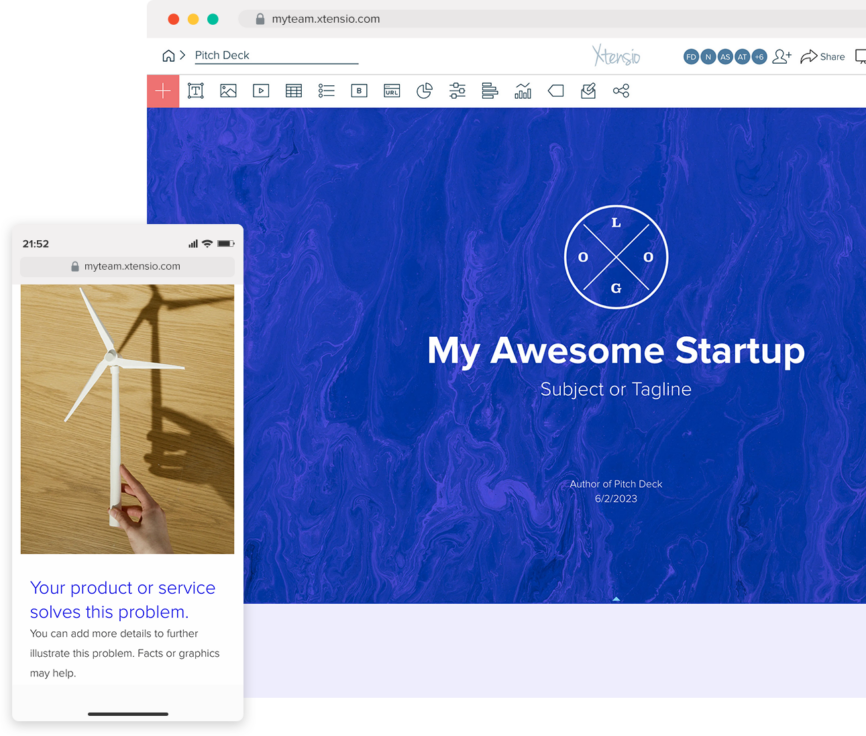
Table of Contents
A step-by-step guide to creating a pitch deck
A pitch deck is a visual presentation that distills your business concept into a concise and compelling narrative. In this guide, we will take you through the process of creating an impactful pitch deck that captures attention and communicates your story effectively.
1. The Problem
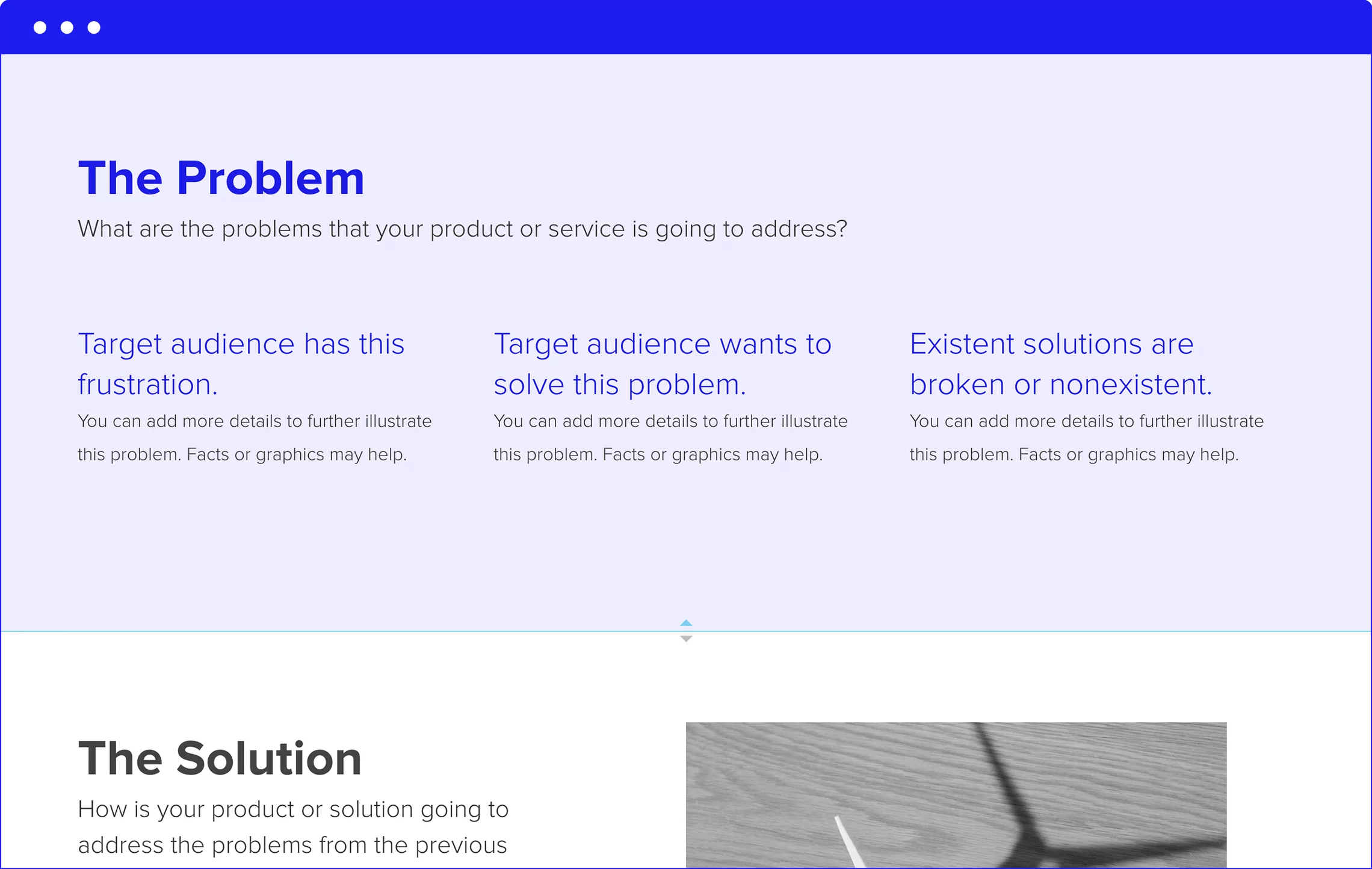
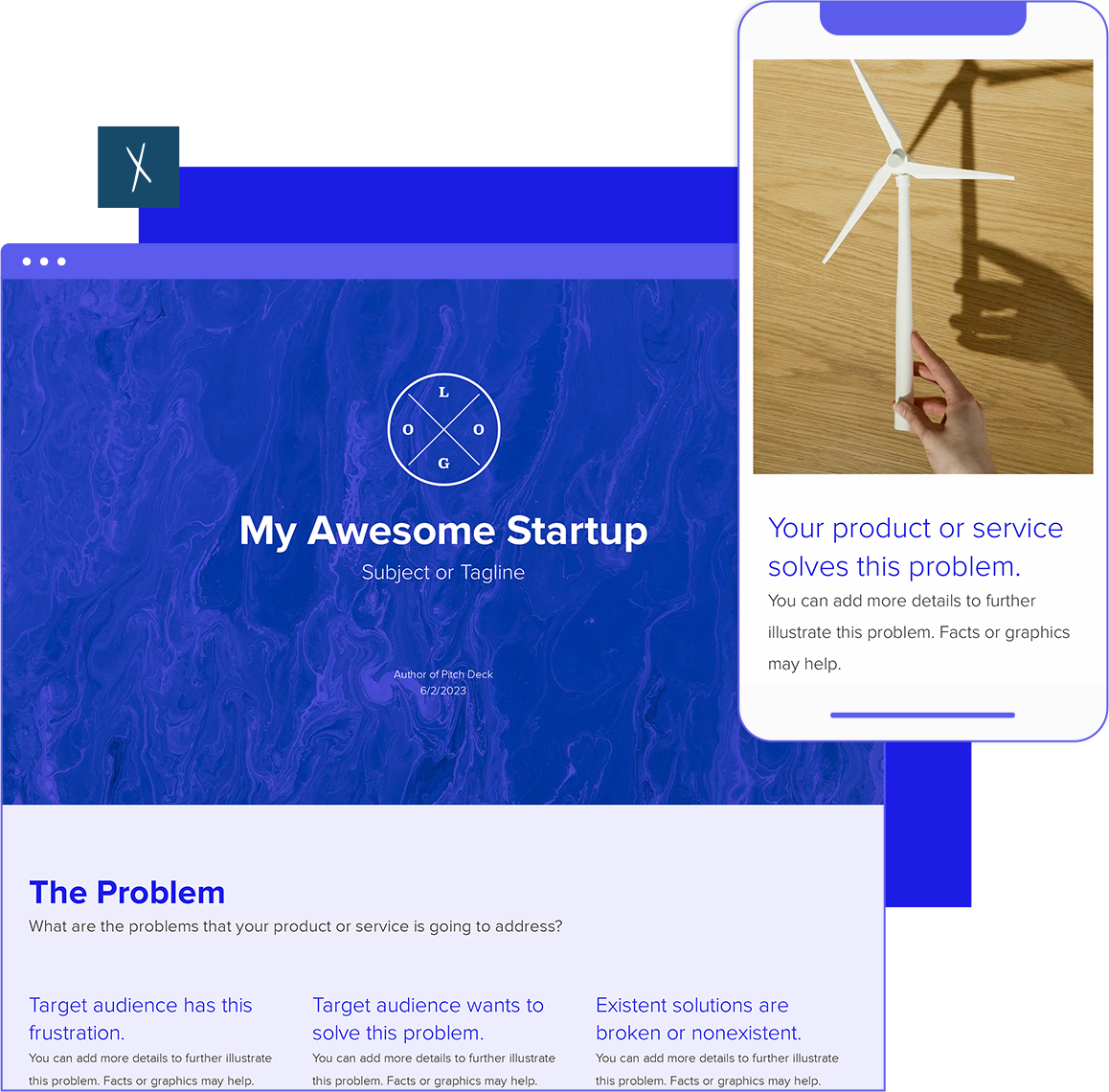
As the introduction to your pitch, this is where you will explain why your product or service exists by describing the critical problem that it solves. This problem plays a major role in grabbing the attention of investors. If you describe the problem accurately, you’ll connect with your audience by touching on a problem they’ve experienced in their own lives.
- Clearly define target audience’s frustration – use statistics and observations. How did you realize this frustration? Be a storyteller, share your experience.
- Focus on the “common” factor – You were spurred to create a solution because you saw the problem affecting others as well. How did you come to the conclusion that others are trying to solve this problem you observed? Does this problem apply only to a specific group or is it a broader issue?
2. The Solution
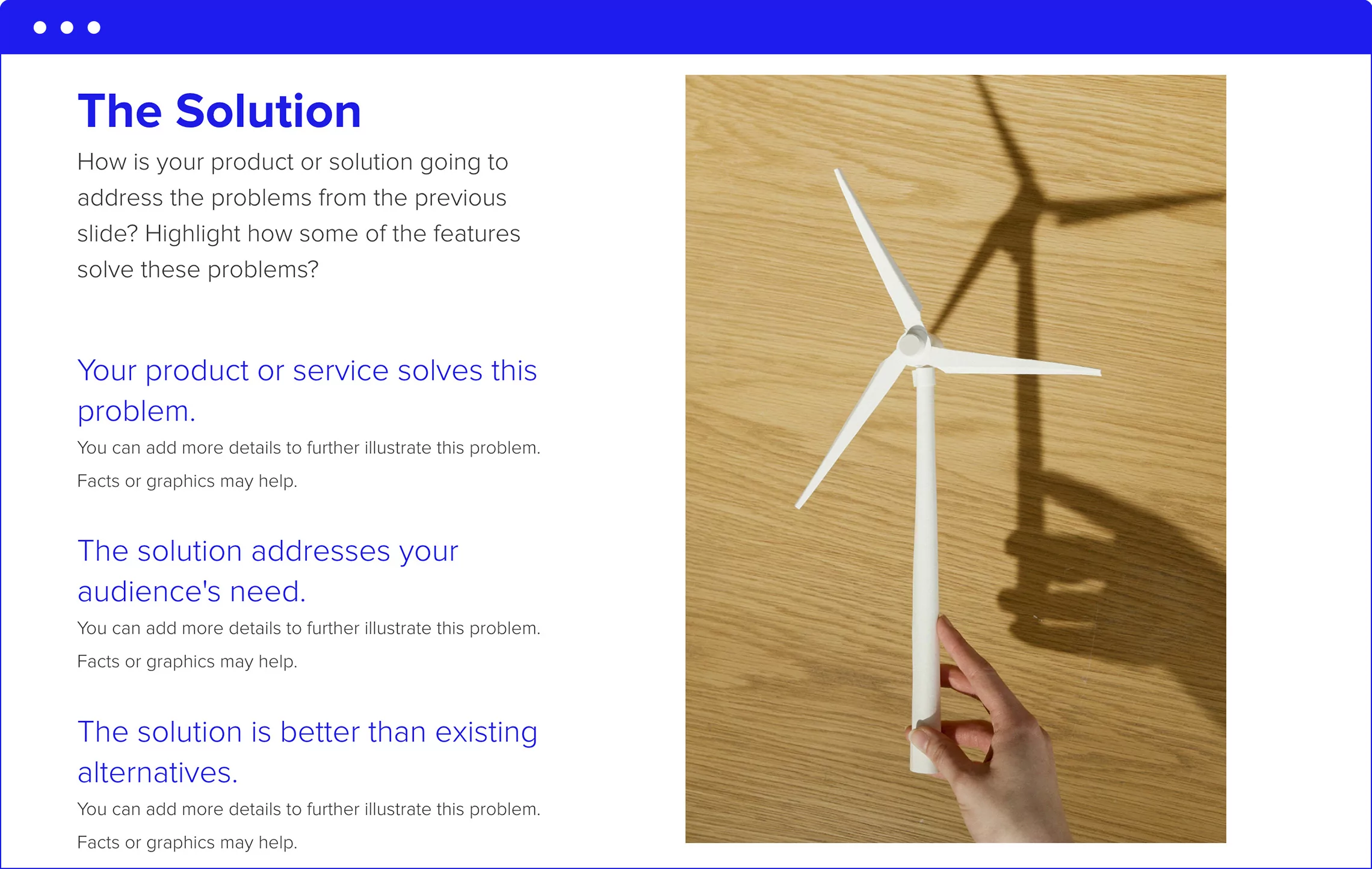
Where there’s a problem, there’s a solution. In this section, you want to highlight the features of your product or service and show how it works. This requires knowing your market and how where the value of your product fits into this market. How do you plan to solve the problem you’ve outlined? Is there already a solution to the problem? Or is the problem that the existing solutions are not good enough?
Utilize the SWOT analysis for both your product and your competitors to get a broader look at the market and where your solution fits in (Learn how to do a SWOT analysis). Diving into your competitors will help you outline why alternative solutions fail and how you can eliminate these failures. Once you identify the important factors that define your unique value proposition, you can highlight these benefits to investors. Remember, your idea may sound innovative but feasibility is the most important factor. Higher feasibility will result in higher interest of investors.
3. Value Proposition
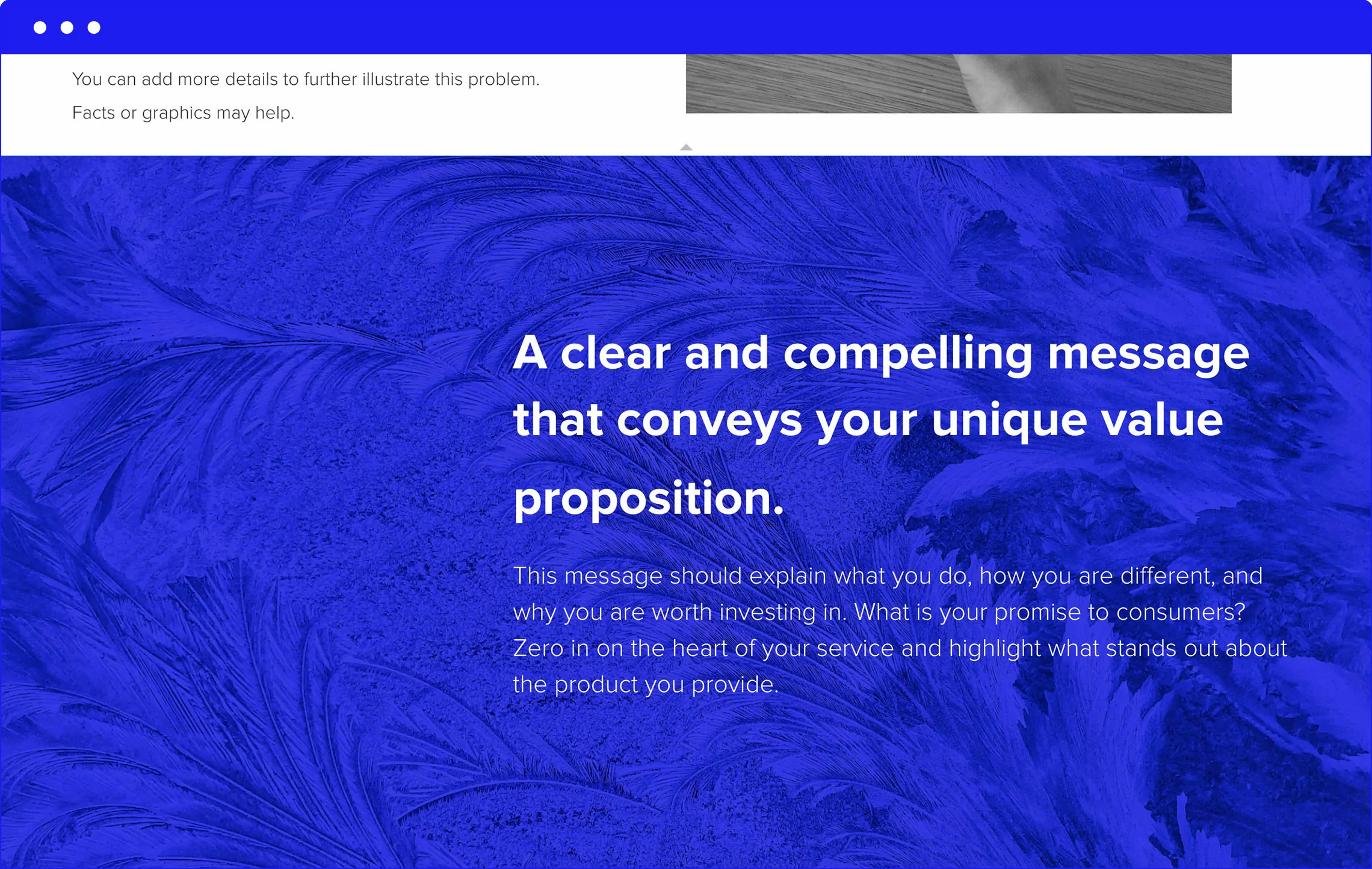
Now that you underlined the problem and solution, it is time to reveal your unique value proposition. You should have a compelling message that explains why you are worth investing in. Bear in mind to use a simple language, meaning that it should be very clear and understandable.

Quick Tip: Use the Brand Positioning Canvas to help you define your unique value proposition.
4. The Competition
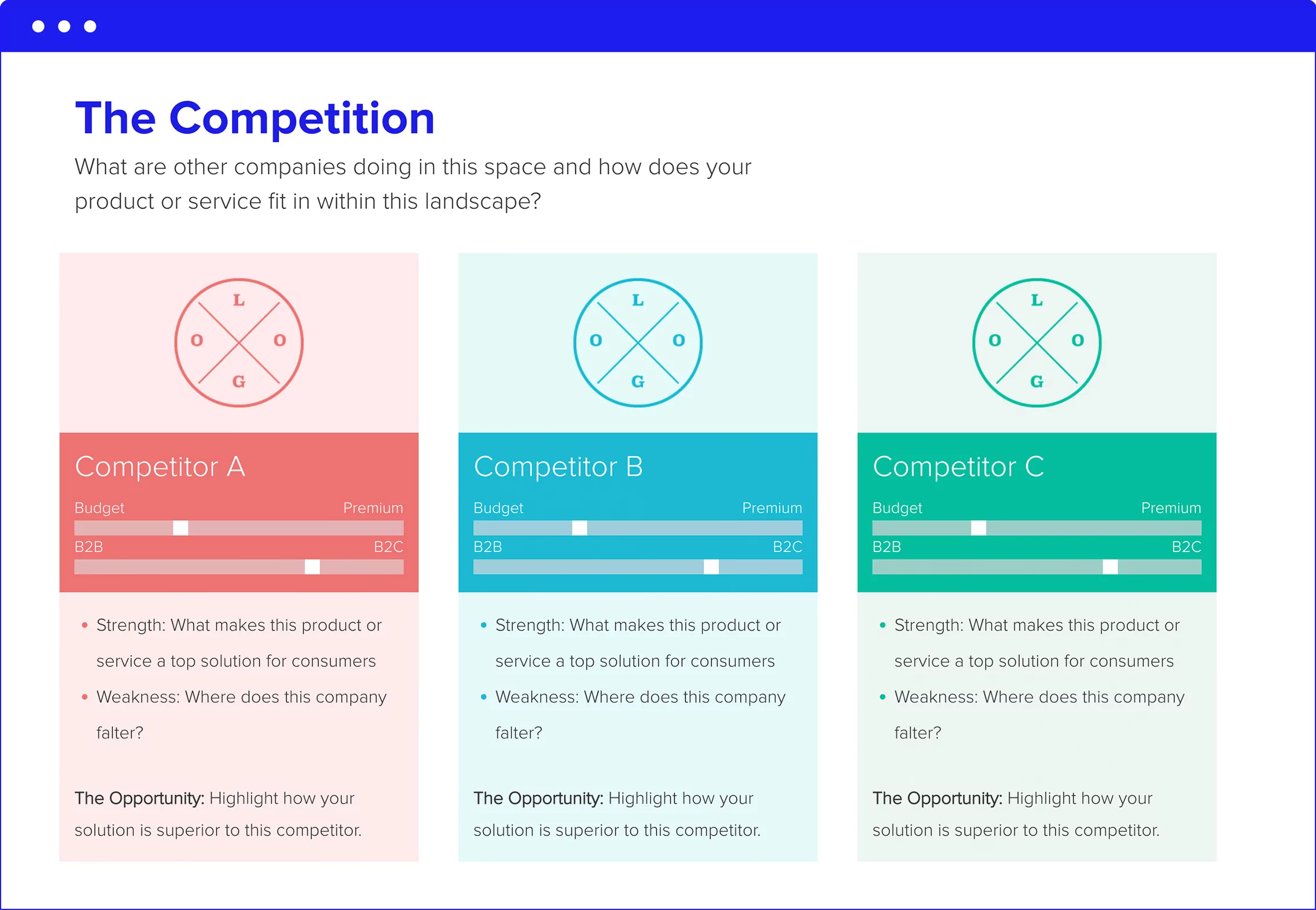
Here, you will need to examine other companies in the market. How are they dealing with the same problem, what is their solution and where does your product/service fit in this scenario? The best way to draw the scheme of competition in investor minds and to demonstrate it with clarity is to use visuals. You can take advantage of the Competitive Analysis template to put your facts and research together before you implement them into your pitch deck.
5. Competitive Advantages
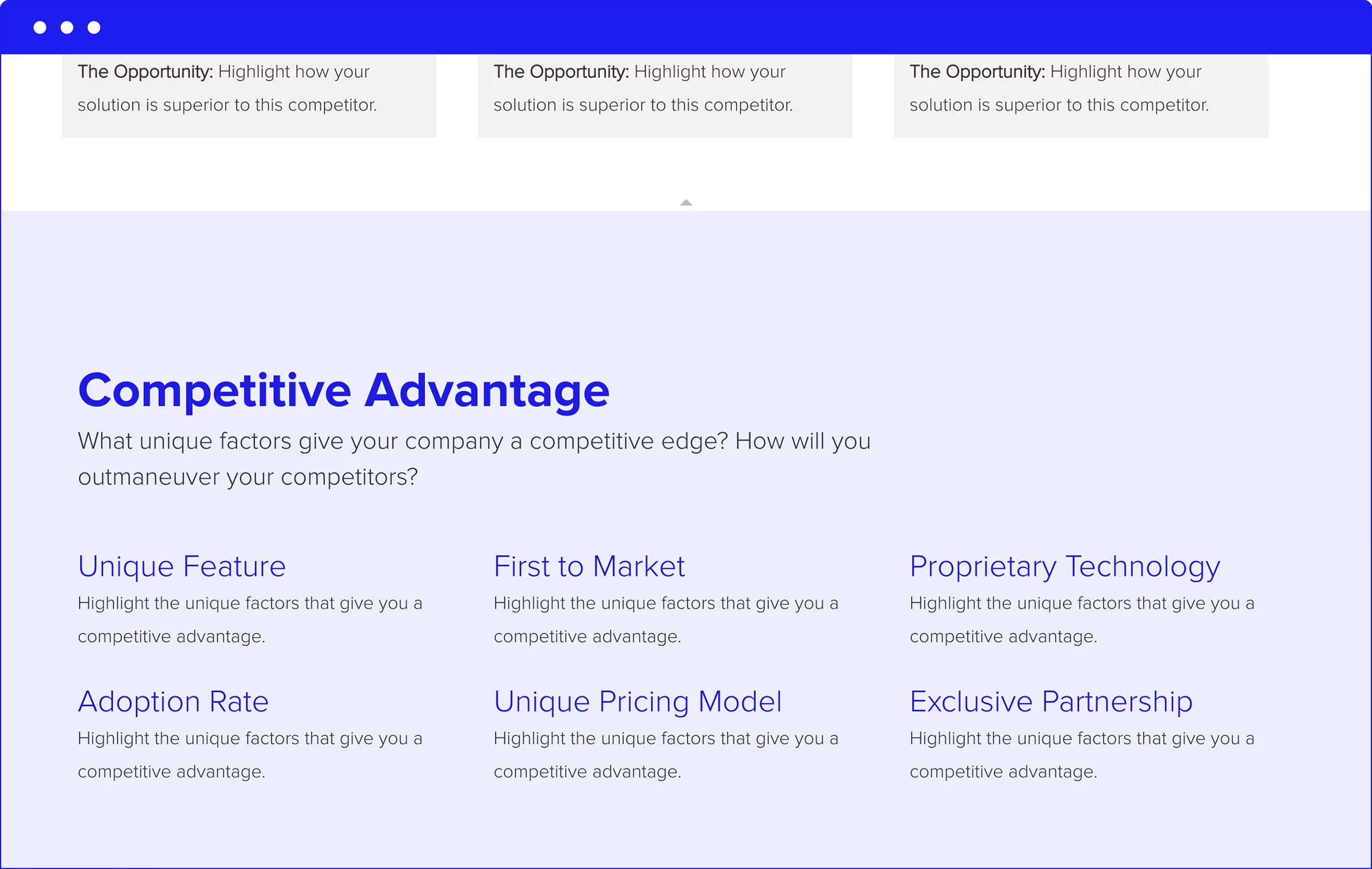
After displaying the competition, indicate the unique factors that give your company a competitive edge. What will set you apart and how did you define these advantages?
- Which uniques features does your product/service have?
- What is the adoption rate?
- Are you the first product on the market that is solving the issue?
- Or are you solving an old issue in a completely new, innovative way?
- What does your pricing model look like? Will it align with your target audiences’ budget to spend on solving the issue at hand?
- How do you utilize technology?
- Will you, now or in the future, consider potential partnerships?
All of these elements will prove the strength of your market research. If you know these factors you will be more convincing and able to answer possible questions investors might have without hesitation.
6. Market Validation & Traction
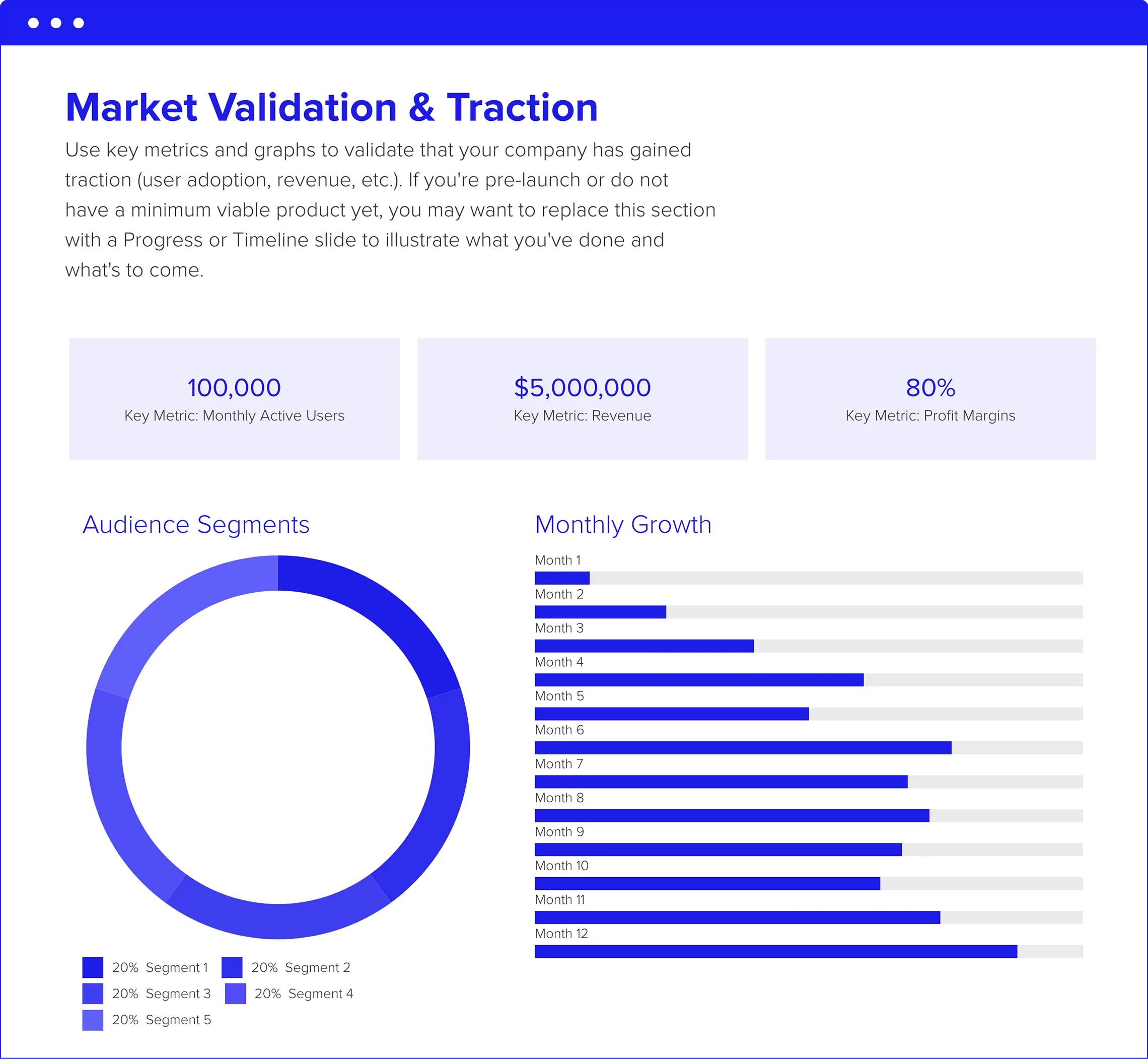
Use key metrics such as monthly active users, ARPU (average revenue per user), profit margins, etc… Showing these key metrics will prove that you are realistic in your approach and ready to establish your company further.
If you’re pre-launch or do not have a minimum viable product yet, you may want to replace this slide with a Progress or Timeline slide to illustrate what you’ve done and what’s to come. You might also use financial predictions based on your business model. But, keep in mind that many startups fail as a result of a wrong business model. To be able to raise fundings, you will need a strong business model that assures financial success.
Bonus: You can use Xtensio’s Business Model Canvas to define goals and collaborate easily with other co-founders.
7. The Team
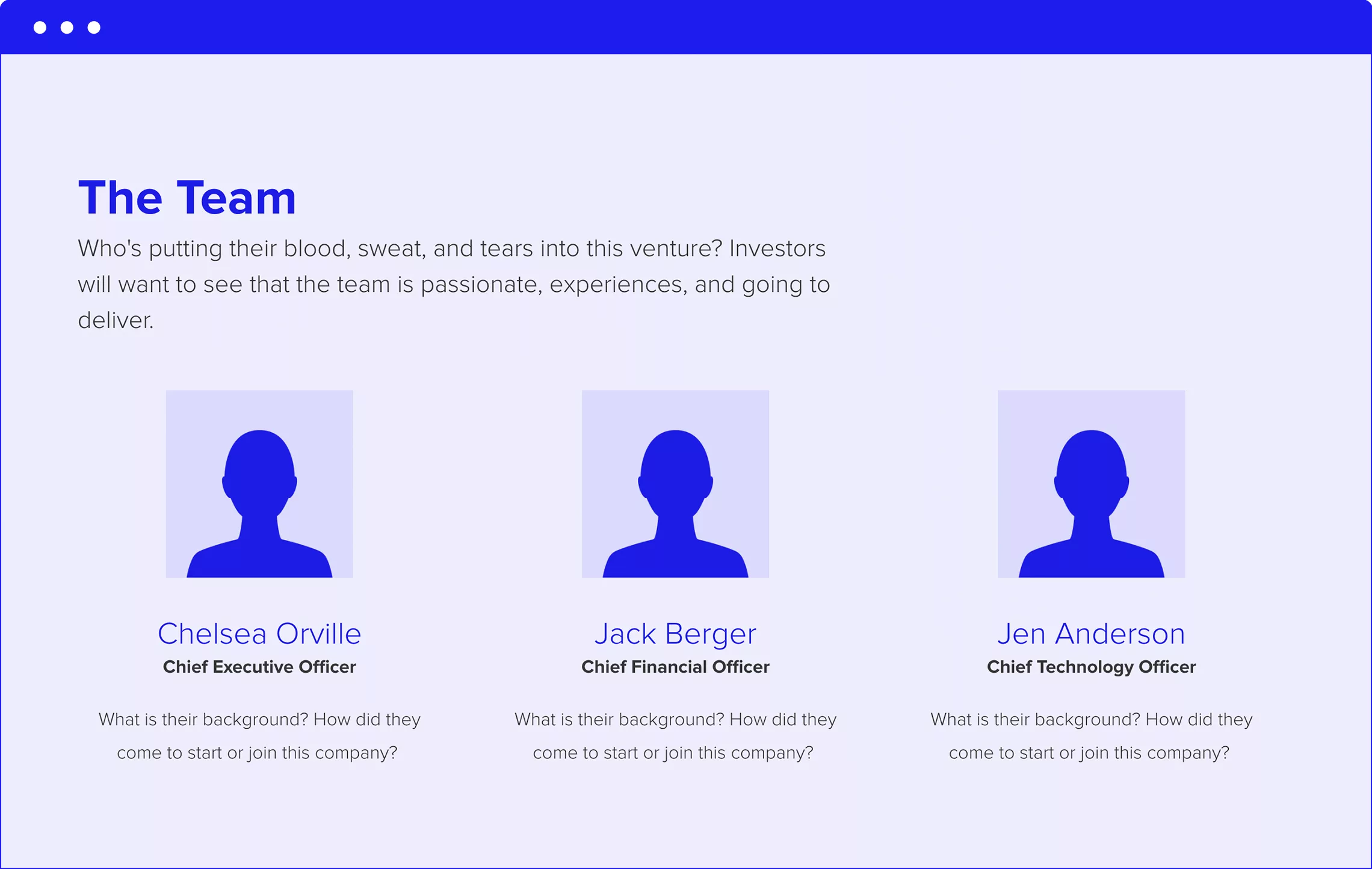
Have you ever heard the saying, “Investors don’t invest in the ideas, they invest in you?” Indeed, it can be all about business relationships and how passionate you appear when you speak about your idea. It’s not a one-person game. You will need a strong team of people who are in this together and ready to put their efforts in common goals towards the company’s future.
Pitch deck design principles that win investors
Investors see hundreds of pitch decks every year. The ones that stand out share specific design principles that make information easy to absorb and remember. These aren’t about making things “look pretty” — they’re about reducing cognitive load so investors focus on your idea, not on deciphering your slides.
One idea per slide
The most common design mistake is cramming multiple concepts onto a single slide. Each slide should communicate exactly one key point. If you find yourself using the phrase “and also” when describing what a slide covers, split it into two slides. Investors process information sequentially — when you stack ideas, they retain none of them. A 12-slide deck with one clear idea per slide outperforms an 8-slide deck with dense, multi-layered slides every time.
Visual hierarchy and whitespace
Every slide needs a clear visual hierarchy: a headline that states the key takeaway, supporting data or visuals in the middle, and minimal text at the bottom if needed. Use whitespace deliberately — it’s not wasted space, it’s breathing room that directs attention. Crowded slides signal a founder who can’t prioritize. Aim for no more than 30 words per slide (excluding charts and labels). If you need more words, you need fewer ideas on that slide.
Consistent branding throughout
Your pitch deck is a brand artifact. Use your company’s color palette, typography, and logo consistently across every slide. This signals professionalism and attention to detail — two qualities investors look for in founding teams. Avoid using more than three colors (your primary brand color, a secondary accent, and a neutral). If your deck looks like it was assembled from different templates, investors will wonder how organized your company actually is.
Data visualization over data tables
When presenting metrics, traction, or market size, always use charts and graphs instead of raw numbers in tables. A simple bar chart showing month-over-month growth is processed in seconds; the same data in a table takes minutes. Choose the right chart type: line charts for trends over time, bar charts for comparisons, pie charts only when showing parts of a whole (and never more than 5 slices). Label your axes clearly and highlight the data point you want investors to remember.
Common pitch deck mistakes to avoid
Even experienced founders make structural mistakes that undermine otherwise strong pitch decks. These errors don’t just weaken individual slides — they erode investor confidence in your ability to think clearly about your business.
Leading with the solution instead of the problem. If investors don’t feel the pain of the problem first, your solution has no context. The problem slide creates emotional investment — skip it or rush through it, and your solution slide falls flat. Spend at least 20% of your presentation time on the problem. Make investors nod before you show them the answer.
Using vanity metrics. Page views, downloads, and registered users sound impressive but tell investors nothing about business viability. What matters is engagement depth: daily active users, retention rates, revenue per user, and conversion rates. A startup with 500 paying customers who renew monthly is more investable than one with 50,000 free signups who never return. Every metric on your deck should answer: “Does this prove people will pay for this?”
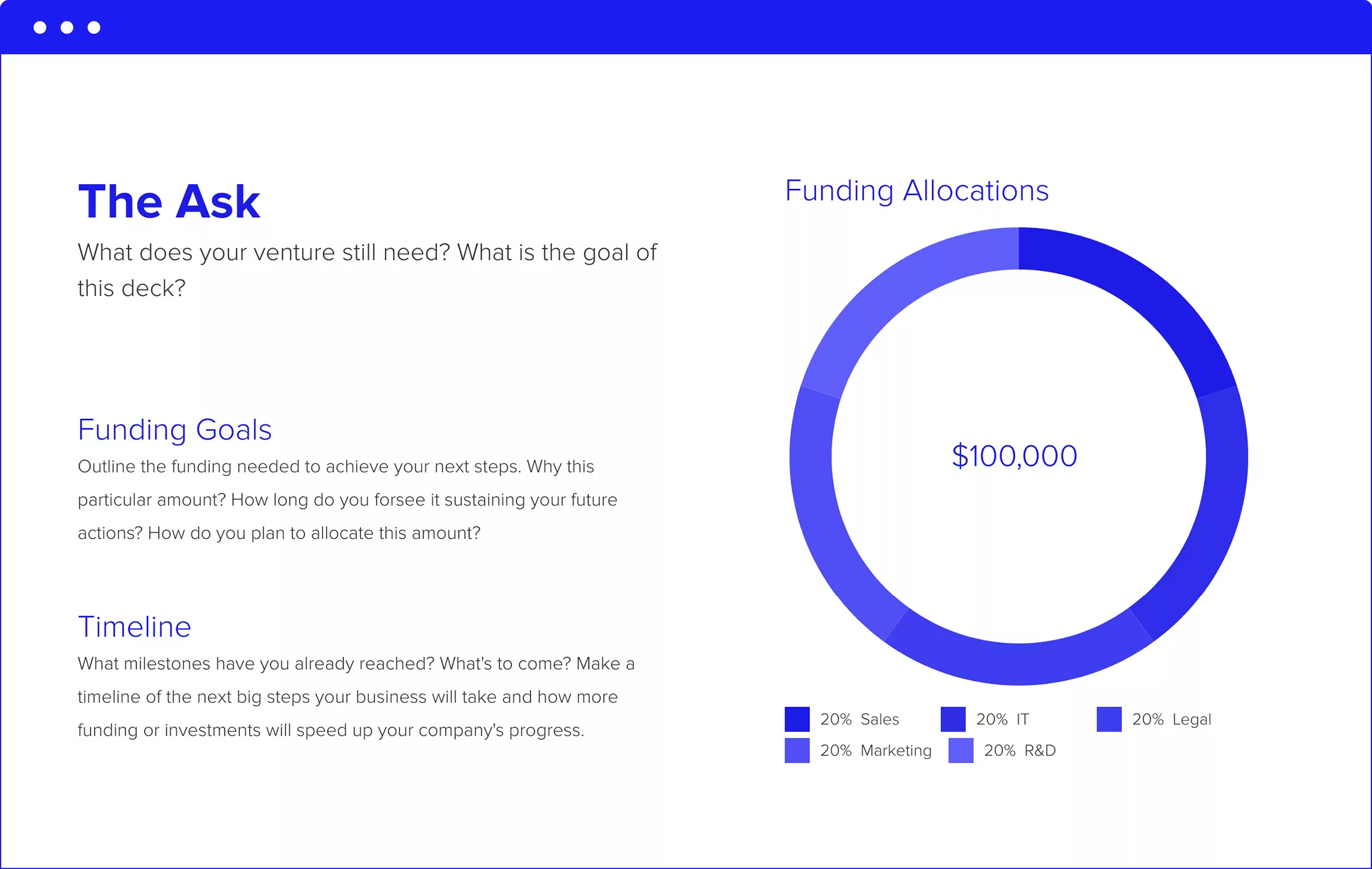
Ignoring the ask slide. Many founders treat the fundraising ask as an afterthought — “We’re raising $2M” with no further detail. Investors want to know: How much are you raising? What’s the intended use of funds (hiring, product development, marketing, infrastructure)? What milestones will this funding help you achieve? What’s the timeline? Be specific. “We’re raising $2M to hire 3 engineers and launch in 2 new markets by Q3” is infinitely stronger than “We’re raising $2M for growth.”
Claiming “no competition.” Saying “we have no competitors” doesn’t impress investors — it worries them. Either the market doesn’t exist, or you haven’t done your research. Every product competes with something, even if it’s the status quo (spreadsheets, manual processes, doing nothing). Show that you understand the competitive landscape and can articulate why your approach is different. Use your competitive analysis to build this slide with specificity.
Making financial projections without grounding them. A hockey-stick revenue chart with no explanation of how you’ll get there is a red flag. Every financial projection needs to be built bottom-up from your unit economics: customer acquisition cost, lifetime value, conversion rates, and growth assumptions. Show the math, even briefly. Investors can do arithmetic — if your numbers don’t add up, they’ll notice.
How to practice and deliver your pitch
A great deck with a poor delivery loses. The pitch deck is a visual aid — you are the pitch. Preparation separates founders who get funded from founders who get polite rejections.
The 10-20-30 rule
Guy Kawasaki’s framework remains practical: 10 slides, 20 minutes, 30-point minimum font size. Even if your deck has more slides, your verbal pitch should fit within 20 minutes — leave the rest of the meeting for Q&A. This constraint forces clarity. If you can’t explain your business in 20 minutes, you don’t understand it well enough. Practice until you can deliver each slide’s key point in under 2 minutes.
Rehearse for questions, not just delivery
Most founders practice their presentation flow but not their Q&A. Investors will interrupt. They’ll ask about your unit economics during your problem slide. They’ll challenge your market size assumptions. Prepare for the 10 hardest questions you could receive: What if a competitor copies this feature? Why hasn’t this been solved before? What happens if your CAC doubles? How do you defend this market position? Practice answering these questions concisely — under 60 seconds each — without losing your composure or your narrative thread.
Tailor the energy to the format
An in-person pitch to a room of 10 VCs requires different energy than a Zoom call with a single angel investor. In-person: make eye contact, use your hands, move naturally, and project confidence. On video: look at the camera (not the screen), eliminate background distractions, and increase vocal variety to compensate for reduced body language. For a pitch deck sent cold via email (no live presentation), your slides need to be more self-explanatory — add brief notes or captions that provide the context your voice would normally supply.
Adapting your deck for different audiences
Not every pitch deck should be the same. Different investors have different priorities, and your deck should flex to meet them. This doesn’t mean creating entirely separate decks — it means having a modular structure where you can emphasize different sections depending on who you’re presenting to.
Venture capital firms
VCs are looking for scale. They want to see a large addressable market (TAM over $1B), a clear path to market dominance, and unit economics that improve with scale. Emphasize your market size slide, your competitive moat, and your growth trajectory. VCs invest in categories, not just companies — show them that the category is massive and that you’re positioned to own a meaningful piece of it.
Angel investors
Angels invest more on conviction and personal connection. They care deeply about the founding team, the problem’s personal relevance, and early traction. Spend more time on your problem narrative (make it personal and vivid), your team’s unique qualifications, and your early customer stories. Angels are more tolerant of early-stage uncertainty but less tolerant of founders who seem disconnected from the problem they’re solving.
Corporate investors and strategic partners
Strategic investors evaluate your product through the lens of their existing business. How does your solution integrate with their ecosystem? What synergies exist? Emphasize your technology, your integration capabilities, and the specific use cases that align with their business. De-emphasize generic market sizing and focus on the slice of the market that overlaps with their strategic interests.
Keeping your pitch materials aligned
Your pitch deck doesn’t exist in isolation. It’s one piece of a broader set of investor-facing materials that includes your one-pager, investor update, executive summary, and financial model. When these documents tell inconsistent stories — different revenue numbers, contradictory positioning, misaligned timelines — investors lose trust. The pitch deck says you’re targeting enterprise; the one-pager says SMBs. The deck projects $5M ARR by Q4; the financial model shows $3M. These contradictions are deal-killers.
The solution is maintaining all your pitch materials in a single workspace where updates to core numbers, positioning, and milestones propagate across every document. When your MRR crosses a new threshold, you update it once — and your pitch deck, startup one-pager, and investor update all reflect the same current reality.
In Xtensio, your pitch deck lives alongside your competitive analysis, business model canvas, and user personas in the same workspace. When you update your competitive positioning, the same language flows into your pitch deck and your one-pager. Learn more about how to keep your investor materials aligned using a connected workflow that eliminates version chaos.
Pitch deck design principles that win investors
Investors see hundreds of pitch decks every year. The ones that stand out share specific design principles that make information easy to absorb and remember. These aren’t about making things “look pretty” — they’re about reducing cognitive load so investors focus on your idea, not on deciphering your slides.
One idea per slide
The most common design mistake is cramming multiple concepts onto a single slide. Each slide should communicate exactly one key point. If you find yourself using the phrase “and also” when describing what a slide covers, split it into two slides. Investors process information sequentially — when you stack ideas, they retain none of them. A 12-slide deck with one clear idea per slide outperforms an 8-slide deck with dense, multi-layered slides every time.
Visual hierarchy and whitespace
Every slide needs a clear visual hierarchy: a headline that states the key takeaway, supporting data or visuals in the middle, and minimal text at the bottom if needed. Use whitespace deliberately — it’s not wasted space, it’s breathing room that directs attention. Crowded slides signal a founder who can’t prioritize. Aim for no more than 30 words per slide (excluding charts and labels). If you need more words, you need fewer ideas on that slide.
Consistent branding throughout
Your pitch deck is a brand artifact. Use your company’s color palette, typography, and logo consistently across every slide. This signals professionalism and attention to detail — two qualities investors look for in founding teams. Avoid using more than three colors (your primary brand color, a secondary accent, and a neutral). If your deck looks like it was assembled from different templates, investors will wonder how organized your company actually is.
Data visualization over data tables
When presenting metrics, traction, or market size, always use charts and graphs instead of raw numbers in tables. A simple bar chart showing month-over-month growth is processed in seconds; the same data in a table takes minutes. Choose the right chart type: line charts for trends over time, bar charts for comparisons, pie charts only when showing parts of a whole (and never more than 5 slices). Label your axes clearly and highlight the data point you want investors to remember.
Common pitch deck mistakes to avoid
Even experienced founders make structural mistakes that undermine otherwise strong pitch decks. These errors don’t just weaken individual slides — they erode investor confidence in your ability to think clearly about your business.
Leading with the solution instead of the problem. If investors don’t feel the pain of the problem first, your solution has no context. The problem slide creates emotional investment — skip it or rush through it, and your solution slide falls flat. Spend at least 20% of your presentation time on the problem. Make investors nod before you show them the answer.
Using vanity metrics. Page views, downloads, and registered users sound impressive but tell investors nothing about business viability. What matters is engagement depth: daily active users, retention rates, revenue per user, and conversion rates. A startup with 500 paying customers who renew monthly is more investable than one with 50,000 free signups who never return. Every metric on your deck should answer: “Does this prove people will pay for this?”
Ignoring the ask slide. Many founders treat the fundraising ask as an afterthought — “We’re raising $2M” with no further detail. Investors want to know: How much are you raising? What’s the intended use of funds (hiring, product development, marketing, infrastructure)? What milestones will this funding help you achieve? What’s the timeline? Be specific. “We’re raising $2M to hire 3 engineers and launch in 2 new markets by Q3” is infinitely stronger than “We’re raising $2M for growth.”
Claiming “no competition.” Saying “we have no competitors” doesn’t impress investors — it worries them. Either the market doesn’t exist, or you haven’t done your research. Every product competes with something, even if it’s the status quo (spreadsheets, manual processes, doing nothing). Show that you understand the competitive landscape and can articulate why your approach is different. Use your competitive analysis to build this slide with specificity.
Making financial projections without grounding them. A hockey-stick revenue chart with no explanation of how you’ll get there is a red flag. Every financial projection needs to be built bottom-up from your unit economics: customer acquisition cost, lifetime value, conversion rates, and growth assumptions. Show the math, even briefly. Investors can do arithmetic — if your numbers don’t add up, they’ll notice.
How to practice and deliver your pitch
A great deck with a poor delivery loses. The pitch deck is a visual aid — you are the pitch. Preparation separates founders who get funded from founders who get polite rejections.
The 10-20-30 rule
Guy Kawasaki’s framework remains practical: 10 slides, 20 minutes, 30-point minimum font size. Even if your deck has more slides, your verbal pitch should fit within 20 minutes — leave the rest of the meeting for Q&A. This constraint forces clarity. If you can’t explain your business in 20 minutes, you don’t understand it well enough. Practice until you can deliver each slide’s key point in under 2 minutes.
Rehearse for questions, not just delivery
Most founders practice their presentation flow but not their Q&A. Investors will interrupt. They’ll ask about your unit economics during your problem slide. They’ll challenge your market size assumptions. Prepare for the 10 hardest questions you could receive: What if a competitor copies this feature? Why hasn’t this been solved before? What happens if your CAC doubles? How do you defend this market position? Practice answering these questions concisely — under 60 seconds each — without losing your composure or your narrative thread.
Tailor the energy to the format
An in-person pitch to a room of 10 VCs requires different energy than a Zoom call with a single angel investor. In-person: make eye contact, use your hands, move naturally, and project confidence. On video: look at the camera (not the screen), eliminate background distractions, and increase vocal variety to compensate for reduced body language. For a pitch deck sent cold via email (no live presentation), your slides need to be more self-explanatory — add brief notes or captions that provide the context your voice would normally supply.
Adapting your deck for different audiences
Not every pitch deck should be the same. Different investors have different priorities, and your deck should flex to meet them. This doesn’t mean creating entirely separate decks — it means having a modular structure where you can emphasize different sections depending on who you’re presenting to.
Venture capital firms
VCs are looking for scale. They want to see a large addressable market (TAM over $1B), a clear path to market dominance, and unit economics that improve with scale. Emphasize your market size slide, your competitive moat, and your growth trajectory. VCs invest in categories, not just companies — show them that the category is massive and that you’re positioned to own a meaningful piece of it.
Angel investors
Angels invest more on conviction and personal connection. They care deeply about the founding team, the problem’s personal relevance, and early traction. Spend more time on your problem narrative (make it personal and vivid), your team’s unique qualifications, and your early customer stories. Angels are more tolerant of early-stage uncertainty but less tolerant of founders who seem disconnected from the problem they’re solving.
Corporate investors and strategic partners
Strategic investors evaluate your product through the lens of their existing business. How does your solution integrate with their ecosystem? What synergies exist? Emphasize your technology, your integration capabilities, and the specific use cases that align with their business. De-emphasize generic market sizing and focus on the slice of the market that overlaps with their strategic interests.
Keeping your pitch materials aligned
Your pitch deck doesn’t exist in isolation. It’s one piece of a broader set of investor-facing materials that includes your one-pager, investor update, executive summary, and financial model. When these documents tell inconsistent stories — different revenue numbers, contradictory positioning, misaligned timelines — investors lose trust. The pitch deck says you’re targeting enterprise; the one-pager says SMBs. The deck projects $5M ARR by Q4; the financial model shows $3M. These contradictions are deal-killers.
The solution is maintaining all your pitch materials in a single workspace where updates to core numbers, positioning, and milestones propagate across every document. When your MRR crosses a new threshold, you update it once — and your pitch deck, startup one-pager, and investor update all reflect the same current reality.
In Xtensio, your pitch deck lives alongside your competitive analysis, business model canvas, and user personas in the same workspace. When you update your competitive positioning, the same language flows into your pitch deck and your one-pager. Learn more about how to keep your investor materials aligned using a connected workflow that eliminates version chaos.
Regularly update your Pitch Deck
The core elements of your company might stay the same, but time passes and you will probably need to update your values, dates, and even images as your company evolves. The pitch deck template is adaptable just like other Xtensio tools, it can and should be repurposed, revisited, and revised to suit your evolving needs. You can always add, delete, and move your modules and sections around with Xtensio’s versatile editor to adapt the pitch deck as you need it.
Written by

Variations on the Pitch Deck with editable templates

Most pitch decks are built in PowerPoint or Google Slides, but these tools produce static files that go stale the moment you email them. A deliverables workspace lets you share your pitch deck as a live link with engagement analytics, so you know exactly when an investor opens it.

Create and deliver beautiful work, professionally.
Build, brand, and deliver living documents your clients actually engage with.







Join 409,446 professionals delivering work with Xtensio.