Brand Positioning Canvas Template
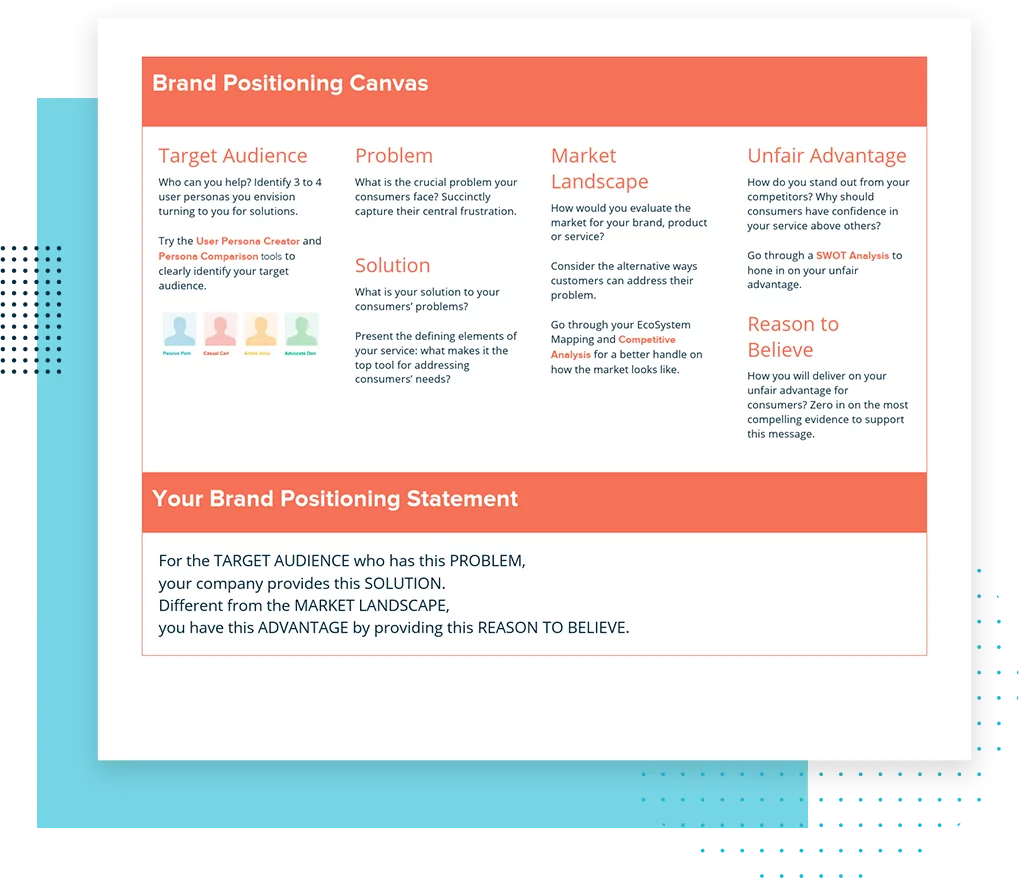
The brand positioning canvas template helps you underscore your unique value by forming a single statement about your product or service. Guiding you through defining your brand positioning statement, brand essence, and brand personality, the positioning canvas helps establish and communicate your company value.
- Create a visually-rich positioning canvas to outline your value proposition and define your brand positioning statement.
- Connect your company’s core values across key brand messaging.
- Share the canvas internally so all team members are using the same information to describe, promote and measure your brand.
Xtensio is your team’s deliverables workspace.
Create, collaborate, and deliver client-ready docs—then keep them current.
Join 409,533 using Xtensio.
Xtensio is the workspace for professional deliverables.
Make one deliverable today—then build a repeatable system for every client and project.
This is where teams create, collaborate, organize, and deliver the documents that run their work.
Everything stays on-brand, current, and ready to share.

Organize every deliverable
Keep strategy, sales, marketing, and client docs together by workspace.
Create fast, stay consistent
Start from 200+ templates or AI drafts, then apply your brand kit.
Collaborate in the doc
No more “final_v7.pdf” loop.
Standardize across deliverables
Apply your brand kit + reusable modules so every deliverable matches.
Improve what you send
See engagement, iterate, and reuse what works across projects.
Brand canvas example templates
How to create a brand positioning with Xtensio
- Create a free account and start editing, no credit card required.
Follow along with the instructional brand positioning details. Add charts, graphs, images, and videos to customize the canvas template and make it your own. Drag & drop. Resize. It’s the easiest editor ever.
- Customize everything in the brand positioning canvas template to match your brand.
Define your style guide. Add your (or your client’s) brand fonts and colors. You can even pull colors directly from a website to easily brand your canvas and more.
- Work on your brand canvas together on the cloud.
Add colleagues (or clients) to collaborate on the client canvas template. Changes automatically save and sync across all devices, in real-time.
- Share a link. Present a slideshow. Embed. Download a PDF/PNG.
The canvas template seamlessly adapts to your workflow. No more jumping from tool to tool to design different types of deliverables.
- Reuse and repurpose.
Save your own custom brand positioning canvas template. Or copy and merge into other documents.

What is a brand canvas?
The brand canvas template helps you underscore your unique value by forming a single statement about your product or service. The brand positioning is the gospel for larger organizations; for startups, it provides focus despite growing pains and critical pivots. When faced with the dilemma of whether or not a potential decision is “on brand,” the brand positioning statement becomes a valuable resource.
How do you create a brand positioning canvas?
Establishing your brand’s position in the marketplace is not an overnight exercise. Whether you are a startup in the early stages of developing a product or a long-established company seeking to reinvent itself and stay relevant, positioning and repositioning your brand is meant to be a process. However, the ultimate result must be a crystal clear brand positioning statement that informs both internal decision-making and external communications, as well as how the two feed off of each other.
- Define your target audience.
- Succinctly capture the problem you’re trying to solve.
- Outline your solution.
- Analyze your market landscape.
- Explain why your product has an unfair advantage and give customers a “reason to believe”.
Then organize the insights you’ve gleaned from going through this process.
Here’s a suggested formula for creating your brand positioning statement:
For the TARGET AUDIENCE who has this PROBLEM, your company provides this SOLUTION. Different from the MARKET LANDSCAPE, you have this ADVANTAGE by providing this REASON TO BELIEVE.
To dive deeper into developing this brand positioning statement follow our how to guide. This exercise will inform your marketing strategy as well as help establish your brand guidelines.
Brand Positioning Canvas vs Positioning Statement vs Brand Strategy
These three tools serve different purposes in the branding process, yet teams frequently confuse them. A brand positioning canvas is a visual framework that maps your competitive landscape, target audience, and value proposition on a single page. It is designed for team alignment and workshop-style collaboration. A positioning statement is the one-sentence output that distills the canvas into a format your marketing team can execute against. A brand strategy is the comprehensive plan that encompasses identity, voice, activation channels, and measurement.
Think of it as a hierarchy: the canvas generates insights, the statement crystallizes them, and the strategy operationalizes them. Most teams skip the canvas and jump straight to writing a positioning statement, which is why so many statements feel generic. The canvas forces you to examine competitive alternatives, customer pain points, and your genuine differentiators before committing to a single sentence. When you build your canvas as a live link in Xtensio, stakeholders can challenge assumptions in real time rather than debating a finished statement after the fact.
5 Brand Positioning Mistakes That Confuse Your Market
Even experienced marketing teams make positioning errors that dilute their brand’s impact. Recognizing these patterns early saves months of wasted effort and budget.
1. Positioning too broadly. Claiming you serve “everyone” means you resonate with no one. The most effective positioning narrows your audience until your message feels personally relevant. If your positioning canvas target audience section says “businesses of all sizes,” revisit it.
2. Copying competitor positioning. When every company in your category uses the same language, customers cannot distinguish between options. Your canvas should highlight where competitors cluster and where open space exists for your brand to own a distinct position.
3. Leading with features instead of benefits. Features describe what your product does. Benefits describe what customers achieve. Your positioning statement should answer “so what?” for the customer, not list technical capabilities.
4. Inconsistent messaging across touchpoints. Your website says one thing, your sales deck says another, and your social media says something else entirely. The canvas should be a living document that your entire team references. Share it as a live link through your workspace so everyone works from the same source of truth.
5. Never updating as the market shifts. Positioning is not a one-time exercise. Competitors enter your space, customer needs evolve, and your product capabilities grow. Review your positioning canvas quarterly and update it as conditions change.
How to Test Your Brand Positioning
A positioning canvas is only as strong as its validation. Before committing resources to a new brand direction, test your positioning with real data from four sources.
Customer interviews. Ask 10 to 15 existing customers to describe what you do and why they chose you over alternatives. Compare their language to your positioning statement. If there is a gap between how you describe yourself and how customers describe you, your positioning needs adjustment.
A/B message testing. Run your positioning statement against two or three variations in email subject lines, ad copy, or landing page headlines. Let click-through and conversion rates tell you which framing resonates. Small tests before a full rebrand prevent expensive mistakes.
Competitive perception surveys. Ask prospects to rank your brand against competitors on specific attributes (reliability, innovation, value, expertise). This reveals whether your intended positioning matches market perception. If prospects rank you highly on attributes you do not emphasize, consider repositioning to match reality.
Win/loss analysis. Interview recent prospects who chose you and those who chose a competitor. Patterns in their reasoning reveal which parts of your positioning are working and which fall flat. Document these insights directly in your positioning canvas and share the updated version with your team via the brand positioning how-to guide.
Related to the Brand Positioning Canvas Template
Fully customizable templates that you can make your own.


Teams use Xtensio to create, share, and improve professional deliverables.
Trusted by 409,533 teams, founders, and consultants.



Jerome Katz
Professor of Entrepreneurship @

Jake Peters
CEO @

Robin Bramman
Founder and Chief Brand Mixologist @

Olakunle Oladehin
Executive Director @
Everybody Dance Now!

Aaron Friedland
Executive Director @
The Walking School Bus

Robin Eyre
Owner @

Adam Sher
CEO @

Stephen Paterson
Chief Product Officer @

Create and deliver beautiful work, professionally.
Build, brand, and deliver living documents your clients actually engage with.






Join 409,533 professionals delivering work with Xtensio.