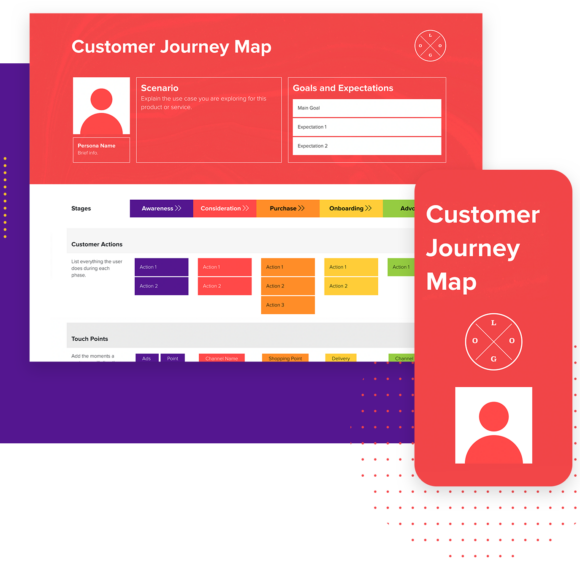
Customer Journey Map Template
Explore how your customers interact with your product, services, or organization with this free Customer Journey Map Template.
- Understand your target customers’ behavior to inform your business, marketing, and product strategy.
- Reveal pain points to optimize the user experience and increase customer engagement.
- Identify new channel opportunities to grow your audience.
Beautiful living documents, built like web pages.
Join the 410,837 professionals using Xtensio.
Xtensio is the workspace for professional deliverables.
Make one deliverable today—then build a repeatable system for every client and project.
This is where teams create, collaborate, organize, and deliver the documents that run their work.
Everything stays on-brand, current, and ready to share.

Organize every deliverable
Keep strategy, sales, marketing, and client docs together by workspace.
Create fast, stay consistent
Start from 200+ templates or AI drafts, then apply your brand kit.
Collaborate in the doc
No more “final_v7.pdf” loop.
Standardize across deliverables
Apply your brand kit + reusable modules so every deliverable matches.
Improve what you send
See engagement, iterate, and reuse what works across projects.
10 reasons to use Xtensio for Customer Journey Mapping.
- Guidance Minimal instructions based on industry standards to help you fill each section.
- Applicable Personas, User Interviews, Ecosystem Maps, and Competitive Analysis documents go hand in hand with Customer Journey Maps. Keep everything under one roof using Xtensio’s popular templates.
- Easy editing Click to start editing. No need to download software. No excessive bells and whistles.
- Live like a website Always up to date.
- Designer quality Present a sleek, online document to stakeholders.
- Flexible layout Drag, drop, resize. Start with one of the Customer Journey Map templates or a blank page.
- Share privately Password protect your folio. Publish publicly with a customized URL.
- On brand Set your preferred colors and fonts in the Team Style Guide.
- Set your own templates For frequently used documents.
- Work together Add collaborators.
Benefits of Customer Journey Mapping:
- Uncovering Insights: Dive deep into the customer psyche, understand their needs, desires, and pain points.
- Driving Business Goals: Align your business strategies with customer expectations, ensuring mutual growth.
- Enhancing Engagement: Foster a deeper connection with your customers by addressing their needs proactively.
- Understanding Evolving Behavior: Stay ahead of the curve by adapting to the ever-changing buyer behavior.
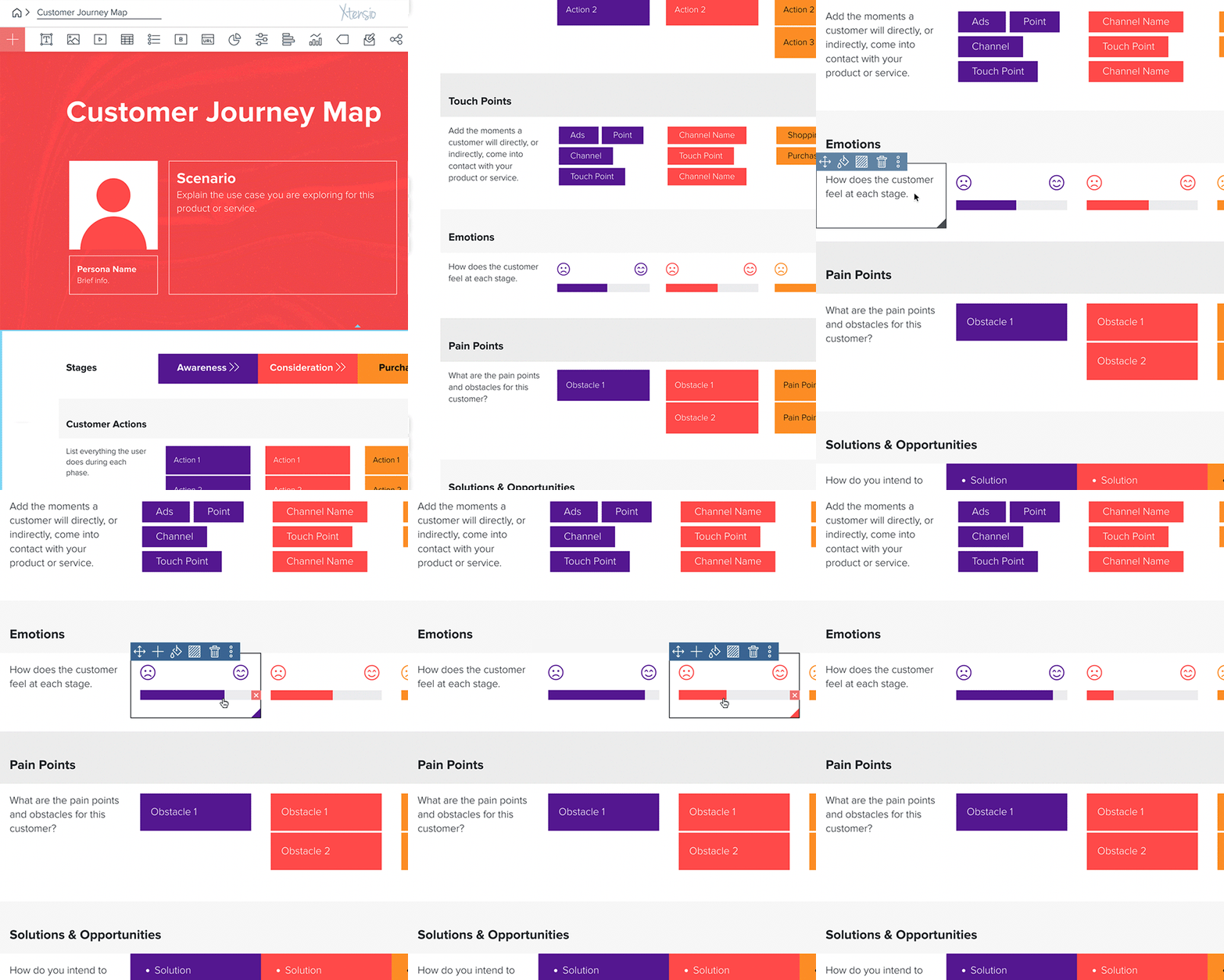
Key Elements of a Customer Journey Map:
- Buyer Persona:
Every customer is unique. By creating detailed buyer personas, businesses can tailor their strategies to cater to specific needs, ensuring a personalized experience.
User Persona Template - Marketing Funnel:
From the first point of contact to the final purchase, understanding the stages of the marketing funnel allows businesses to guide customers seamlessly. - The Buyer’s Journey:
This customer-focused narrative sheds light on the various stages a buyer goes through, ensuring businesses are always one step ahead.
Steps to Create a Comprehensive Customer Journey Map:
- Establish Your Customer Scenario:
Start with a clear picture. Define who your customer is and what scenario they find themselves in. - Define the Steps:
Break down the journey. Understand every step your customer takes, ensuring no stone is left unturned. - List Interactions:
From social media touchpoints to in-store interactions, list out every possible point of contact. - Determine Customer Goals:
Delve deep into what drives your customers. Understand their motivations, desires, and end goals. - Highlight Positive Moments:
Celebrate the wins. Recognize moments that customers love and replicate them across the journey. - Identify Negative Moments:
Every pain point is an opportunity in disguise. Address these challenges head-on to enhance the overall experience.
Why Xtensio’s Customer Journey Map Template Stands Out:
Xtensio is not just another tool; it’s a solution tailored for modern businesses. With its user-friendly interface, businesses can easily customize their journey maps, ensuring a perfect fit. Moreover, Xtensio offers comprehensive insights, helping businesses enhance their customer experience, making it a preferred choice over alternatives.
Why do you need a Customer Journey Map?
Constructing a real-life customer story helps team members develop empathy for customers, and serve them better while helping the business KPIs.
Customer journey maps are usually associated with user experience design, product management, or customer support teams. Their purpose is to identify how a product or service meets customers’ expectations. Reveal what’s working and what should be improved.
More and more branding and marketing teams are using some variation of the customer journey map to inform their strategic decisions. Untapped opportunities to reach and grow audiences may arise from a diligent analysis of a customer’s journey.
There are many ways a customer, user, or simply a human’s experience can be visualized with a journey map depending on the purpose of its use. We created variations on the Customer Journey Mapping exercise. These cover the most common use cases.
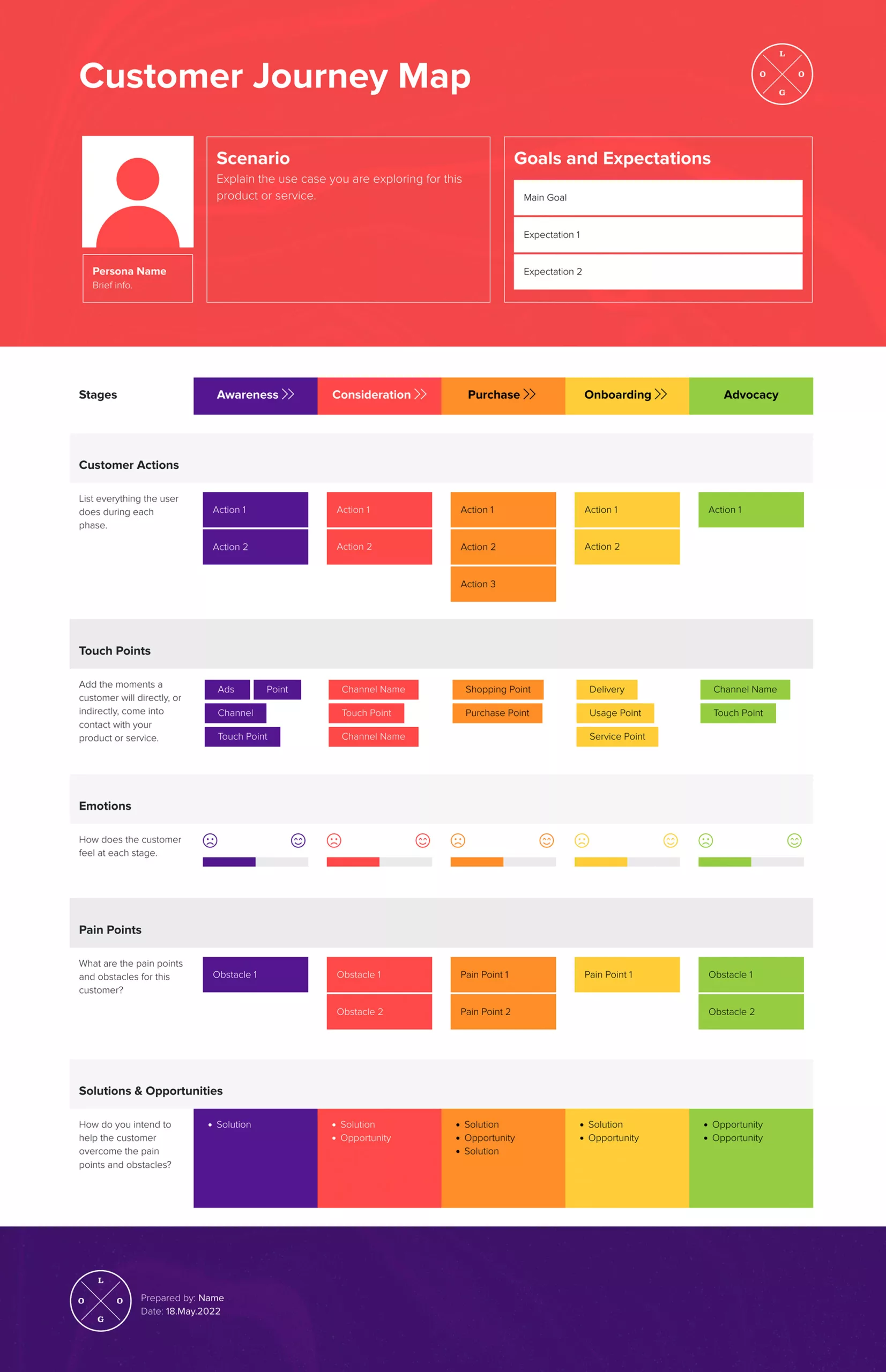
The 7 Parts of a Customer Journey Map
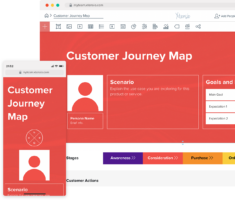
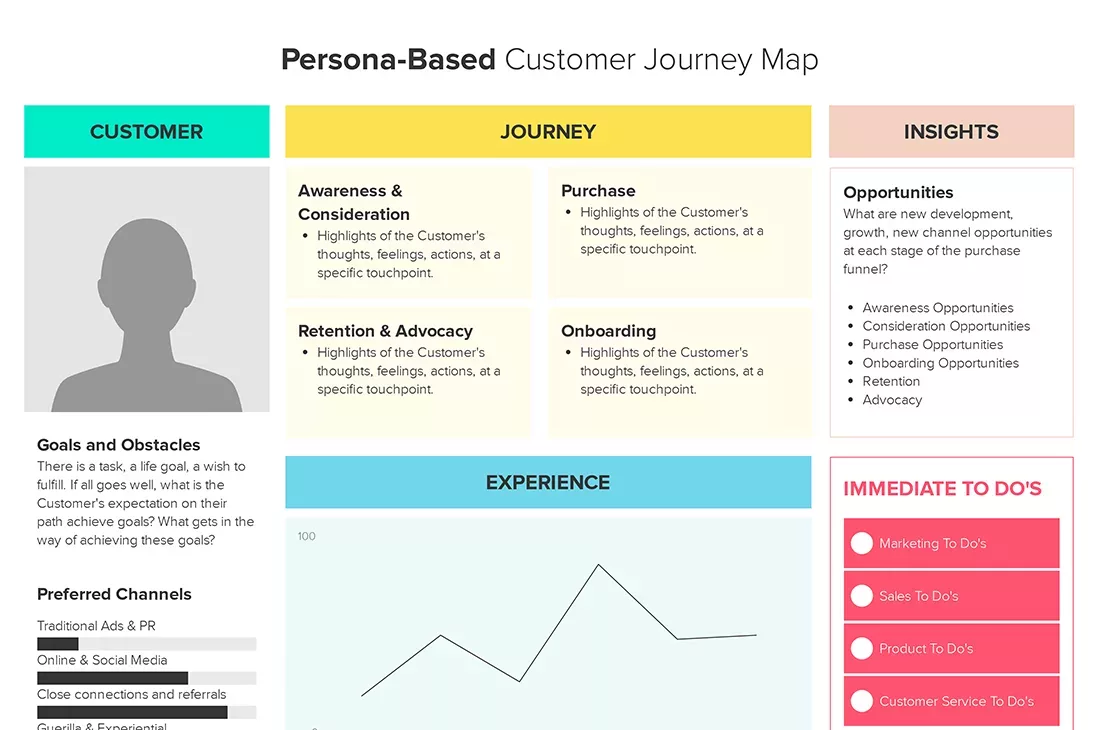
Xtensio’s fully customizable template includes 7 must-have sections that go into a comprehensive Customer Journey Map.
- Intro: Persona + Scenario + Goals
This intro to the Customer Journey Map includes a specific persona, an archetype of a customer likely to use your product. A brief scenario in which this persona is going about their lives, or business as they come in contact with your brand. Learn how to create a user persona in detail here.
If you haven’t already identified personas for your organization, start working on them with Xtensio’s popular User Persona Template.
- Stages
Most typically, a customer’s experience starts with the awareness of your brand and develops towards consideration. A most critical stage is when a customer makes a purchase, subscribes, or signs up for your services. But the ideal journey does not end at sales. Onboarding or the early moments of a product’s usage is essential to match customers’ expectations with their actual experience if not exceed them. If satisfied, a customer’s journey will mature towards loyalty & advocacy.
Xtensio’s main Customer Journey Map template follows this desired timeline of a user’s journey. You may modify this timeline or make them more precise for your scenario.
- Actions
The steps that the customer or user takes as they come in contact with your product. These are the sequence of events in which the customer takes action towards completing a task or achieving a goal.
- Touch Points / Channels
These are points in the physical or digital space where a customer comes in touch with your brand. These can be the actual points of interaction with a product, such as using a tool, clicking a button on a mobile app, or encounters on a marketing channel such as social media posts, TV ads, or promotion emails. These are places where a user quickly develops an opinion about a product and have an emotional response to it.
- Emotions
A wide range of emotions can be analyzed on a customer’s journey. For our multi-purpose customer journey mapping, we show a slider between general positive emotions and negative emotions. Happy, Satisfied, Excited vs. Frustrated, Disappointed, Anxious. You may edit the template to make them more specific.
- Pain Points
The areas where a user or customer is taking too long to proceed to the next action, or dropping off of the journey. Obstacles that get in the way of your persona’s goals and bring their mood down. These can be technical problems with a product experience, or clarity issues with the language used to explain product steps.
- Solutions and Opportunities
Ideas will arise from reviewing all of the above to tackle the pain points, create an experience that exceeds customers’ expectations, and discover opportunities to rise above competing brands. This area can also pinpoint which team members will be responsible for making customer experience improvements.
There can be variations in these sections depending on the purpose of your map. Other sections related to KPIs or teams can be added to this template as well. To get started with the most essential steps, try Xtensio’s template which applies the best practices out there.
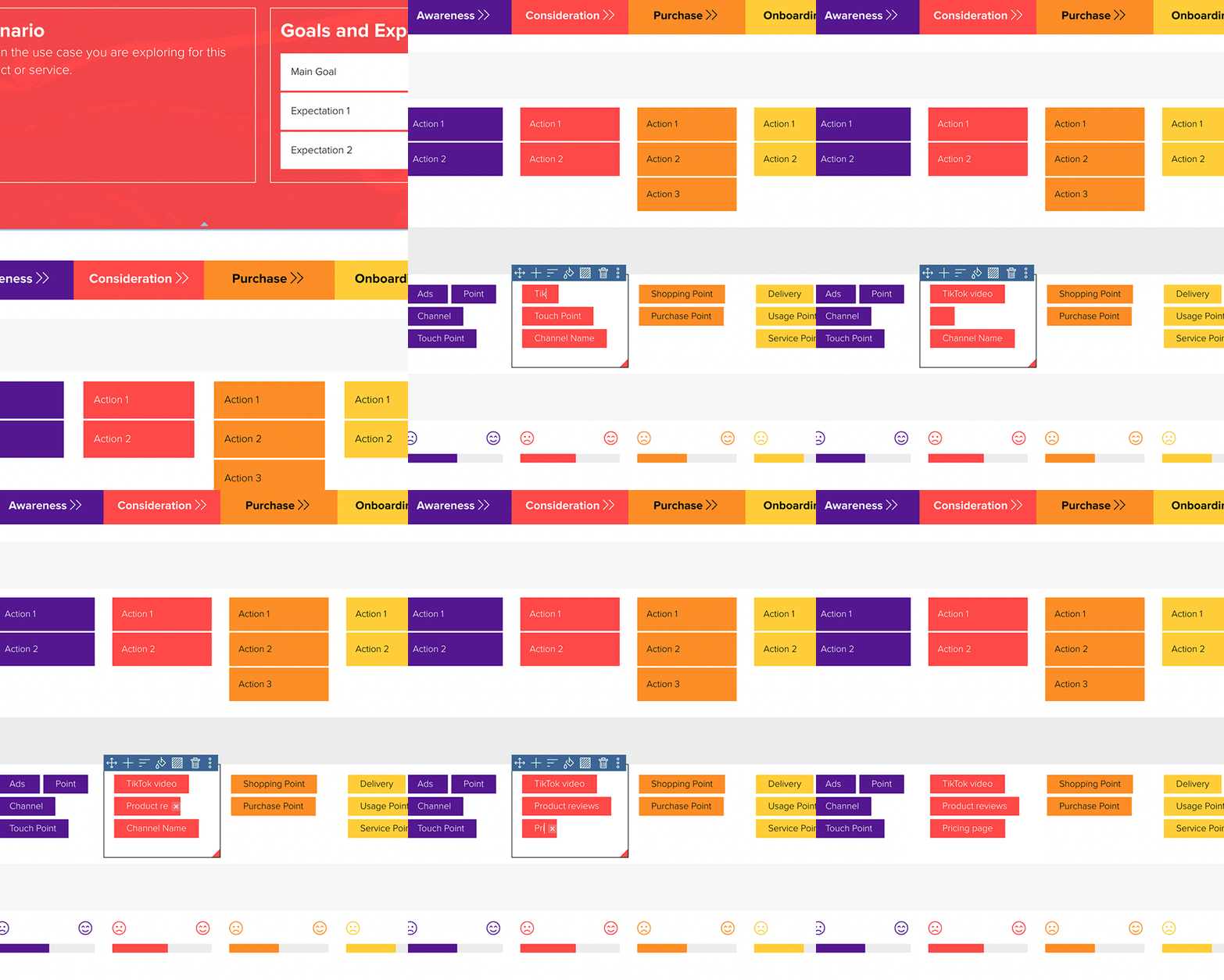
Related to the Customer Journey Map Template
Fully customizable templates that you can make your own.
Customer journey map examples by industry
A customer journey map looks different depending on your business model. Here are the key patterns:
SaaS customer journey
The SaaS journey focuses on: awareness (content, ads, referrals) to consideration (free trial, demo, comparison) to decision (pricing, onboarding) to retention (product usage, support, expansion) to advocacy (referrals, reviews). Key touchpoints include the signup flow, onboarding emails, first-value moment, and renewal decision.
E-commerce customer journey
E-commerce journeys center on: discovery (search, social, ads) to browsing (product pages, reviews) to purchase (cart, checkout) to delivery (tracking, unboxing) to post-purchase (support, returns, repeat buying). Map the emotional highs and lows to find improvement opportunities.
B2B services customer journey
B2B journeys are longer and involve multiple stakeholders: need recognition to research to vendor evaluation to proposal to engagement to ongoing relationship. The journey often loops as successful projects lead to the next engagement.
Types of customer journey maps
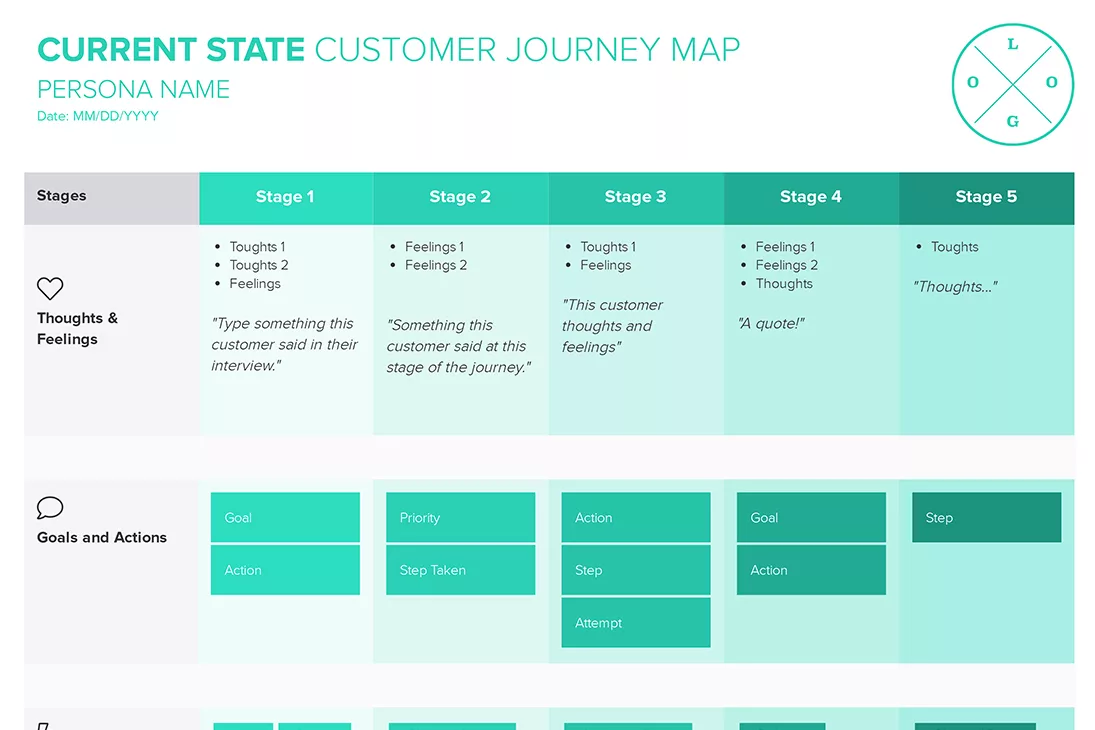
- Current state map — Documents how customers experience your product today. Best for identifying pain points and quick wins.
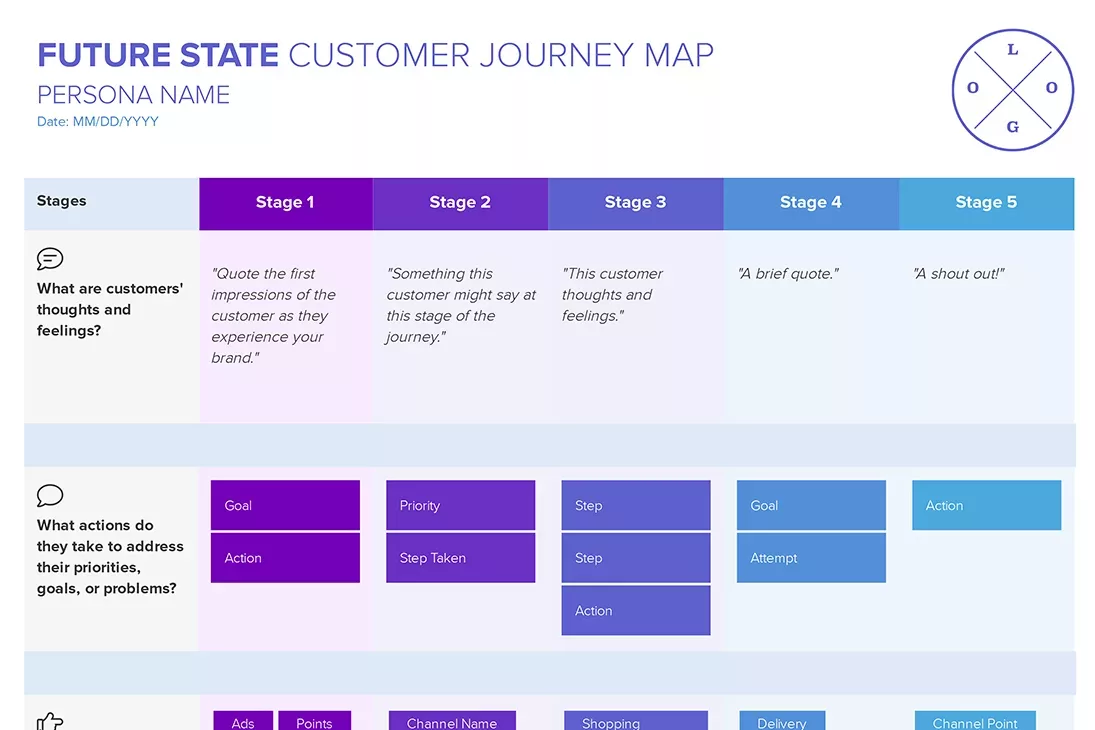
- Future state map — Envisions the ideal experience. Best for aligning teams before redesigning touchpoints.
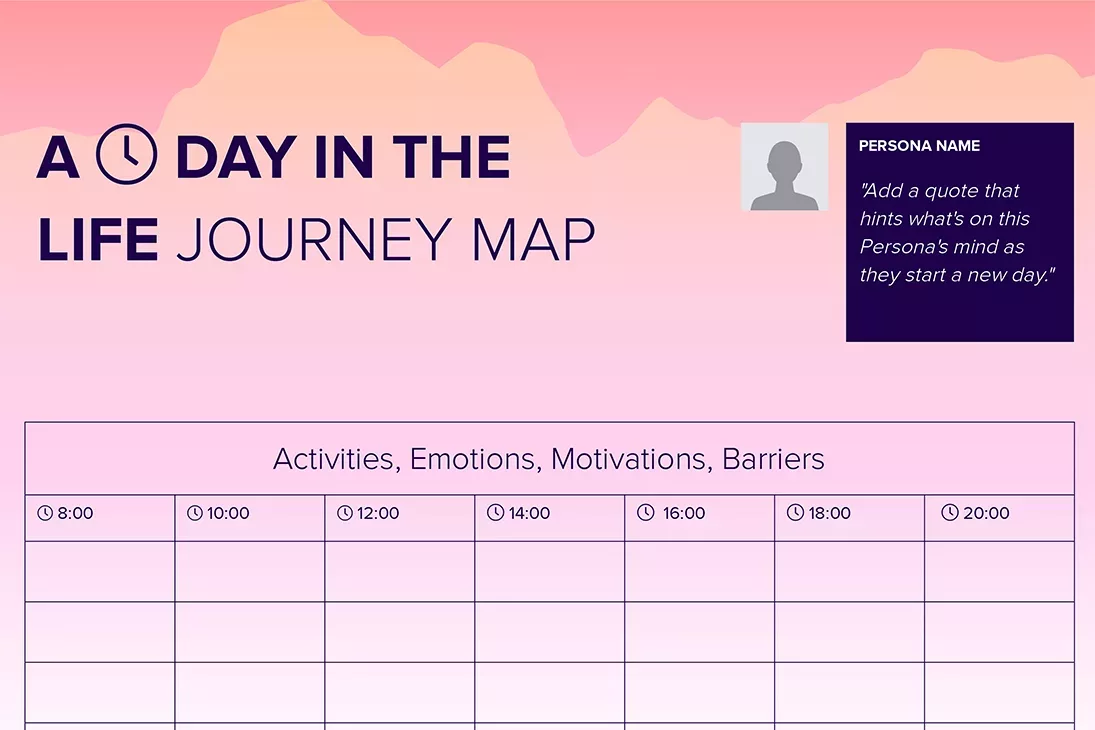
- Day-in-the-life map — Captures the full daily routine, not just brand interactions. Best for understanding context and unmet needs.
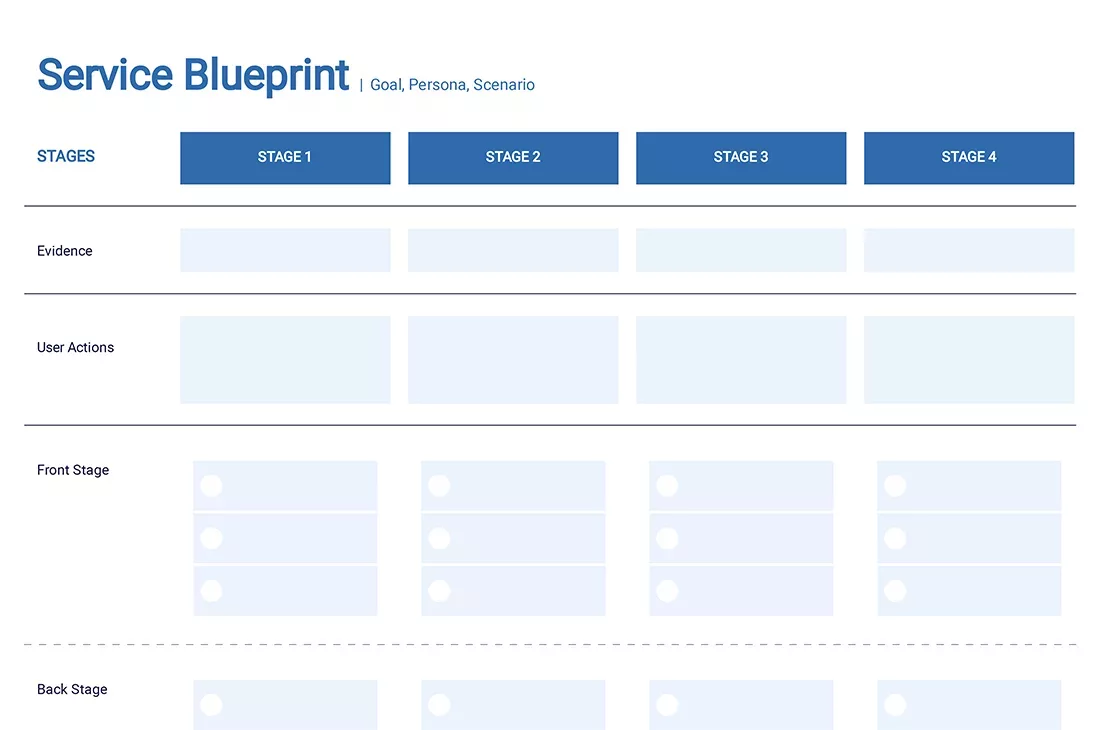
- Service blueprint — Adds backstage processes supporting each touchpoint. Best for operational improvement.
- Persona-based map — Separate journey for each persona. Best when segments have meaningfully different experiences.
Why your journey map should be a living deliverable
Customer journeys evolve as your product changes and expectations grow. A journey map in a static slide deck becomes obsolete the moment customer behavior shifts. The most useful journey maps are living documents your team updates continuously.
With Xtensio, your customer journey map lives in a shared workspace where you can:
- Update touchpoints as they change — add new channels, note shifting pain points
- Collaborate across teams — UX, marketing, product, and CS all contribute to the same source of truth
- Create persona-specific versions — duplicate the template for each persona without starting from scratch
- Share as a branded live link — stakeholders always see the latest version
- Keep it alongside related deliverables — personas, messaging docs, campaign briefs all in one project workspace

Jeff Schenck
Marketing Manager @

David Nason
CEO/Founder @

Grace Ghunaim
Global Chief Strategy Officer (CSO) @

Ben Cary
Founder @

Leon Coe
Instructor @
Texas A&M University

Jennifer Alt
UI/UX Designer @

Zac Heisey
Director of Digital Marketing @

Jenny Johansson
UX Manager @

Ryan Dobson
Global Engineering Manager @
How Product, Marketing, and Service Teams Use Journey Maps Differently
A customer journey map is not a single-department tool. The same map surfaces different insights for different teams — and the most impactful journey mapping work happens when multiple functions contribute to building and interpreting it together.
Product Teams
Product teams use journey maps to identify the gap between what users experience and what the product is designed to deliver. The most valuable moments on the map for product work are the pain points — the stages where customer satisfaction drops, where users abandon the flow, or where they need to leave the product to accomplish something the product should handle. These moments become the highest-leverage items in the backlog, because they represent friction between user intent and product execution.
Product teams also use journey maps for opportunity identification before roadmap planning. By mapping the full experience — including stages that happen outside the product, like discovery, purchase decision, and post-delivery follow-up — PMs can identify where expanding the product’s scope would create meaningful value rather than scope creep. The question is always: “Is there a stage in the journey where a product-level solution would significantly improve the outcome?”
Marketing Teams
Marketing teams use journey maps to align messaging with the customer’s state of mind at each stage. A customer in the awareness stage has different questions than one in the consideration stage — and content or ads that ignore this mismatch underperform. A journey map lets the marketing team audit whether their assets are addressing the right questions at each stage, whether the handoffs between stages are clear, and whether there are gaps where potential customers are dropping off because no asset is meeting them where they are.
Attribution modeling becomes more accurate when marketing teams understand the journey. Instead of crediting the last-touch channel, journey maps reveal which touchpoints actually move customers from awareness to consideration to decision — and which channels are supporting roles rather than conversion drivers. This changes budget allocation in ways that last-click attribution never can.
Customer Success and Service Teams
For service and success teams, journey maps focus on the post-purchase experience: onboarding, activation, ongoing usage, renewal, and expansion. The key question is: at what stage are customers most likely to churn, and what is happening right before that stage? Journey maps that include customer sentiment data from support tickets, NPS surveys, and churn interviews reveal patterns that aggregate retention metrics mask. A team might see a high 30-day retention rate while missing that most churn happens at day 60, after an onboarding honeymoon period ends.
Customer Journey Map Mistakes to Avoid
- Building it from internal assumptions alone. A journey map built by an internal team without direct customer input reflects what the team believes customers experience, not what customers actually experience. The two are almost always different. Any journey map used to drive decisions should be validated with at least five to ten customer interviews before being treated as authoritative.
- Making it too complex to be actionable. A journey map with 25 stages, 8 data layers, and every possible edge case is intellectually thorough but operationally useless. The goal is not to map every possible experience — it is to make the most important experience visible enough to improve. Focus on the primary path for your most important customer segment and add complexity only when the simple version has been validated.
- Mapping the journey you want, not the one that exists. Teams building journey maps are often proud of their product or service and unconsciously map an optimistic version of the experience. The painful insight — the point where customers give up, feel confused, or switch to a workaround — is the most important part of the map. Do not soften it.
- Not connecting the map to priorities. A journey map that is presented, praised, and filed away changes nothing. The map should produce a ranked list of pain points and opportunities. Each item should have an owner, a hypothesis for improvement, and a place in the backlog or roadmap. Without this, the journey map is research, not a management tool.
- Treating it as a one-time artifact. Customer journeys change as the product evolves, as the market changes, and as customer expectations shift. A journey map that is six months old without a review is likely outdated in meaningful ways. Revisit the map whenever a significant change occurs — a new product launch, a major competitor move, or a notable shift in support ticket volume or content.
From Journey Map to Roadmap: Translating Insights Into Improvements
A customer journey map is only as valuable as the improvements it produces. The gap between completing a map and changing something in the product, service, or communication is where most journey mapping initiatives lose momentum. Here is how to bridge it:
Step 1: Identify the top three pain points. After completing the map, rank the pain points by two dimensions: frequency (how often does this happen?) and impact (how much does this affect customer satisfaction or behavior?). High-frequency, high-impact pain points are your first priorities. Low-frequency, low-impact issues can be deferred.
Step 2: Assign ownership. Each pain point should have a team or individual responsible for investigating and proposing an improvement. Without ownership, insights remain observations. The owner is not responsible for implementing a solution on the spot — they are responsible for bringing a recommendation back within a defined timeframe.
Step 3: Identify the minimum viable improvement. Not every pain point requires a major product change. Some of the most impactful journey improvements are in communication timing, messaging clarity, or process design — not code. Ask: “What is the smallest change we could make that would meaningfully reduce this pain?” Smaller changes are faster to validate, and validated improvements compound.
Step 4: Measure before and after. Define a metric that will move if the improvement works. If the pain point is customer confusion during onboarding, the metric might be the percentage of new users who complete a specific activation step within 7 days. Set a baseline before the change and measure the same metric after. Without this, you cannot know whether the improvement actually worked — or whether it is worth repeating the approach elsewhere in the journey.
For a complete step-by-step guide to building your first customer journey map and running the workshop, see how to create a persona — the persona is the foundation that makes a journey map specific and usable, rather than a generic depiction of an average customer who represents no one.

Create and deliver beautiful work, professionally.
Build, brand, and deliver living documents your clients actually engage with.







Join 410,837 professionals delivering work with Xtensio.
How Does Xtensio Compare?
Wondering how Xtensio stacks up against other tools? Here’s the short version:
Xtensio vs Figma: Figma gives you pixel-perfect control, but journey maps need to be updated by the whole team — not just designers.
Xtensio vs Canva: Canva templates look polished, but a journey map is a working document. You need version control, team editing, and live sharing — not a static export.
Xtensio vs Google Docs: Google Docs can outline a journey, but it can’t visualize touchpoints, pain points, and opportunities the way a purpose-built template can.
See the full comparison guide to find which tool fits your workflow best.