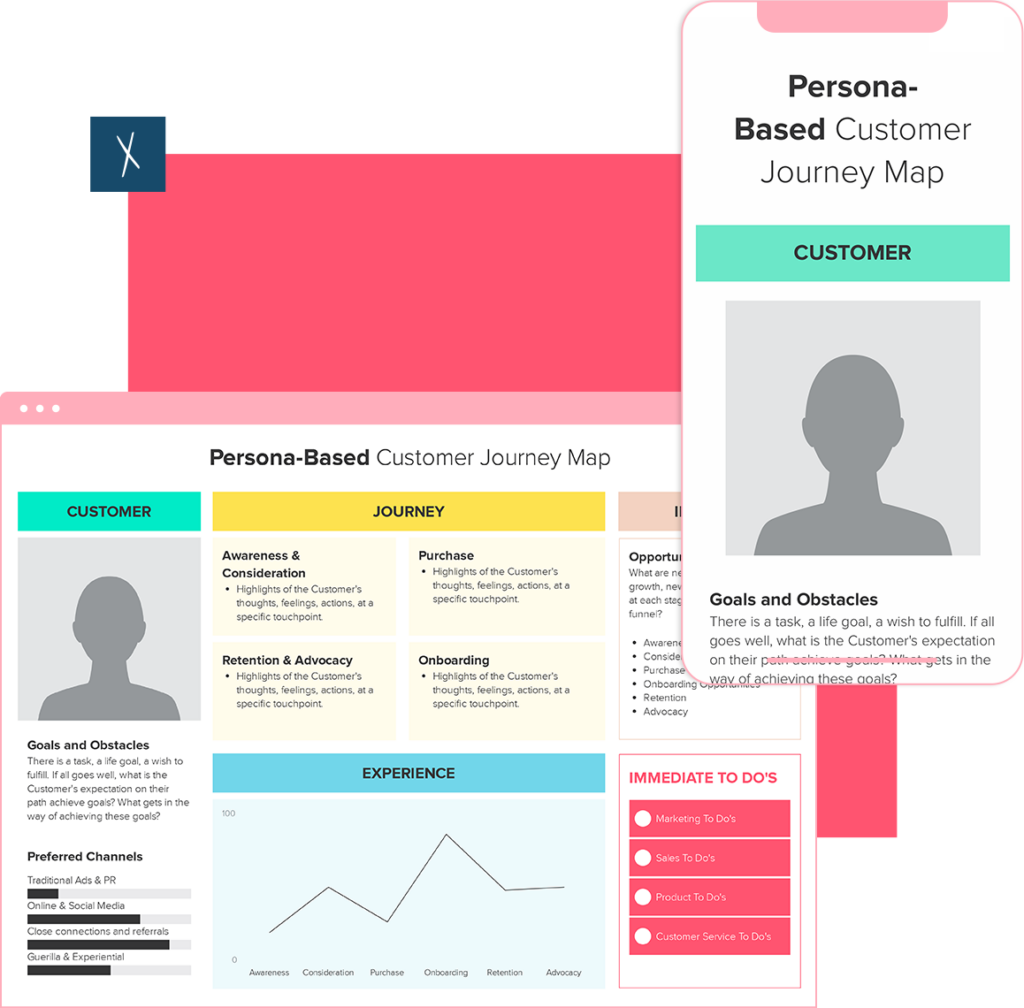
Persona-Based Customer Journey Map Template
User Persona meets Customer Journey Map!
- Present an ideal customer profile
- Highlight their thoughts, actions, and emotions as they interact with your brand.
- List immediate tasks your team can check off.
Create a free account to start. No credit card required.
Beautiful living documents, built like web pages.
Join 409,446 professionals using Xtensio.
Xtensio is the workspace for professional deliverables.
Make one deliverable today—then build a repeatable system for every client and project.
This is where teams create, collaborate, organize, and deliver the documents that run their work.
Everything stays on-brand, current, and ready to share.

Organize every deliverable
Keep strategy, sales, marketing, and client docs together by workspace.
Create fast, stay consistent
Start from 200+ templates or AI drafts, then apply your brand kit.
Collaborate in the doc
No more “final_v7.pdf” loop.
Standardize across deliverables
Apply your brand kit + reusable modules so every deliverable matches.
Improve what you send
See engagement, iterate, and reuse what works across projects.
What is a Persona-Based Customer Journey?
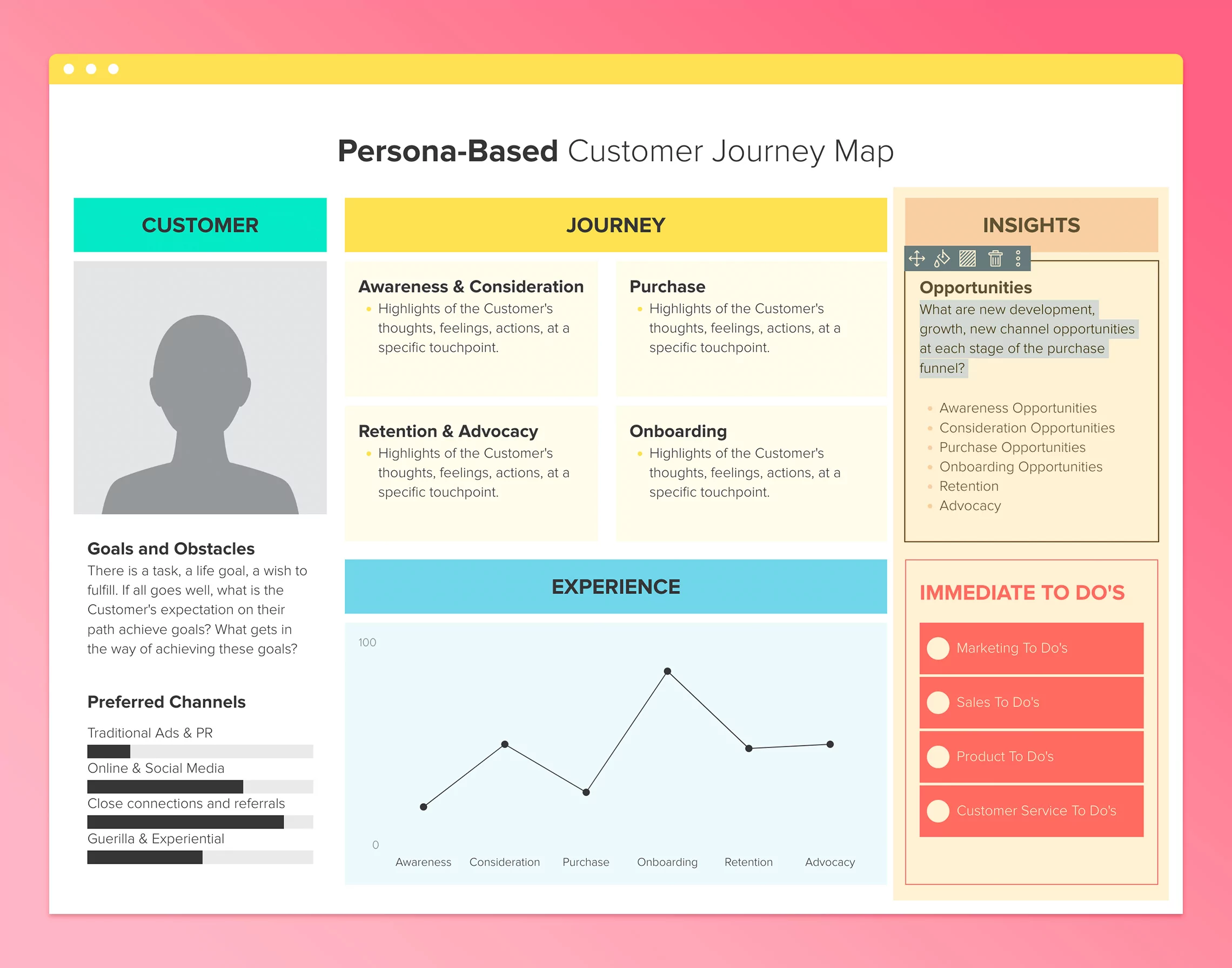
Persona-Based (or Persona-Led) Customer Journey Map is a variation on the Customer Journey Map putting the Persona, their background, and unique experience in the center. It’s simply a different way of laying out a Customer Journey Map. Instead of following a timescale, this one showcases a digest of touchpoints, actions, emotions, and takeaways. This living document would be useful as a summary of highlights to share with the rest of the organization working on a specific project such as launching a new product where the product, marketing, sales, and customer service experiences intersect. You can complete the Persona-Based Customer Journey after a deeper analysis of the User Persona.
How to create a Persona-Based Customer Journey?
There are 3 zones in the Persona-Based Customer Journey Map.
- The left column is all about the Customer.
- Click and type a name for this Customer, relevant to their relationship with your product or organization. For example “GenX Prosumer,” or “Working Mother.”
- Write a quick background. Imagine a life-like scenario they would go through, their goals, and obstacles through this scenario.
- Update the Preferred Channels through which you can reach these customers. You can also edit this module to reflect another factor you might like to highlight such as different types of touchpoints.
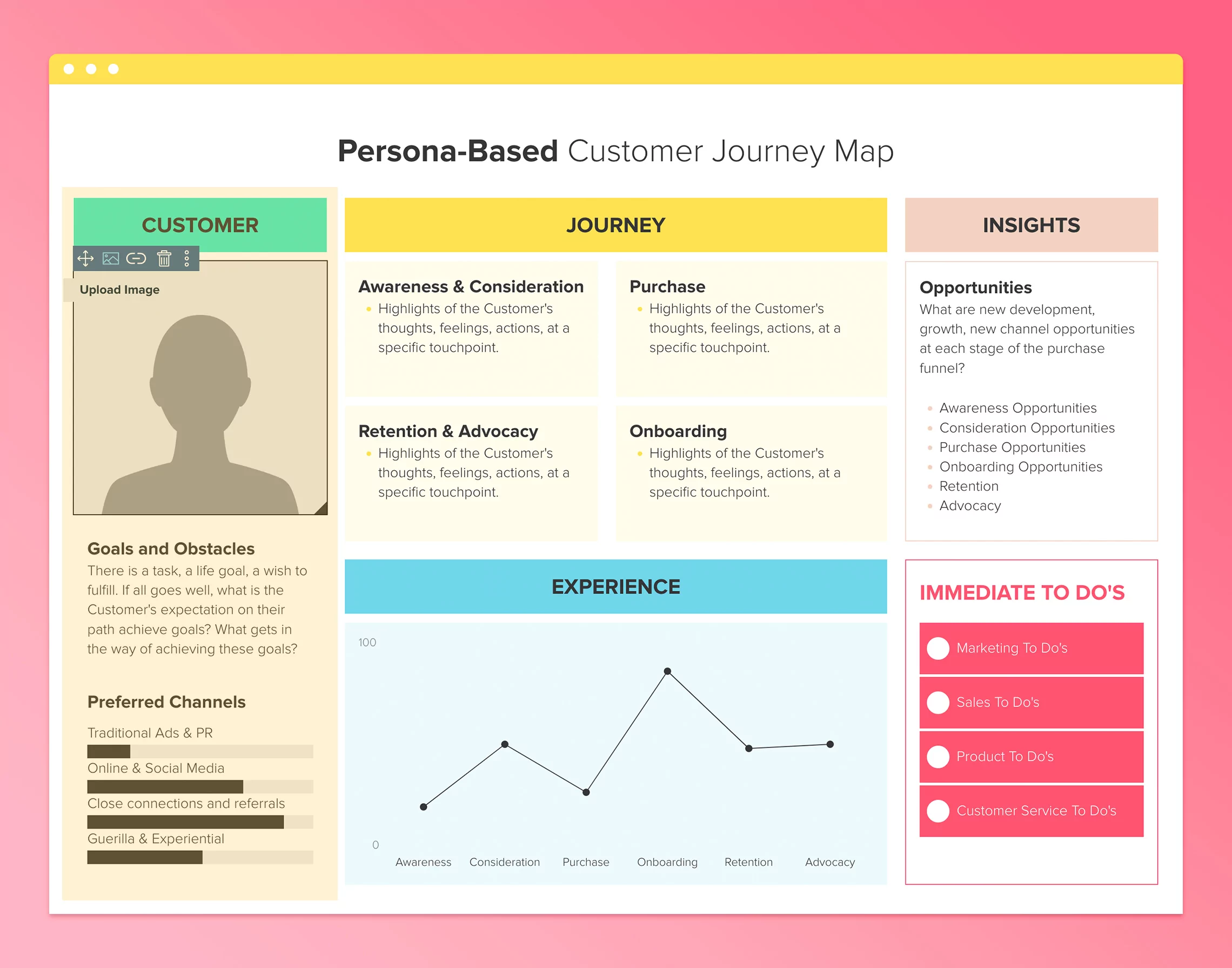
- The center is about the Journey.
- Include pieces of top findings of your Customer Journey Mapping here. The stages are labeled here from Awareness to Advocacy. You can edit these terms to what’s best suitable to your Customers’ experience over different stages.
- The experience chart tracks the wave of emotions from adverse (0) to favorable (100). Check out our Intuitive Guide to Customer Journey Mapping.
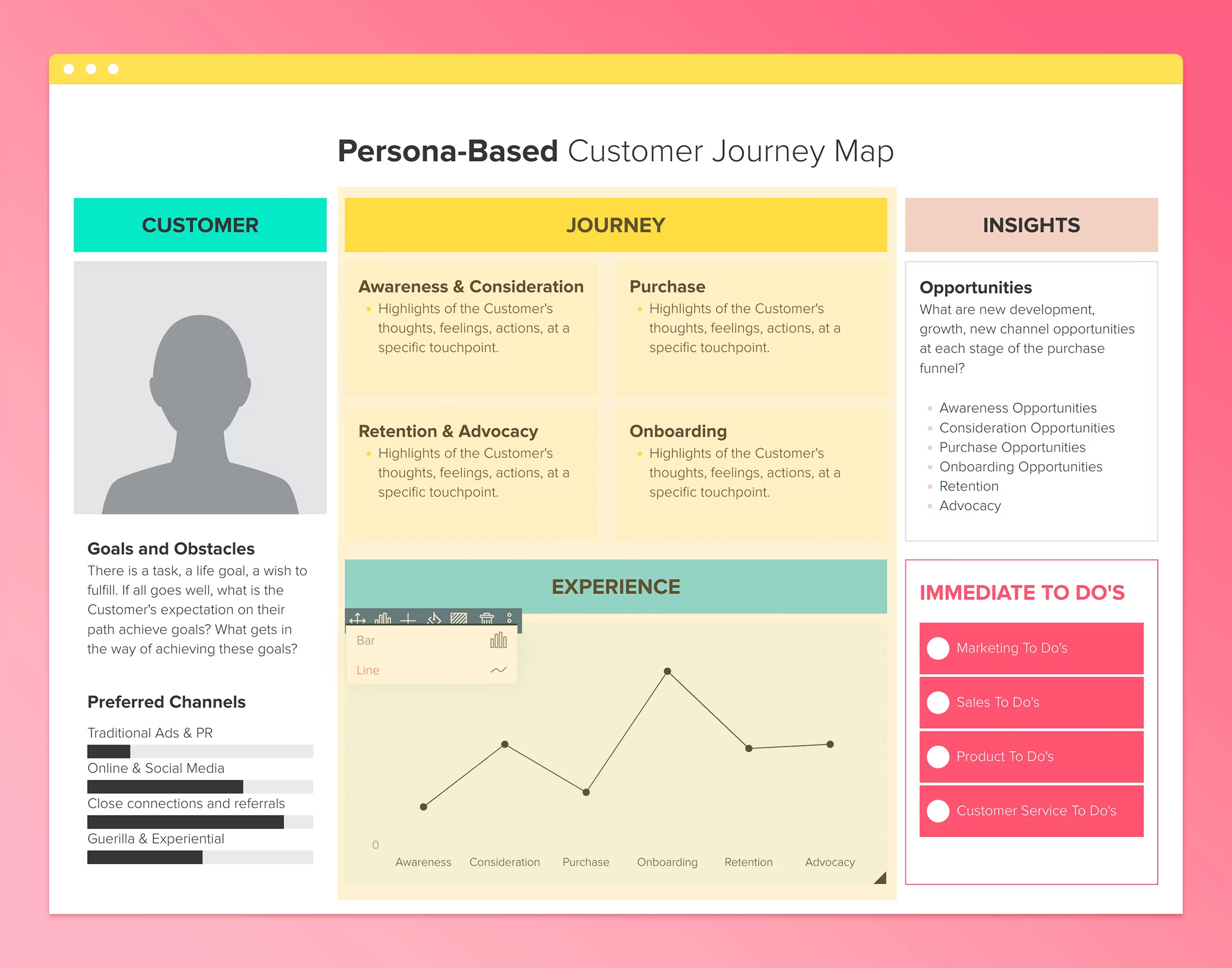
- The right column is about what’s next.
- Briefly list opportunities for new features, growth, and new channels. List them for each stage of the purchase funnel. Or only display the highlights of your choosing.
- Use the task module to check off some immediate To Dos. These can be top priorities for different teams as a way of connecting purpose across the organization.
Why Persona-Based Journey Maps Outperform Generic Ones
A generic customer journey map follows “the average customer.” The problem is that average customer does not exist. A first-time buyer navigating your onboarding flow has completely different friction points than a power user renewing an annual contract. When you map a single journey for both, you end up with a document that describes neither experience accurately.
Persona-based journey maps fix this by anchoring each map to a specific user persona. Instead of averaging out the pain points, you see exactly where each segment struggles, what motivates them at each stage, and where they drop off. Teams that adopt persona-based mapping often see 2-3x higher conversion on targeted touchpoints because their interventions address real behavior, not assumed behavior.
The core difference is specificity. A generic map might say “customer feels frustrated during onboarding.” A persona-based map says “the GenX Prosumer feels overwhelmed by the settings panel because they expected a guided setup, not a blank dashboard.” That level of detail turns a wall poster into an actionable brief your product, marketing, and support teams can actually use.
Here is what persona-based maps reveal that generic maps miss:
- Divergence points: Where two personas have opposite reactions to the same touchpoint. One persona finds your pricing page reassuring; another finds it confusing. You cannot fix both with a single redesign unless you know the split exists.
- Channel preferences: A working parent discovers your product through a colleague’s shared link. A marketing director discovers it through a conference demo. The awareness stage looks completely different for each.
- Emotional intensity: Frustration at checkout hits differently depending on the persona’s urgency. A startup founder under investor pressure has zero tolerance for friction. An enterprise buyer with a 90-day procurement cycle barely notices.
- Decision-making authority: Some personas decide alone. Others need to sell your product internally. The consideration stage for a solo decision-maker is one step; for a committee buyer, it is five steps with different stakeholders at each.
When you share a persona-based journey map as a live link, every team sees which persona they are optimizing for. There is no ambiguity about whose experience you are fixing. That clarity alone prevents the most common journey-mapping failure: a beautiful document that nobody acts on because it describes everyone and no one.
How to Map a Customer Journey for Each Persona
Building a persona-based journey map does not require starting from scratch. If you already have user personas and a general customer journey map, you have the raw material. The process is about connecting them with precision.
Step 1: Select your top 3 personas. Do not map every persona at once. Start with the three that represent your highest-value segments or the segments with the most friction. Prioritize by revenue impact, churn rate, or support ticket volume. If you have not defined personas yet, use Xtensio’s user persona template to build them first.
Step 2: Map the full journey for your primary persona. Walk through awareness, consideration, purchase, onboarding, retention, and advocacy. For each stage, document the persona’s goals, actions, touchpoints, emotions, and pain points. Be specific. Do not write “researches options.” Write “reads three comparison blog posts, asks a colleague on Slack, bookmarks your pricing page.”
Step 3: Identify divergence points. Take your second persona and walk them through the same stages. Where does their journey differ from the first? Mark every point where their actions, emotions, or channels diverge. These divergence points are where generic maps fail and persona-based maps earn their value.
Step 4: Layer in the third persona. By the third map, you will see clear patterns. Some stages are nearly identical across personas (often the final purchase step). Other stages look completely different (awareness and onboarding vary the most). Focus your team’s effort on the stages with the widest divergence.
Step 5: Connect each map to team-level actions. The bottom of every persona journey map should include immediate tasks for product, marketing, sales, and customer success. If a map does not lead to a task list, it is decoration. Use the task module in this template to assign actions and check them off as they are completed.
Step 6: Keep it current. Customer journeys shift as your product evolves and as market conditions change. Share each persona map as a live link through Xtensio workspaces so your team always references the latest version, not a PDF snapshot from six months ago.
Persona Journey Map vs Standard CJM vs Service Blueprint
Three tools dominate the journey-mapping space, and choosing the wrong one wastes weeks of research. Here is when to use each.
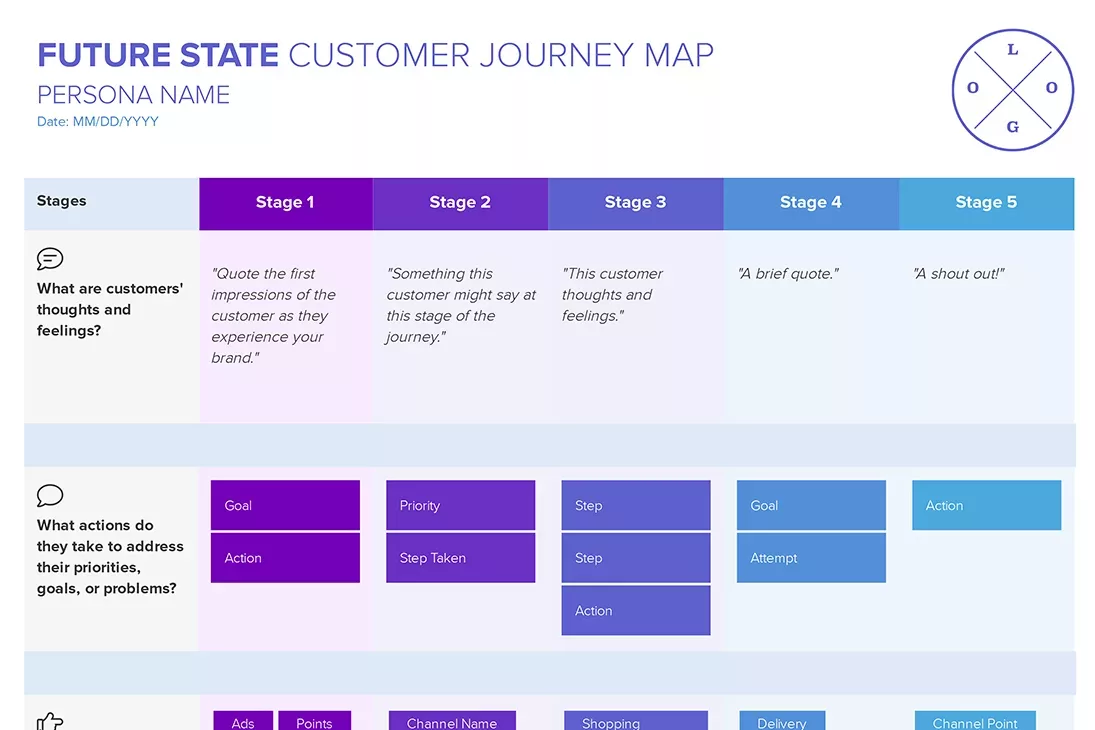
Persona-Based Customer Journey Map takes an outside-in view, segmented by audience. You are asking: “How does this specific type of customer experience our product?” Use it when different customer segments have meaningfully different journeys, when you are personalizing marketing or onboarding, or when a product launch targets a specific audience. This is the most actionable format for cross-functional teams because every department can see exactly whose experience they are responsible for.
Standard Customer Journey Map also takes an outside-in view, but follows a single generalized path. You are asking: “What does the typical end-to-end experience look like?” Use it when you need a broad overview of the customer lifecycle, when you are new to journey mapping, or when your customer base is relatively homogeneous. It is a good starting point, but most teams outgrow it once they realize their “typical customer” is actually three or four distinct personas.
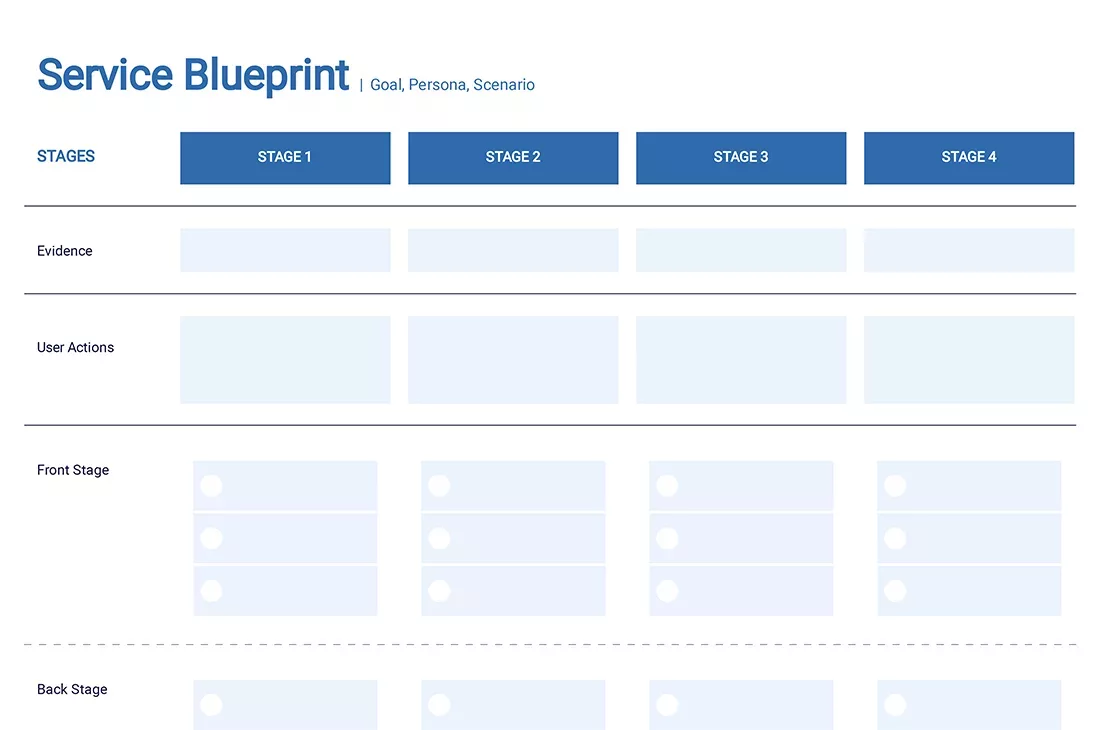
Service Blueprint flips the perspective entirely. It takes an inside-out, operational view. You are asking: “What internal processes, systems, and people support each customer touchpoint?” Use it when you are redesigning internal workflows, identifying backstage failures (a support team bottleneck, a handoff gap between sales and onboarding), or when the customer-facing experience is fine but internal costs are too high. A service blueprint maps everything the customer cannot see.
In practice, mature teams use all three. A persona-based journey map identifies where each segment struggles. A standard CJM provides the high-level lifecycle view for executive presentations. A service blueprint maps the internal operations behind each touchpoint. Start with the persona-based map if you need to drive specific improvements. Start with the standard CJM if you need organizational alignment on the overall experience.
Common Persona Journey Map Mistakes
Most persona-based journey maps fail not because of bad research but because of bad execution. These are the five mistakes that turn a useful strategic document into a file nobody opens after the first meeting.
Mapping too many personas at once. Teams get ambitious and try to map five or six personas simultaneously. The result is six shallow maps instead of two or three deep ones. Each map takes real research: interviews, data analysis, cross-team input. Start with your highest-impact persona, finish it completely, and only then move to the next. Quality compounds; quantity dilutes.
Mapping aspirational journeys instead of actual ones. It is tempting to map the journey you want customers to have. But a journey map is a diagnostic tool, not a vision board. Map what is actually happening today, including the ugly parts: the confusing checkout flow, the support email that never gets answered, the onboarding step where 40% of users drop off. The map should make you uncomfortable. That discomfort is where improvement starts.
Ignoring emotional touchpoints. Actions are easy to document. Emotions are harder. But a map without emotions is just a process diagram. The reason persona-based maps exist is to capture how different people feel at each stage. “Frustrated” is not specific enough. “Frustrated because the persona expected a 2-minute setup and got a 15-minute configuration wizard” tells your product team exactly what to fix.
Treating the map as a one-time project. Customer journeys are not static. Your product changes, your market shifts, your competitors launch new features. A journey map from six months ago describes a journey that may no longer exist. The fix is simple: keep your maps as living documents. Share them as live links so every stakeholder sees the current version, not the original version that was attached to a presentation deck.
Not connecting the map to actions. The most common failure. A team spends three weeks building a beautiful persona journey map, presents it at an all-hands, and then files it away. A journey map without a task list is incomplete. Every pain point should have an owner. Every opportunity should have a next step. Use the task module at the bottom of this template to turn insights into assignments with deadlines. When someone asks “What did we do with that journey map?”, the answer should be a list of shipped improvements, not a link to a forgotten document.
The teams that get the most value from persona-based journey maps treat them as working documents, not deliverables. They live in a shared workspace, they update as new data comes in, and they connect directly to the work being done. That is the difference between a journey map that changes behavior and one that decorates a wall.
Click and fill out Xtensio’s easily editable Persona-Based Customer Journey Map template with your own insights. Set different colors or fonts to make it your own.
Alternatively, select among other types of Customer Journey Maps. Available among Xtensio’s easily editable living document templates for Product Management and Design.
Create a free account to start. No credit card required.
Related to the Persona-Based Customer Journey Map Template
Fully customizable templates that you can make your own.

Zac Heisey
Director of Digital Marketing @

Jake Peters
CEO @

Robin Bramman
Founder and Chief Brand Mixologist @

Alix Han
VP Product Experience @

Marc Anthony Rosa
Product Manager @

Anna Yunker
Content Strategist @

Robin Eyre
Owner @

Adam Sher
CEO @

Humma Arshad
Salesforce Project Manager @

Create and deliver beautiful work, professionally.
Build, brand, and deliver living documents your clients actually engage with.






Join 409,446 professionals delivering work with Xtensio.