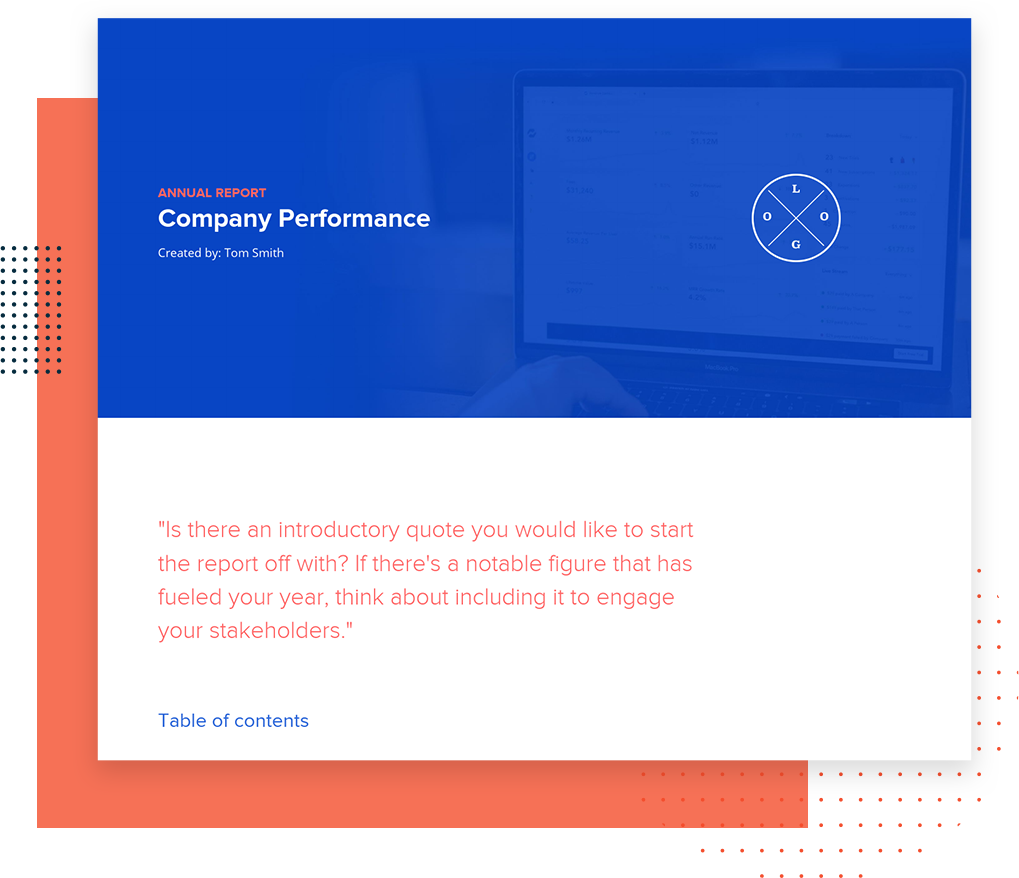
Annual Report Template
Corporations, small businesses and nonprofits use the annual report template to give shareholders and other key stakeholders information about the organization’s activities and financial performance in the previous year. The goal of this report is to give stakeholders a comprehensive overview about the organization’s mission, year-end highlights, projects, financial information and industry highlights.
- Provide investors and shareholders with a thoughtful and visually appealing annual report design to share information on key milestones and the company’s financial information.
- Highlight your company’s key achievements and goals for the coming year.
- Introduce key team members who joined during the previous year.
Xtensio is your team’s deliverables workspace.
Create, collaborate, and deliver client-ready docs—then keep them current.
Join 409,533 using Xtensio.
Xtensio is the workspace for professional deliverables.
Make one deliverable today—then build a repeatable system for every client and project.
This is where teams create, collaborate, organize, and deliver the documents that run their work.
Everything stays on-brand, current, and ready to share.

Organize every deliverable
Keep strategy, sales, marketing, and client docs together by workspace.
Create fast, stay consistent
Start from 200+ templates or AI drafts, then apply your brand kit.
Collaborate in the doc
No more “final_v7.pdf” loop.
Standardize across deliverables
Apply your brand kit + reusable modules so every deliverable matches.
Improve what you send
See engagement, iterate, and reuse what works across projects.
How to create an annual report with Xtensio
- Create a free account and start editing, no credit card required.
Follow along with the instructional annual report design details. Add charts, graphs, images, and videos to customize the annual report template and make it your own. Drag & drop. Resize. Customize the report format however you need. It’s the easiest editor ever.
- Customize everything in the annual report template to match your brand.
Define your style guide. Add your (or your client’s) brand fonts and colors. You can even pull colors directly from a website to easily brand your annual reports and more.
- Work on your annual report details together on the cloud.
Add colleagues (or clients) to collaborate on the annual report template. Changes automatically save and sync across all devices, in real-time.
- Share a link. Present a slideshow. Embed. Download a PDF/PNG.
The annual report seamlessly adapts to your workflow. No more jumping from tool-to-tool to design different types of deliverables.
- Reuse and repurpose.
Save your own custom annual report design templates. Or copy and merge into other documents.

What is an annual report template?
Annual reports are a crucial part of your business and its yearly operations. The annual report is a financial document that businesses provide to shareholders, potential investors, employees and analysts as a source of information about the past year’s performance and financial well-being.
Generally, the first half of an annual report is devoted to company information, industry trends, and other important business news, while the second half usually contains financial data. Sometimes companies use the annual report as a marketing tool or a reminder to shareholder of its business achievements.
What information should be included in an annual report?
Annual reports provide a fundamental overview of the business during the previous year. Typically, the annual report contains categories such as a letter from the company CEO, data regarding the business’s finances and information about business activities.
Message from CEO and business profile
This is your cover page. Talk about your company’s mission and vision. How would you describe your company as a whole? What were the major goals for the previous year? How about your vision looking towards the future?
Year-end highlights
Highlight key business growth using numbers, clients’ names, partnerships, etc. Did you introduce new products or services this year? Or any new marketing campaigns or initiatives? It’s also a good idea to give an overview of any awards, accomplishments or major lists you were included in this year in this section of the annual report template.
Financial overview
This is what your shareholders really care about in the annual report. Showcasing your company’s financial statements allows current and future investors, shareholders, employees and other business stakeholders to determine how well the company has performed in the past, its ability to pay off debts and its plans for growth. You could include financial statements such as:
- Balance sheet.
- Cash flow statement.
- Income statement.
- Customer growth statement.
Industry highlights
Create an overview of where your market stands by outlining a few of your competitors. Where does the market stand? What did your competitors do well last year? Where did they fall short? Introduce key leadership team members
Putting a face to your company is important, especially if you’re using your annual reports as a marketing initiative to gain new interest from investors. Add a high quality cover photo for each team member and describe how each team member plans to help reach your company vision.
How do you write an annual report?
Annual reports are important elements of a brand’s transparency and accountability. These reports communicate the values and goals of your brand and align shareholders on future growth goals. That being said, you should create annual reports that easily speak to a broad audience since these reports can be shared across current and potential investors, shareholders, employees and even consumers.
Here are a few tips for creating an annual report design.
- Create highly visual and narrative-driven annual reports.
- Keep the color palette, fonts and images used in the annual report inline with your brand identity.
- Determine a key message that resonates through every part of your annual report.
- Map out your content – or use an annual report design template to help you structure your content.
Related to the Annual Report Template
Fully customizable templates that you can make your own.
Annual Report vs Impact Report vs Year in Review
These three documents cover similar timeframes but serve different audiences and purposes. Using the wrong format can confuse your readers or fail to communicate what matters most.
An annual report is a comprehensive financial and strategic overview of your organization’s performance over the past year. For publicly traded companies and many nonprofits, it is a regulatory requirement. Annual reports cover revenue, expenses, growth metrics, strategic priorities, risk factors, and governance. The primary audience is investors, board members, and regulatory bodies who need a complete picture of organizational health.
An impact report focuses on outcomes and mission-driven results rather than financial performance. Nonprofits, foundations, social enterprises, and CSR departments use impact reports to show donors, grantmakers, and communities what their funding accomplished. The emphasis is on lives changed, programs delivered, and goals achieved. Impact reports are persuasive documents designed to inspire continued support.
A year in review is a marketing narrative that highlights wins, milestones, and culture moments. Startups, agencies, and internal teams use year-in-review documents to celebrate progress, build team morale, and attract talent or clients. The tone is lighter, the design is bolder, and the focus is on storytelling rather than compliance. Year-in-review documents work well as shareable content on social media and in newsletters.
Many organizations need more than one of these documents. Build all three in the same workspace to keep your data consistent and your messaging aligned across audiences.
Annual Report Sections Stakeholders Actually Read
Most annual reports are 30 to 60 pages. Most stakeholders read fewer than five pages. Understanding which sections get actual attention helps you invest your effort where it matters.
CEO or executive letter. This is the most-read section in any annual report. Stakeholders want the leader’s honest assessment of the year: what went well, what was difficult, and where the organization is heading. The best executive letters are candid about challenges, specific about strategy, and concise. One to two pages maximum. Avoid generic optimism and corporate jargon.
Financial highlights. Investors and board members go straight to revenue, expenses, margins, and year-over-year comparisons. Present the numbers clearly with visual charts and brief commentary that explains the “why” behind each trend. Do not make readers hunt through footnotes for the key figures.
Growth metrics and KPIs. Beyond financials, stakeholders want to see the operational indicators that predict future performance: customer count, retention rate, market share, employee headcount, and any metrics specific to your industry. Compare these to prior year and to the targets you set.
Strategic priorities. What are the two to three big bets for the coming year? Stakeholders use this section to evaluate whether leadership has a clear direction. Be specific enough that you can be held accountable. “Expand internationally” is vague. “Launch in three European markets by Q3” is a commitment.
What to cut: Lengthy mission statements that have not changed, stock photography, department-by-department summaries that repeat the same metrics in different words, and any section that exists because “we always include it” rather than because someone reads it.
How to Keep Your Annual Report Current Year-Round
The biggest pain point in annual report production is the end-of-year scramble. Teams spend weeks gathering data, writing sections, and reconciling numbers because they treat the report as a once-a-year event. A better approach is to build the report progressively throughout the year.
Quarterly data collection. At the end of each quarter, update the financial and operational sections of your annual report with the latest numbers. This takes 30 minutes per quarter instead of three weeks in January. It also catches data errors early when they are easier to correct.
Rolling narrative updates. When a major milestone happens, write two to three sentences about it immediately. By year-end, you have a draft narrative built from real-time observations rather than hazy recollections of events from 11 months ago.
Living document approach. Instead of building your annual report in a design tool that requires a fresh export every time you make a change, build it in Xtensio as a living deliverable. Share the draft as a live link with your executive team for ongoing review. When the report is final, the same link serves as the published version. No file versioning confusion, no “which PDF is the latest” emails.
Reuse last year’s structure. Your annual report template should be a reusable starting point, not a blank page. Duplicate last year’s report, update the data, and refine the narrative. This preserves your design standards and section structure while cutting production time in half. See our guide on how to write an annual report for a step-by-step walkthrough of each section.
Teams use Xtensio to create, share, and improve professional deliverables.
Trusted by 409,533 teams, founders, and consultants.



Jerome Katz
Professor of Entrepreneurship @

Jake Peters
CEO @

Robin Bramman
Founder and Chief Brand Mixologist @

Olakunle Oladehin
Executive Director @
Everybody Dance Now!

Aaron Friedland
Executive Director @
The Walking School Bus

Robin Eyre
Owner @

Adam Sher
CEO @

Stephen Paterson
Chief Product Officer @

Create and deliver beautiful work, professionally.
Build, brand, and deliver living documents your clients actually engage with.







Join 409,533 professionals delivering work with Xtensio.
Related reports: Monthly Marketing Report Template, Weekly Project Status Report Template