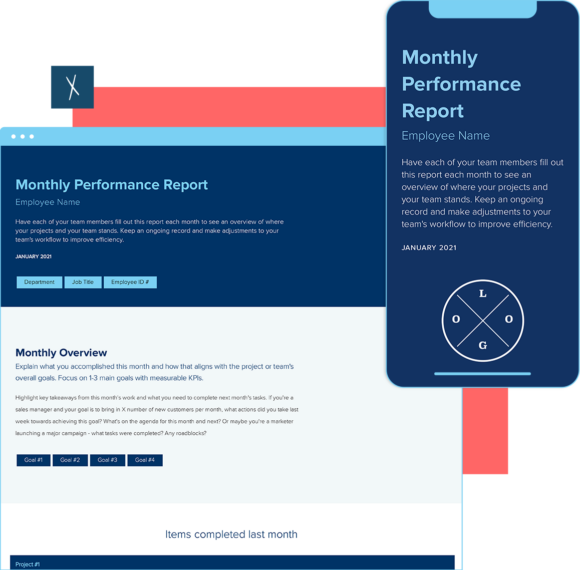
Monthly Performance Report Template
The monthly performance report template helps you communicate achievements, inform management on key decisions and also challenge strategic assumptions. The goal of this exercise is to have each member of your team complete the report on a monthly basis to keep an ongoing record of performance and to analyze and improve the team’s workflow.
- Monitor business performance indicators for any business function (e.g. operations, sales, finance, product, etc.)
- Analyze your team’s efficiency and achievements and set realistic performance goals.
- Understand the weaknesses to establish improvement priorities.
Xtensio is your team’s deliverables workspace.
Create, collaborate, and deliver client-ready docs—then keep them current.
Join 410,083 using Xtensio.
Xtensio is the workspace for professional deliverables.
Make one deliverable today—then build a repeatable system for every client and project.
This is where teams create, collaborate, organize, and deliver the documents that run their work.
Everything stays on-brand, current, and ready to share.

Organize every deliverable
Keep strategy, sales, marketing, and client docs together by workspace.
Create fast, stay consistent
Start from 200+ templates or AI drafts, then apply your brand kit.
Collaborate in the doc
No more “final_v7.pdf” loop.
Standardize across deliverables
Apply your brand kit + reusable modules so every deliverable matches.
Improve what you send
See engagement, iterate, and reuse what works across projects.
How to create a performance report with Xtensio
- Create a free account and start editing, no credit card required.
Follow along with the instructional report details. Add charts, graphs, images, and videos to customize the performance report template and make it your own. Drag & drop. Resize. It’s the easiest editor ever.
- Customize everything in the performance report template to match your brand.
Define your style guide. Add your (or your client’s) brand fonts and colors. You can even pull colors directly from a website to easily brand your monthly performance reports and more.
- Work on your performance reports together on the cloud.
Add colleagues (or clients) to collaborate on the performance report template. Changes automatically save and sync across all devices, in real-time.
- Share a link. Present a slideshow. Embed. Download a PDF/PNG.
The report template seamlessly adapts to your workflow. No more jumping from tool-to-tool to design different types of deliverables.
- Reuse and repurpose.
Save your own custom monthly performance report templates. Or copy and merge into other documents.

What is a performance report?
An employee performance report gives managers and executive staff a clear and accurate image of a company’s performance in relation to a given job, project, or objective. Managers can use the performance report to assess current performance levels, create realistic performance targets, and identify shortcomings in order to implement improvement techniques. This exercise is very valuable during performance reviews, whether they are done monthly, quarterly, or annually.
How do I write a monthly performance report?
You will present your performance reports to your organization’s senior management. Put yourself in your manager’s shoes and ask yourself, “What does my supervisor want to see in this report?” “How would the report assist me in evaluating my performance as an employee?”
Here are a few tips for presenting important information in your performance reports:
- Keep your audience in mind; your manager will be evaluating your performance based on job description and goals.
- Address core topics: your achievements related to your specific job description and goals.
- Use concise, measurable and assertive language to explain what you’ve accomplished with measurable KPIs.
Monthly Report vs Dashboard vs Quarterly Review
Teams often conflate these three reporting formats, which leads to either redundant work or critical gaps in how performance information flows through an organization. Each format serves a distinct purpose for a different audience and timeframe.
A monthly performance report is a narrative document that combines metrics with context. It explains what happened, why it happened, and what the team plans to do about it. Monthly reports are designed for stakeholders who need to understand trends and make decisions based on the story behind the numbers. The report’s value comes from the analysis and recommendations, not just the data points. Share your monthly report as a live link so stakeholders can access it anytime without digging through email attachments.
A dashboard is a real-time metrics display designed for operational teams who need to monitor performance continuously. Dashboards show current state but rarely explain context or recommend actions. They answer “what is happening right now” but not “what should we do about it.” Dashboards complement monthly reports but do not replace them.
A quarterly review is a strategic assessment that evaluates progress against longer-term goals, identifies systemic patterns across three months of data, and recommends adjustments to strategy. Quarterly reviews use monthly report data as inputs but synthesize it into strategic conclusions. While a monthly report might note that conversion rates dipped in March, the quarterly review asks whether the dip reflects a seasonal pattern, a competitive shift, or an internal execution problem.
The practical workflow: dashboards inform daily operations, monthly reports capture the narrative and recommendations for management, and quarterly reviews drive strategic pivots. Build all three as reusable templates in your workspace so each month you duplicate rather than recreate from scratch.
5 Monthly Report Mistakes That Waste Everyone’s Time
A monthly report that nobody reads is worse than no report at all because it consumes creation time without delivering value. These five mistakes are the most common reasons stakeholders stop paying attention to performance reports.
1. Data dump without insights. Listing every metric without interpreting what they mean forces readers to do the analysis themselves. Most will not bother. For every data point you include, add a one-sentence interpretation: “Website traffic increased 12% month-over-month, driven primarily by the product launch blog post which accounted for 8,400 of the 11,200 new sessions.” Context turns data into decisions.
2. No comparison to goals or benchmarks. Reporting that you closed 47 deals this month means nothing without context. Is 47 above or below target? How does it compare to last month, the same month last year, or the industry average? Every metric should be presented against a benchmark so readers instantly know whether performance is good, bad, or neutral.
3. Inconsistent format month to month. Changing the report structure, metric definitions, or section order each month makes it impossible for stakeholders to track trends over time. Lock in a standard template and use it consistently. Xtensio lets you save your monthly report as a reusable template that you duplicate each month, ensuring consistency while allowing the content to change.
4. Burying bad news. Hiding underperformance deep in the report or spinning negative results with vague language erodes trust. Address shortfalls directly, explain the root cause, and present a corrective action plan. Stakeholders respect transparency and lose confidence in reports that only deliver good news.
5. No action items. A report that ends with data and analysis but no recommended next steps is incomplete. Every monthly report should close with three to five specific action items, each with an owner and a deadline. This turns the report from an informational document into a management tool.
Monthly Report Sections by Department
Different departments track different metrics, but the report structure should remain consistent across the organization. Here is what each department should include in their monthly performance report.
Marketing: Lead generation (MQLs and SQLs), campaign performance by channel, content engagement metrics, cost per acquisition, and pipeline contribution. Include month-over-month trends and highlight which campaigns or channels are delivering above or below expected ROI. Link to the specific dashboards or analytics views that support your conclusions.
Sales: Pipeline value (new, progressed, closed), revenue against quota, average deal size, sales cycle length, and win/loss rates. Break down performance by rep, region, or product line depending on your organization’s structure. Flag any deals that slipped from the forecast and explain why.
Product: Features shipped versus planned, adoption rates for recent releases, bug backlog status, and customer feedback themes. Product reports should connect engineering output to business outcomes: “Feature X shipped on schedule and has been adopted by 34% of active accounts in the first two weeks, exceeding the 25% target.”
Operations: Service level agreement (SLA) compliance, process efficiency metrics, cost reduction progress, and incident reports. Operations teams should highlight any systemic issues that affected multiple departments and describe the corrective actions taken. For client-facing teams, use the monthly performance report how-to guide to structure your first report, then refine the template based on stakeholder feedback each month.
Related to the Monthly Performance Report Template
Fully customizable templates that you can make your own.
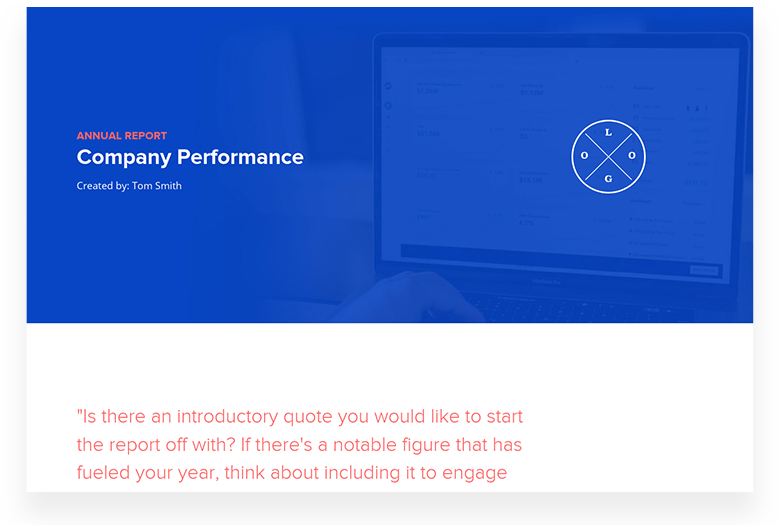
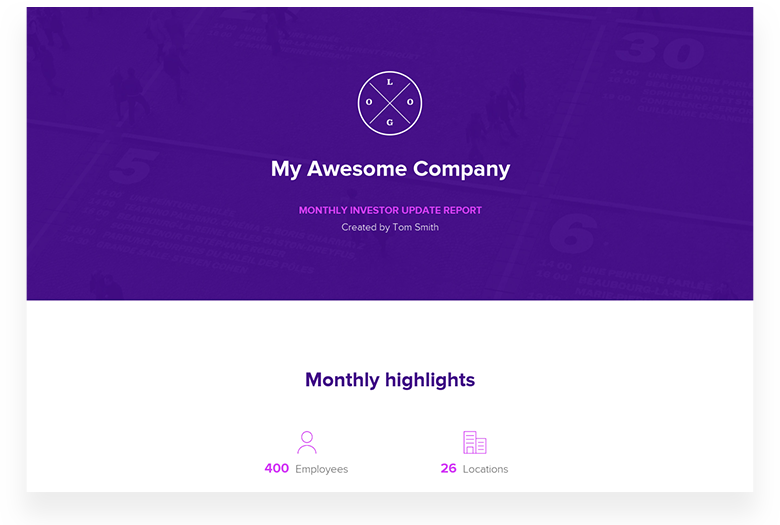
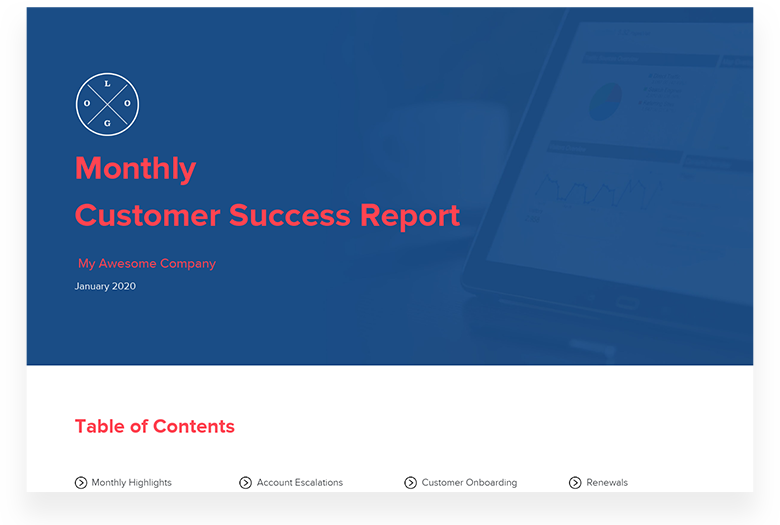
Teams use Xtensio to create, share, and improve professional deliverables.
Trusted by 410,083 teams, founders, and consultants.



Jerome Katz
Professor of Entrepreneurship @

Jake Peters
CEO @

Robin Bramman
Founder and Chief Brand Mixologist @

Olakunle Oladehin
Executive Director @
Everybody Dance Now!

Aaron Friedland
Executive Director @
The Walking School Bus

Robin Eyre
Owner @

Adam Sher
CEO @

Stephen Paterson
Chief Product Officer @

Create and deliver beautiful work, professionally.
Build, brand, and deliver living documents your clients actually engage with.







Join 410,083 professionals delivering work with Xtensio.
Related reports: Monthly Marketing Report Template, Weekly Project Status Report Template