SWOT Analysis doesn’t speak to your business philosophy? Try these SWOT Analysis alternatives.
Updated by Xtensio
SWOT is an age-old tool used in business strategic moves and is still popular today to kick off strategic planning processes. It breaks it down into Strengths, Weaknesses, Opportunities, and Threats. But is it still relevant in a rapidly changing world? Does it ask the right questions for startups or organizations looking to transform themselves? What are the alternatives? We curated some alternatives to SWOT Analysis that take different approaches to business. Philosophically, operationally, and practically. The templates below come with helpful guidance to help you conduct your research and fill in the sections. Click and use the ones that best resonate with you and your organization.
Try it first! If you like Xtensio’s easy online editor create an account to save your edits.
Why Consider SWOT Alternatives?
A SWOT analysis is one of the most widely used strategic planning frameworks in business. It maps Strengths, Weaknesses, Opportunities, and Threats into a simple four-quadrant grid. But SWOT has a well-documented blind spot: it treats internal weaknesses and external threats as static observations rather than actionable starting points. For teams that want to move from analysis to action, this gap matters.
Three common problems push teams toward alternatives. First, SWOT conflates different types of insight (a weakness is not the same as a threat, yet both sit in “negative” quadrants with no clear next step). Second, SWOT is backward-looking by design: it catalogs the current state but does not prescribe direction. Third, the framework lacks a built-in mechanism for prioritization, so teams end up with a list of 40 items and no idea which 3 to act on this quarter.
The six alternatives below address these gaps differently. SOAR replaces deficit-thinking with aspiration. PESTLE zooms out to macro forces. NOISE focuses on internal operations. Porter’s Five Forces analyzes competitive dynamics. TOWS converts SWOT outputs into strategies. And a deeper SWOT itself, done right, still has value. Each framework comes with a free, editable template you can customize and share as a live link that stays current as your strategy evolves.
How to Choose the Right Framework
The best strategic analysis framework depends on what question you are trying to answer. Use this decision guide:
- “Where should we focus our energy?” Use SOAR. It is designed for teams that want to build on strengths rather than catalog weaknesses.
- “What external forces could disrupt us?” Use PESTLE. It systematically scans political, economic, social, technological, legal, and environmental factors.
- “What is blocking our operations right now?” Use NOISE. It maps Needs, Opportunities, Improvements, Strengths, and Exceptions for internal process improvement.
- “How competitive is our market position?” Use Porter’s Five Forces. It analyzes supplier power, buyer power, competitive rivalry, substitution threats, and new entrant threats.
- “We did a SWOT. Now what?” Use TOWS. It takes your existing SWOT data and generates four types of strategies: SO, WO, ST, and WT.
- “We need a general strategic snapshot.” Use SWOT itself, but go deeper than the standard grid. Add prioritization scores, assign owners, and set review cadences.
Many teams run two or three of these frameworks in sequence. A common pattern: start with PESTLE to understand the landscape, run a SWOT to assess internal readiness, then use TOWS to convert insights into a strategic action plan. With a workspace that supports reusable templates, you can maintain all three as living documents and update them quarterly.
SOAR Analysis
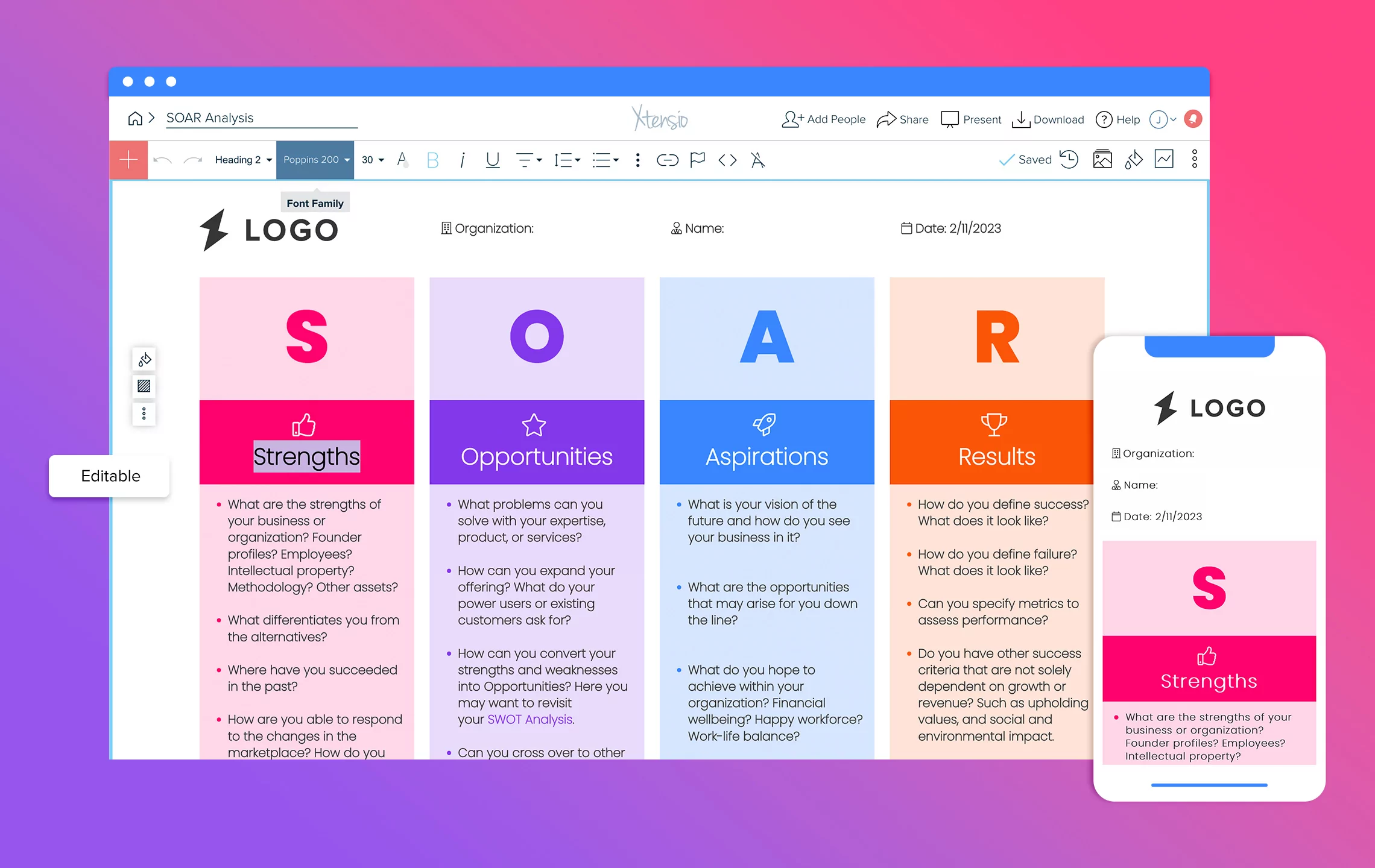
SOAR Analysis takes a visionary and aspirational approach to analyze how your business stands on the playing field. Stands for Strengths, Opportunities, Aspirations, and Results. Get started with Xtensio’s instructional template.
PESTLE Analysis
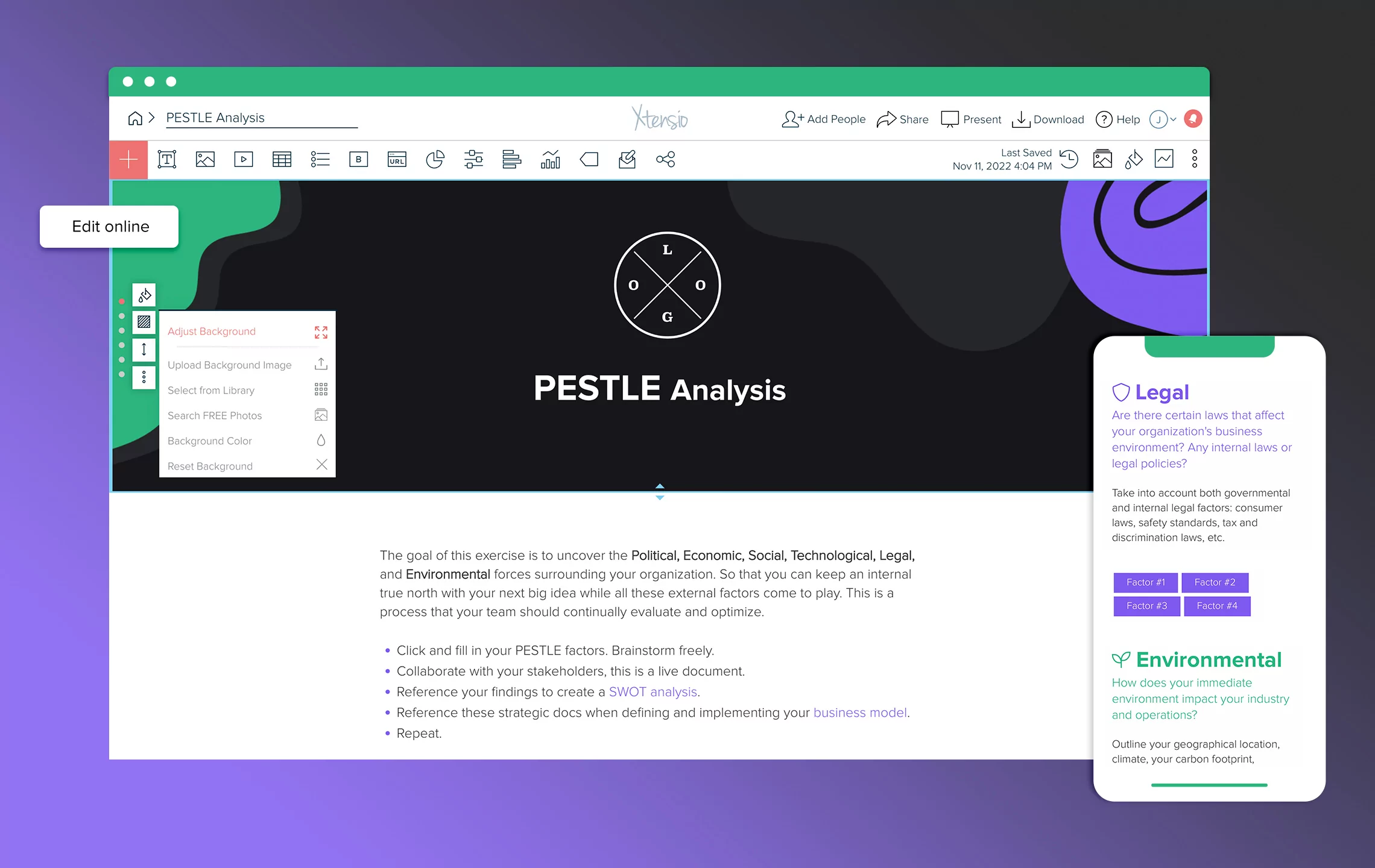
We all saw how our entire world toppled with a global pandemic and how forces larger than you may affect your organization, big or small. Become attuned to Political, Economic, Social, Technological, Legal, and Environmental forces surrounding your company with our instructional PESTLE Analysis template.
NOISE Analysis
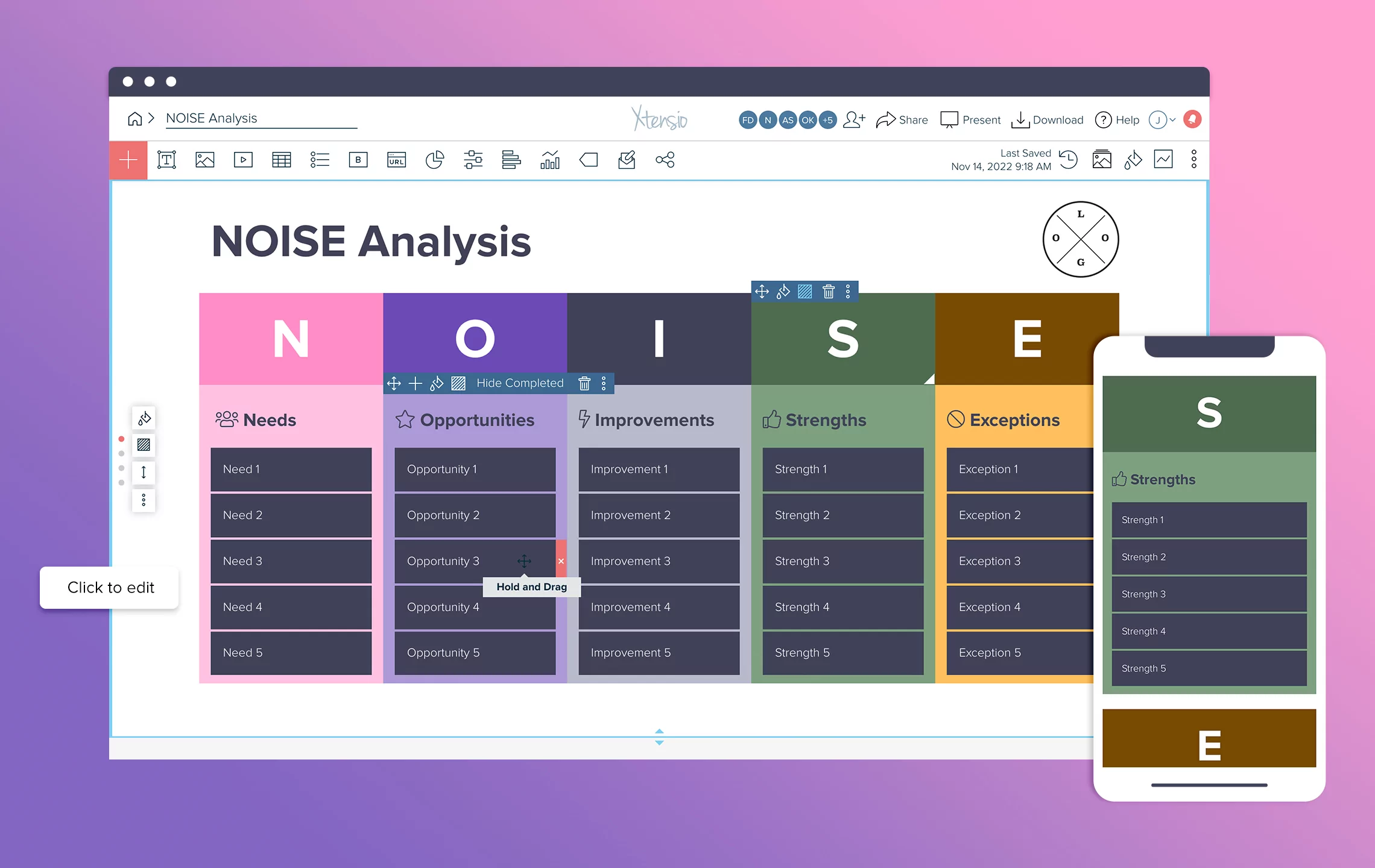
Take a solution-focused approach to analyze the current state of your organization in order to develop short and long-term plans.
Complete the five sections of the NOISE Analysis to review your company’s Needs, Opportunities, Improvements, Strengths, Exceptions. Work on this together with your team, to hone in on findings that are actionable right away.
PORTER’S FIVE FORCES Analysis
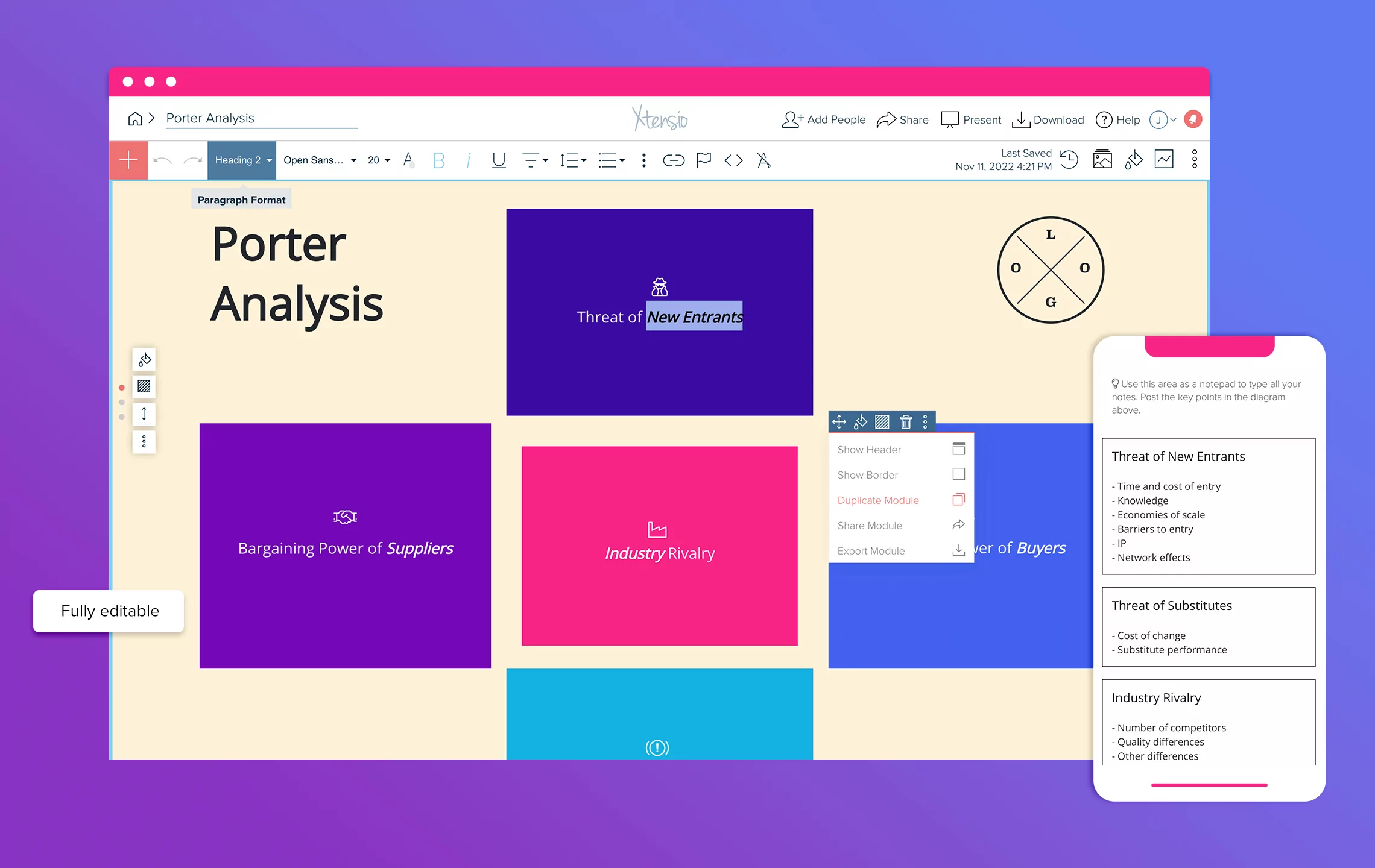
SWOT’s close friend, and perhaps first rival Porter’s Five Forces helps obtain a broad perspective of the industry in which your organization is striving to exist. That said, the fragility of global economic, social, and political systems calls for an adaptive mindset, and a creative ability to fill in the gaps left by traditional business frameworks like this one.
TOWS Matrix
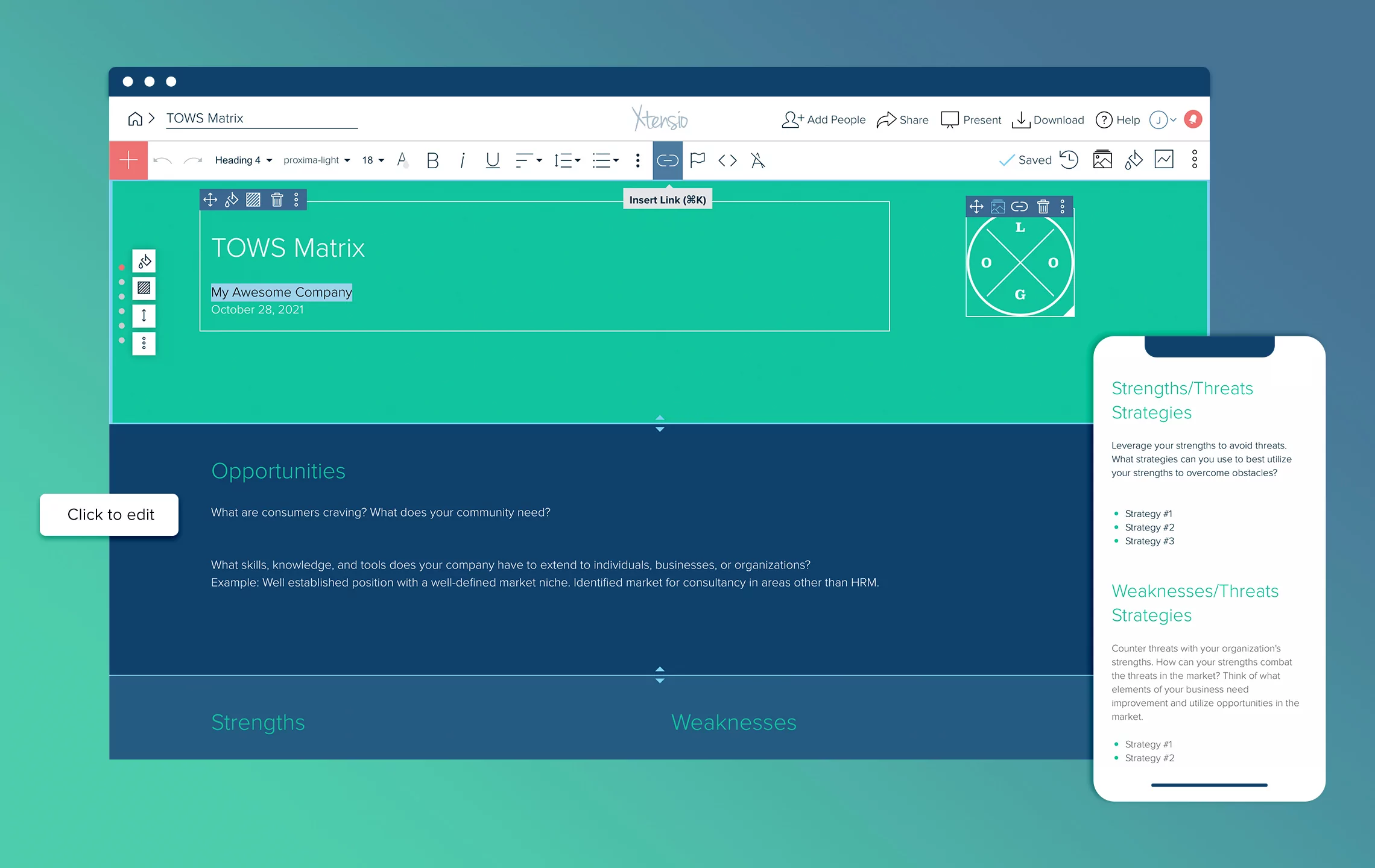
Taking the traditional SWOT Analysis a step further, the TOWS analysis specifically allows you to connect Strengths and Weaknesses to Opportunities and Threats to help create actionable strategies from those findings.
SWOT Analysis
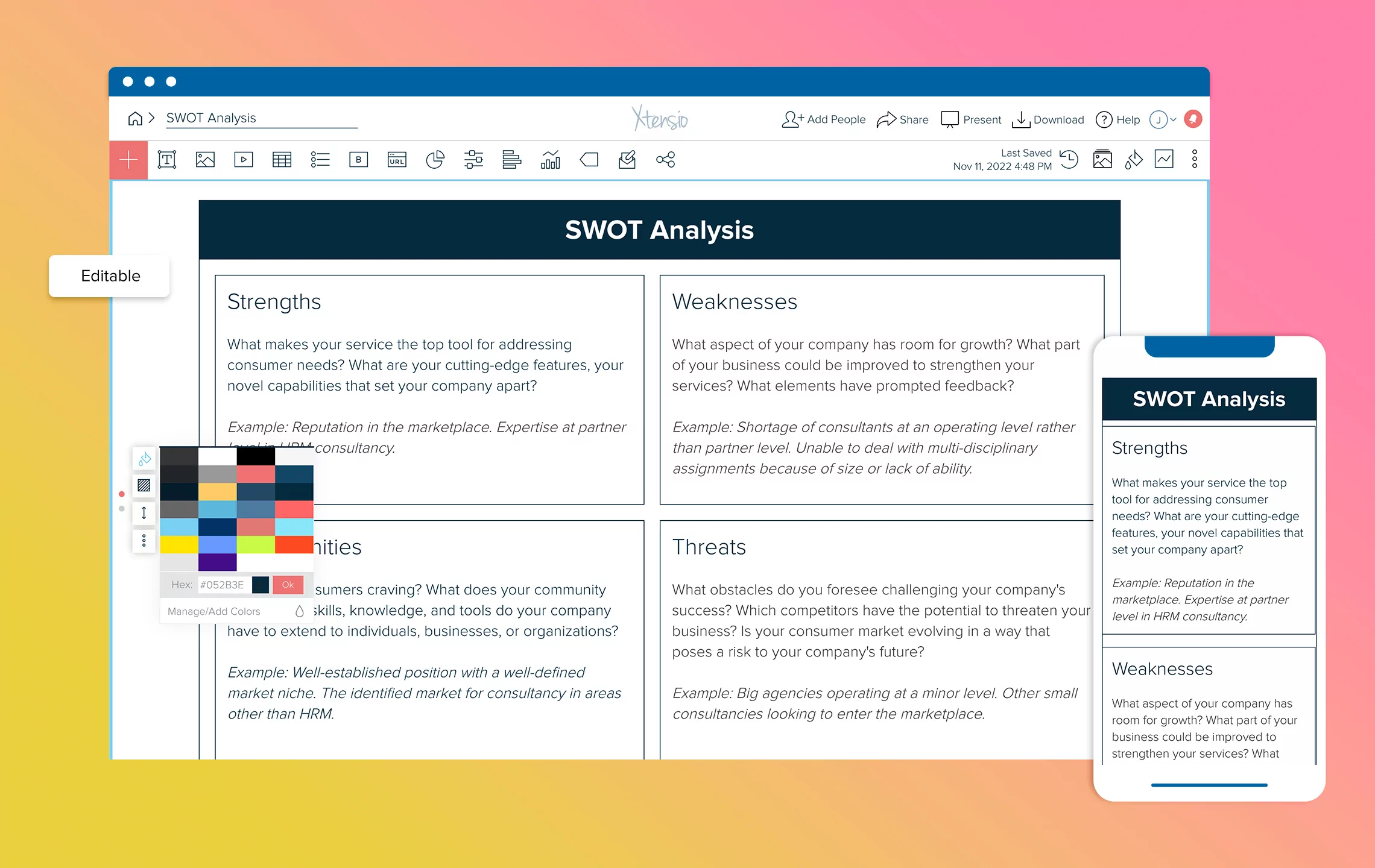
And of course, the good old SWOT (Strengths, Weaknesses, Opportunities, Threats) to help navigate your business’ competitive standing in the field. Go to our SWOT How to Guide to learn more about it and check out some editable examples of completed SWOT Analysis. To support your SWOT analysis, also do a Competitive Analysis with this free template.
Common Mistakes When Choosing a Strategic Framework
Teams frequently make three mistakes when selecting analysis frameworks. The first is using SWOT by default without considering whether it fits the question at hand. If your challenge is operational rather than strategic, NOISE will give you more actionable output. If your challenge is competitive positioning, Porter’s Five Forces cuts deeper than SWOT ever will.
The second mistake is treating the analysis as a one-time exercise. A strategic framework loses its value the moment the market shifts. The most effective teams revisit their analyses quarterly and update them with fresh data. This is where a living deliverables workspace pays for itself: your SOAR analysis or Five Forces map stays current because stakeholders access it via a live link, not a PDF that was last updated six months ago.
The third mistake is failing to connect analysis to action. A SWOT grid with 30 items and no priorities is not a strategy. Whichever framework you choose, end with three specific initiatives, each with an owner and a deadline. The SWOT Analysis template and its alternatives on this page all include sections for next steps precisely for this reason.
Keeping Your Strategy Alive
The difference between teams that execute strategy and teams that just plan it often comes down to document maintenance. A strategy document that lives in a shared drive and never gets opened after the offsite is worse than no document at all: it gives the illusion of alignment while the team drifts. The solution is simple: keep your strategic analyses in a format that is easy to update and impossible to lose. Share them as live links. Set a calendar reminder to revisit them. And use the same template structure every cycle so progress is visible over time. With Xtensio, you can create once, reuse across projects, and know that every stakeholder is looking at the same current version.
When SWOT Falls Short: Situations That Call for a Different Framework
SWOT works well as a general-purpose strategic snapshot, but certain business situations expose its limitations. Recognizing when SWOT is the wrong tool is just as valuable as knowing how to run one.
Strengths-only planning. When a team is building momentum and wants to double down on what is working rather than catalog what is broken, SOAR is the better fit. SOAR replaces weaknesses and threats with aspirations and results, keeping the conversation forward-looking. This is especially useful for startup teams running their first annual planning cycle or nonprofits defining a new strategic direction.
Competitive positioning decisions. SWOT identifies that competition exists, but it does not analyze competitive dynamics. If the core question is “How defensible is our market position?”, Porter’s Five Forces provides the structure. It maps supplier power, buyer leverage, substitute threats, competitive rivalry, and barriers to entry, giving you a granular picture SWOT cannot deliver.
Innovation and blue ocean strategy. When the goal is to create new market space rather than compete in an existing one, SWOT’s four-quadrant model is too anchored in current reality. Blue Ocean Strategy tools (the Strategy Canvas, the Four Actions Framework) help teams identify what the industry takes for granted and what can be eliminated, reduced, raised, or created. SWOT tells you where you stand; Blue Ocean tools tell you where nobody else is standing yet.
Crisis management and rapid response. In a crisis, the time horizon shrinks from quarters to days. SWOT’s broad scanning process is too slow. A rapid NOISE analysis (Needs, Opportunities, Improvements, Strengths, Exceptions) surfaces the immediate operational fixes your team can act on today. Pair it with a SOAR analysis once the crisis stabilizes to shift from reactive to proactive planning.
Macro-environment scanning. If external factors like regulation, economic shifts, or technology disruption are the primary concern, PESTLE is purpose-built for this. SWOT lumps all external factors into “Opportunities” and “Threats” without distinguishing political from economic from technological forces. PESTLE separates them so you can assign different teams to monitor different categories.
Combining Frameworks for Deeper Strategic Insight
The most rigorous strategic plans do not rely on a single framework. They layer multiple lenses to build a complete picture. Here are three proven combinations that teams use to move from broad analysis to specific action.
PESTLE + SWOT + TOWS (the full-stack strategic analysis). Start with PESTLE to scan the macro environment. Feed those findings into a SWOT to assess how your organization maps against the landscape. Then run a TOWS matrix to generate four types of strategies: SO (use strengths to capture opportunities), WO (address weaknesses to capture opportunities), ST (use strengths to counter threats), and WT (mitigate weaknesses to avoid threats). This three-step sequence takes about two weeks and produces a strategic action plan, not just a list of observations. It is the standard approach for annual strategic planning in mid-size companies.
SOAR + Business Model Canvas (the growth-stage combo). SOAR keeps the conversation aspirational and momentum-driven, which is exactly what growth-stage companies need. But aspiration without a business model is just wishful thinking. Pair your SOAR analysis with a Business Model Canvas to pressure-test whether your aspirations are structurally viable. The SOAR tells you where to aim; the canvas tells you whether the unit economics, channels, and value propositions can actually get you there.
Porter’s Five Forces + Value Chain Analysis (the competitive moat combo). Porter’s Five Forces maps the external competitive landscape. Value Chain Analysis maps your internal operations. Together, they reveal where you have a defensible advantage and where you are vulnerable. If Five Forces shows high buyer power in your industry, your Value Chain analysis will tell you whether your cost structure or differentiation is strong enough to withstand that pressure. This combination is especially valuable for companies evaluating whether to enter a new market or defending market share against aggressive competitors.
The key to combining frameworks is maintaining a single source of truth for each analysis. When three different frameworks feed into the same strategic plan, version control matters. Keep each analysis as a living deliverable in your workspace, share them with stakeholders as live links, and update them on a set cadence. That way, your PESTLE scan from Q1 informs your SWOT refresh in Q2 without anyone digging through old email attachments.
How to Turn Any Framework Into a 90-Day Action Plan
The gap between strategic analysis and strategic execution is where most planning processes fail. Teams invest hours filling in a SWOT or SOAR grid, then file it away and return to business as usual. The framework itself is not the strategy. The strategy is what you do next. Here is a repeatable process for converting any framework output into a 90-day plan your team will actually follow.
Step 1: Prioritize by impact and feasibility. Take every item from your analysis and score it on two dimensions: potential impact on your core business goal (1-5) and feasibility given current resources (1-5). Multiply the scores. The top 3-5 items by combined score are your 90-day priorities. Everything else goes into a backlog for the next cycle.
Step 2: Assign a single owner to each priority. Not a team. Not a department. One person who is accountable for progress. This is the step most teams skip, and it is the step that determines whether your analysis produces results. If nobody owns a strategic initiative, nobody drives it forward.
Step 3: Define a measurable outcome for each initiative. “Improve competitive positioning” is not a goal. “Increase win rate from 22% to 28% in enterprise deals by Q3” is a goal. Every priority needs a metric, a target, and a deadline. Without these, your 30-day check-in will have nothing concrete to evaluate.
Step 4: Set a 30-day review cadence. At the end of each month, the owner presents progress against the target. Adjust scope, resources, or approach as needed. At the 90-day mark, run the framework again with fresh data and compare against the previous cycle. This is where living documents pay for themselves: open the same SWOT template or analysis guide, update the data, and the entire team can see what changed and what stayed the same.
The best strategic teams treat frameworks as recurring operating rhythms, not one-time exercises. Whether you choose SWOT, SOAR, PESTLE, or a combination, the value multiplies when you revisit, update, and act on your findings every quarter.
Stay tuned to this page.
We will keep adding more frameworks as they come into our radar
Check out related template bundles:





Create and deliver beautiful work, professionally.
Build, brand, and deliver living documents your clients actually engage with.






Join 409,446 professionals delivering work with Xtensio.