
How-to Guide
How to Write a Go-to-Market Plan
A go-to-market plan says who you sell to, what you will say, how they will buy and how you will reach them. Here is how to write one.
Launches go wrong in familiar ways. Sales describes the product one way and the website describes it another. Marketing spends the budget on a channel the target customer never uses. Pricing is decided the week before launch. Nobody agreed what success looks like, so three months later nobody can say whether it worked.
A go-to-market plan prevents this by putting the decisions in one place before launch: who the product is for, what you will say to them, how they will buy, which channels you will use and how you will judge the result. This guide walks through each section, whether you are launching a product, a new service or an existing offer in a new market.
When You Need a Go-to-Market Plan
Write one whenever you are taking something new to buyers. That covers:
- A new product or feature that needs its own message and launch.
- A new service from a consultancy or agency, sold to existing or new clients.
- A new market, such as a different region, industry or customer size.
- A relaunch, when a product has changed enough that the old message no longer fits.
Consultants often write go-to-market plans for clients. The same structure works, and it gives the client a document their whole team can work from.
What to Include in a Go-to-Market Plan
Keep it focused on decisions, not background research. These six parts cover most launches:
- Summary and launch goals. What you are launching, when, and what success looks like.
- Market and target customer. Who you are selling to, the problem they have and what they use today.
- Positioning and key messages. One positioning statement and three supporting messages.
- Pricing and how people buy. The price, the packages and the path from interest to purchase.
- Channels. One card per channel, each with the plan, an owner and a budget.
- Launch timeline, success metrics and risks. The dates, the numbers you will track and what could go wrong.
The Go-to-Market Plan Template has all six sections in this order, with a short prompt in each one telling you what to write, and a finished example to follow.
Write the Summary Last, but Put It First
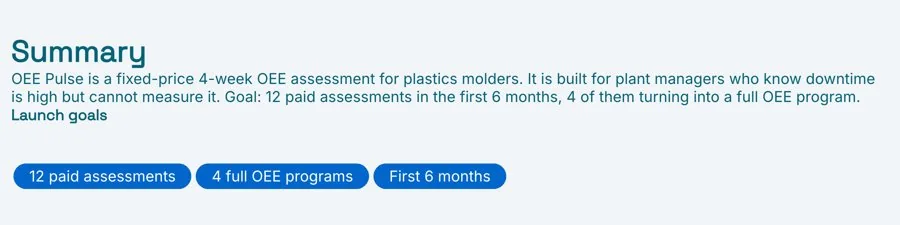
Readers start at the top, so the plan should open with a short summary: what is launching, for whom, on what date, and the two or three goals that define success. Write it after the other sections, once the decisions are made. Make the goals measurable, for example a number of new customers, a revenue figure or a number of qualified sales conversations in the first quarter.
Define the Target Customer Narrowly
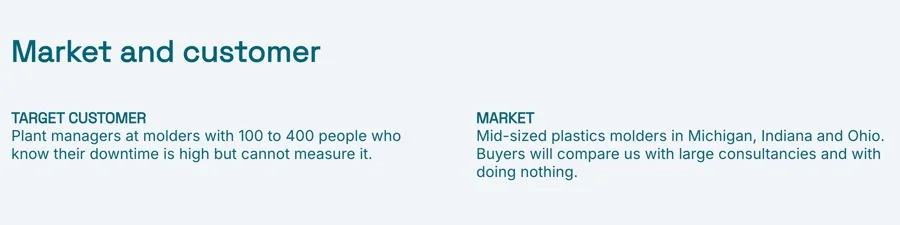
“Small businesses” is a market, not a target customer. Describe the specific buyer: their role, the size and type of their organization, the problem they are trying to solve and what they use today instead. The narrower the description, the easier every later decision becomes, from the words on the website to the channels you choose.
If you have more than one type of buyer, pick the one you will focus on first and note the others for later. A user persona for your main buyer is a useful companion here, and a competitive analysis shows what they will compare you against.
Agree the Positioning Before Anyone Writes Copy
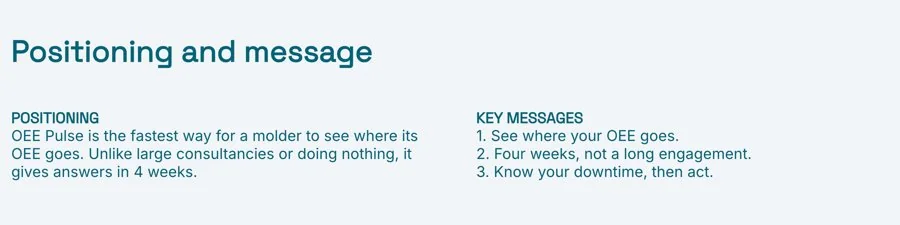
Positioning is the sentence everyone on the team should be able to say: for this customer, with this problem, the product does this, unlike the alternative. Under it, write three key messages, each one a benefit with a short line of proof. Sales decks, web pages and emails then draw from the same three messages, so the customer hears one story wherever they meet you.
Decide Pricing and How People Buy
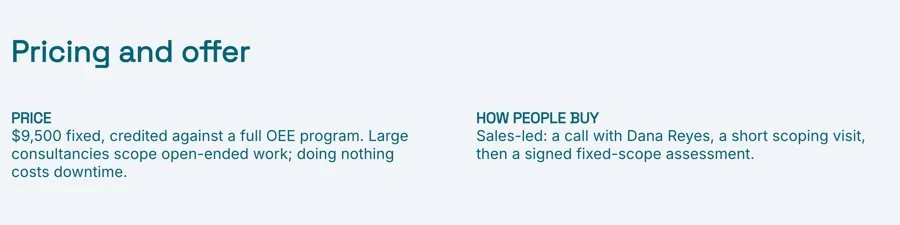
Set out the price or packages and, just as important, the steps a customer takes to buy. Do they sign up and pay online, book a demo or request a quote? Each path needs different channels and a different amount of sales time. Note any launch offer and when it ends, and who approves discounts, so nobody improvises on a sales call.
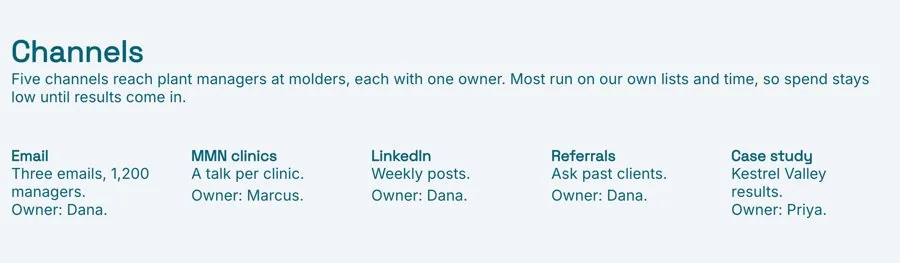
Give Every Channel a Plan, an Owner and a Budget
List each channel on its own card: email to existing customers, partner introductions, paid search, events, content, direct outreach. For each one write:
- What you will do, in a sentence or two
- Who owns it, by name
- The budget, in money and in time
- The number you will watch to judge it
Three or four channels done well beat eight done thinly. Choose the ones where your target customer already spends time, and drop any channel that has no owner.
Set the Timeline, Metrics and Risks
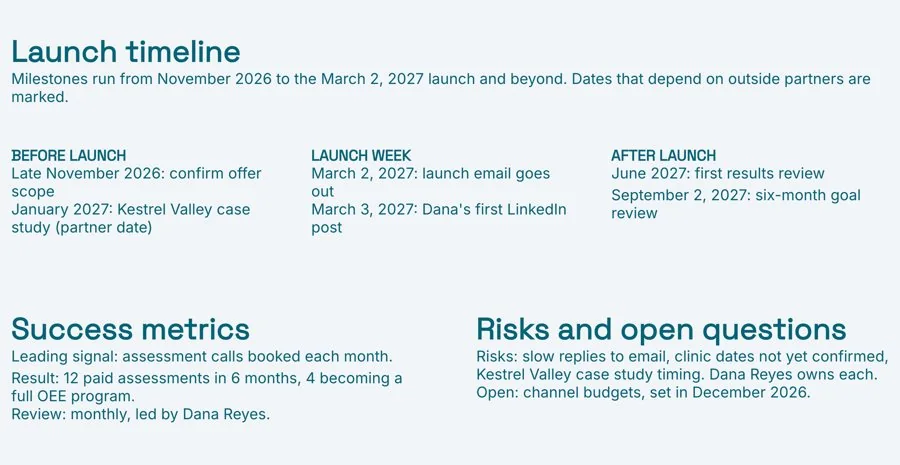
Close with a launch timeline from preparation to the weeks after launch, with an owner for each milestone. Add the success metrics from your summary and when you will review them, for example two weeks and six weeks after launch. Then list three to five risks, such as a late feature, a slow sales cycle or a competitor announcement, each with what you will do if it happens.
Share It as a Live Link, Not an Attachment
A go-to-market plan is a working document. Dates slip, a channel gets more budget, a message is rewritten after the first sales calls. If the plan lives in an attachment, half the team ends up working from an old version.
Share it as a live link instead. Everyone involved, from sales to the agency running ads, works from the same page, and when you update a date or a budget they see it straight away. Keep it in a project workspace with the launch brief and creative, and invite clients or partners in when they need to see it.
If you are writing the plan for a client, engagement analytics shows when they opened it, so you know whether to walk through it on your next call or go straight to decisions.
Common Go-to-Market Plan Mistakes
- Targeting everyone. A plan aimed at every possible buyer ends up speaking to none of them.
- Too many channels. Spreading a small budget across many channels makes it impossible to learn which one works.
- No owners. Every channel and milestone needs one named person.
- Goals you cannot measure. “Build awareness” is not a goal. Pick a number and a date.
- Treating the plan as finished at launch. Update it as results come in.
Prefer to start with AI? The AI Go-to-Market Plan Generator writes a first draft from a short description of your product and customer, with the target market, positioning, pricing, channels and timeline, ready for you to edit.
Related Templates and Guides
- Go-to-Market Plan Template
- Marketing Plan Template
- Competitive Analysis Template
- User Persona Template
- Pitch Deck Template
Frequently Asked Questions
What is a go-to-market plan?
A plan for taking a product or service to buyers. It covers the target customer, positioning and messages, pricing, the channels you will use, the launch timeline and how you will measure success.
What is the difference between a go-to-market plan and a marketing plan?
A go-to-market plan is tied to one launch and covers sales and pricing as well as marketing. A marketing plan usually covers all of a business’s marketing over a period, such as a year.
How long should a go-to-market plan be?
Long enough to record the decisions and no longer. Most fit in a few pages, with supporting research kept in separate documents linked from the plan.
Who should be involved in writing it?
Whoever owns the product or service, plus the people responsible for sales and marketing. Each channel owner should agree to their own section before launch.
When should I start the plan?
Several weeks before launch, so there is time to prepare channels and materials. Keep updating it after launch as results come in.
Ready to plan your next launch?
Start from the template, fill in your market, message and channels, and share one live link with everyone involved in the launch. Free, no credit card required.

