How To Write A Project Status Report in 4 steps
Updated by Xtensio
Wanna know the easy way to keep a big project on track? Enter project status reports. They’re like instant updates on what’s happening, so no task, milestone, or hiccup goes unnoticed. Clients and key players stay in the loop, and we stay on course. With our step-by-step guide and free template, making these reports is a breeze.
Ready to give it a shot? Explore this template.
Xtensio is your team space for beautiful living documents.
Create, manage and share business collateral, easily.
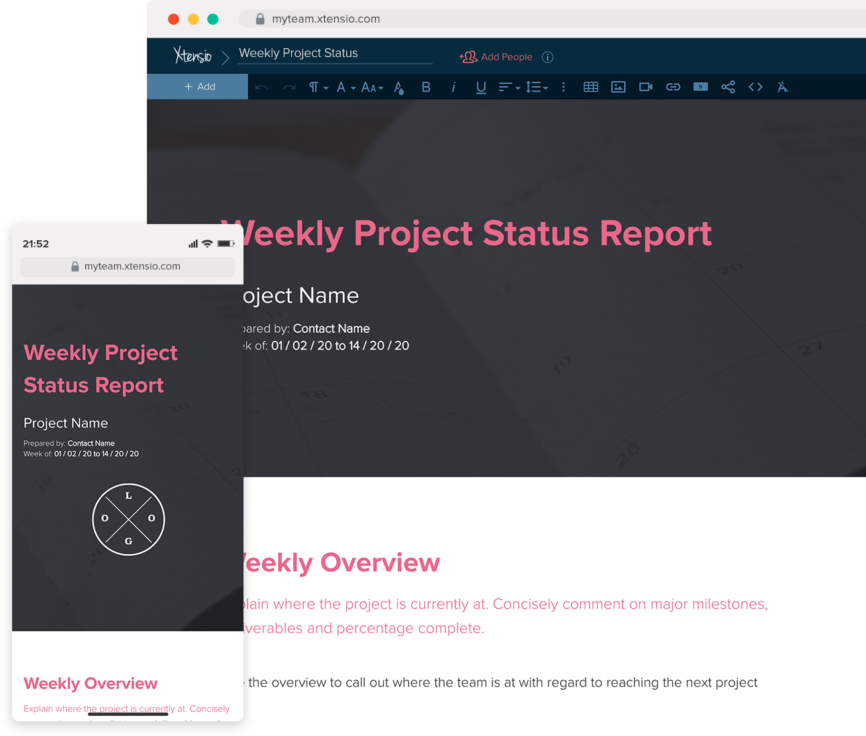
Table of Contents
Keeping everyone in the loop about how your project is coming along is super helpful. It gives everyone a clear picture of what your team is up to, how the timeline is shaping up, the big things that need attention, and any possible risks. Plus, it’s a great way to spot chances to work smarter.
Monthly and quarterly reports give you that big-picture view of where your project is headed. But for the nitty-gritty updates that happen in real-time, use weekly reports. They’re like a play-by-play of what’s happening right now. You can whip up a weekly report in minutes with Xtensio!
Regular updates do a bunch of cool things:
- Make it easier to talk about how the project is moving forward.
- Highlight the important stuff that needs doing and the milestones you’re hitting.
- Quickly tell where things stand, help make predictions, and set expectations.
- Give you the scoop on any problems and how to fix them.
- Let you communicate with the project manager and the whole gang of key players.
- Help everyone see how the team is doing and how well you’re working.
This awesome project status report template is like a secret weapon. It keeps you on track, helps you see what needs doing, and makes sure you’re not missing any deadlines. Reporting is like magic in project management, and with Xtensio’s free status report template, it’s a breeze to keep tabs on how you’re doing, what’s tripping you up, and when things are due.
What Is a Project Status Report and Who Reads It
A project status report is a recurring document that communicates progress, risks, and next steps to stakeholders who are not involved in day-to-day execution. It bridges the gap between the team doing the work and the people funding, sponsoring, or depending on that work.
Different stakeholders read the report for different reasons. Executive sponsors want to know if the project is on track, on budget, and delivering the expected outcomes. Peer teams want to know about dependencies, timelines, and potential impacts on their work. The project team itself uses the report as a forcing function to assess progress honestly.
A well-written status report takes 5 to 10 minutes to prepare each week and saves hours of status meetings, Slack messages, and one-off email updates. It is one of the highest-leverage communication tools a project manager has — invest in getting the format right early.
Share your report as a live link rather than an email attachment. Stakeholders can bookmark it and check progress whenever they need to, without searching through their inbox.
What to Include in Every Project Status Report
Start with a traffic-light summary: green (on track), amber (at risk), or red (off track). This one indicator lets busy executives decide whether to read further or move on. If the status is amber or red, include a one-sentence explanation immediately after the indicator.
Next, list milestones with their planned and actual completion dates. Color-code each milestone to show whether it is completed, in progress, at risk, or not started. This section is the core of the report — it shows whether the project is where it should be.
Include a risks and blockers section that lists anything threatening the timeline, budget, or scope. For each risk, note the severity, the owner, and the mitigation plan. Executives do not want to be surprised — they want to know about problems early and see that someone is handling them.
Close with next steps for the coming reporting period and any decisions or approvals you need from stakeholders. This keeps the report action-oriented rather than purely informational.
Project Status Report vs Project Update vs Weekly Standup Notes
These three communication formats serve different audiences and purposes. Standup notes capture daily tactical details — what was done, what is planned, what is blocked. They are for the project team, not for stakeholders.
A project update is an informal, ad-hoc communication — typically a Slack message or email — triggered by a specific event: a milestone completed, a risk materialized, or a decision needed. Updates are reactive and event-driven.
A project status report is formal, recurring, and comprehensive. It covers the full project landscape at regular intervals (weekly or biweekly). It is the permanent record that stakeholders reference when they want to understand how the project has progressed over time.
Many project managers make the mistake of replacing formal status reports with Slack updates. The problem is that Slack messages disappear into a feed — there is no single, persistent source of truth. A status report creates that source of truth.
How Often Should You Send Project Status Reports
Weekly reporting is standard for active projects with tight deadlines, many dependencies, or high executive visibility. The weekly cadence catches problems early and keeps stakeholders engaged without overwhelming them.
Biweekly reporting works for longer-running projects in steady-state phases where progress is incremental and predictable. If the project is in execution mode and the team is heads-down building, biweekly is usually sufficient.
Monthly reporting suits maintenance-mode projects, internal initiatives with low urgency, or projects where the primary stakeholders have limited bandwidth. Monthly reports should be more comprehensive than weekly ones — covering a full month of progress with trend analysis.
Regardless of cadence, maintain consistency. If stakeholders expect a report every Friday and it arrives sporadically, they lose confidence in the project’s management. Use a reusable template to keep the format consistent and reduce the time it takes to prepare each edition.
4 Steps for writing your project status report
1. Create your status report header and weekly overview
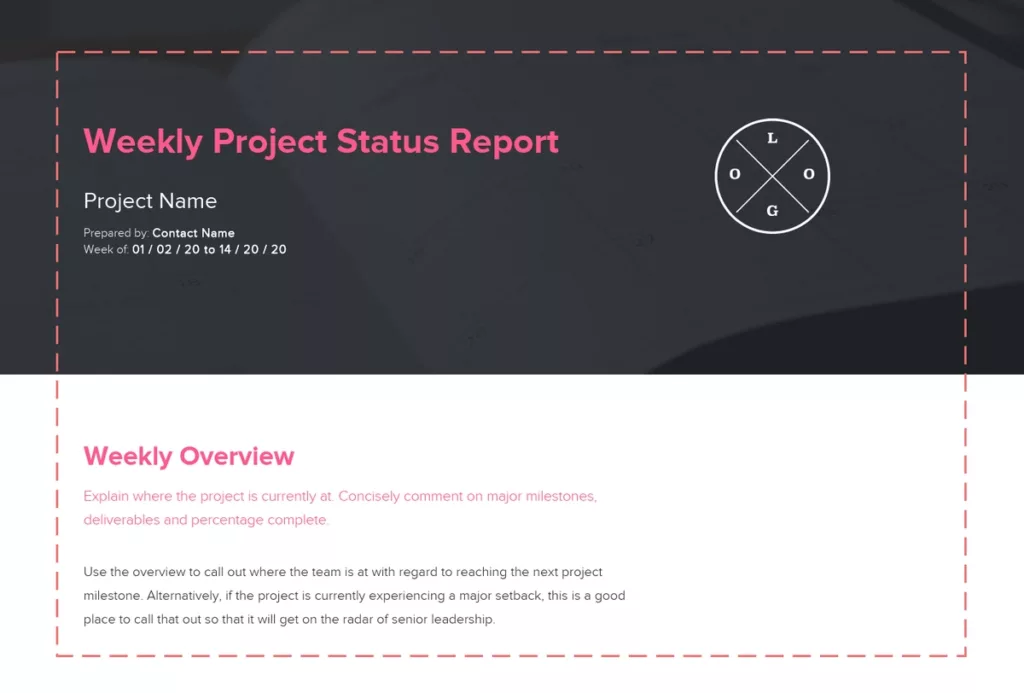
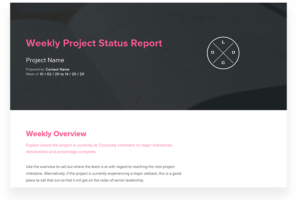
Introduce your status report by adding your company name, the project name, and the name of who prepared the report. You will also want to add the date so it’s easy to go back and reference these reports for your team, client, and other stakeholders. You can also update the logo, folio color scheme, and background to match your company branding.
Use the overview to indicate where the team stands in terms of meeting the next project milestone. If the project is currently facing a big setback, this is a suitable opportunity to bring it to the attention of top leadership.
2. Give a high-level overview of the key project areas using stoplight reporting
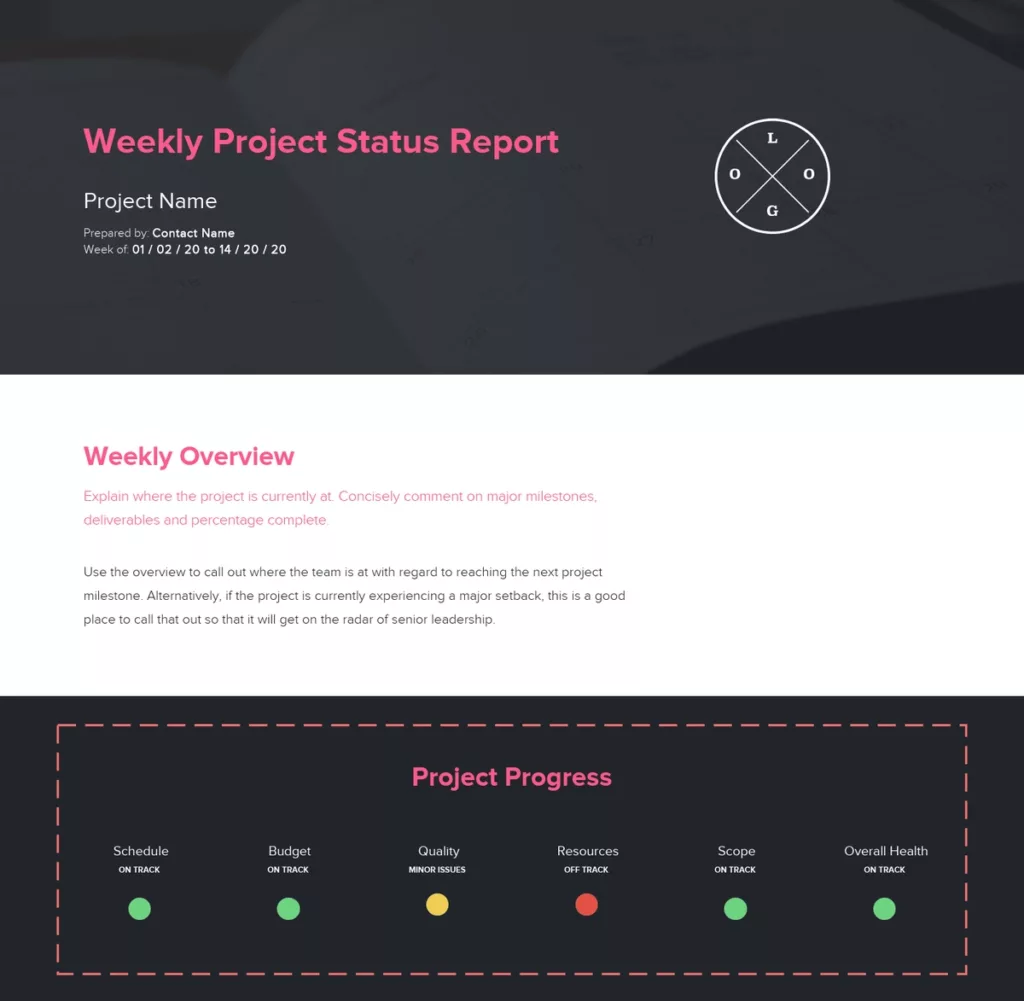
Highlight where each of the main elements of your project is at using the stoplight report. Some factors to think of when using the stoplight report:
- Schedule
- Budget
- Quality
- Resources
- Scope
- Overall project health
Use green, red, and yellow indicators to give stakeholders a quick visual cue of where things are at.
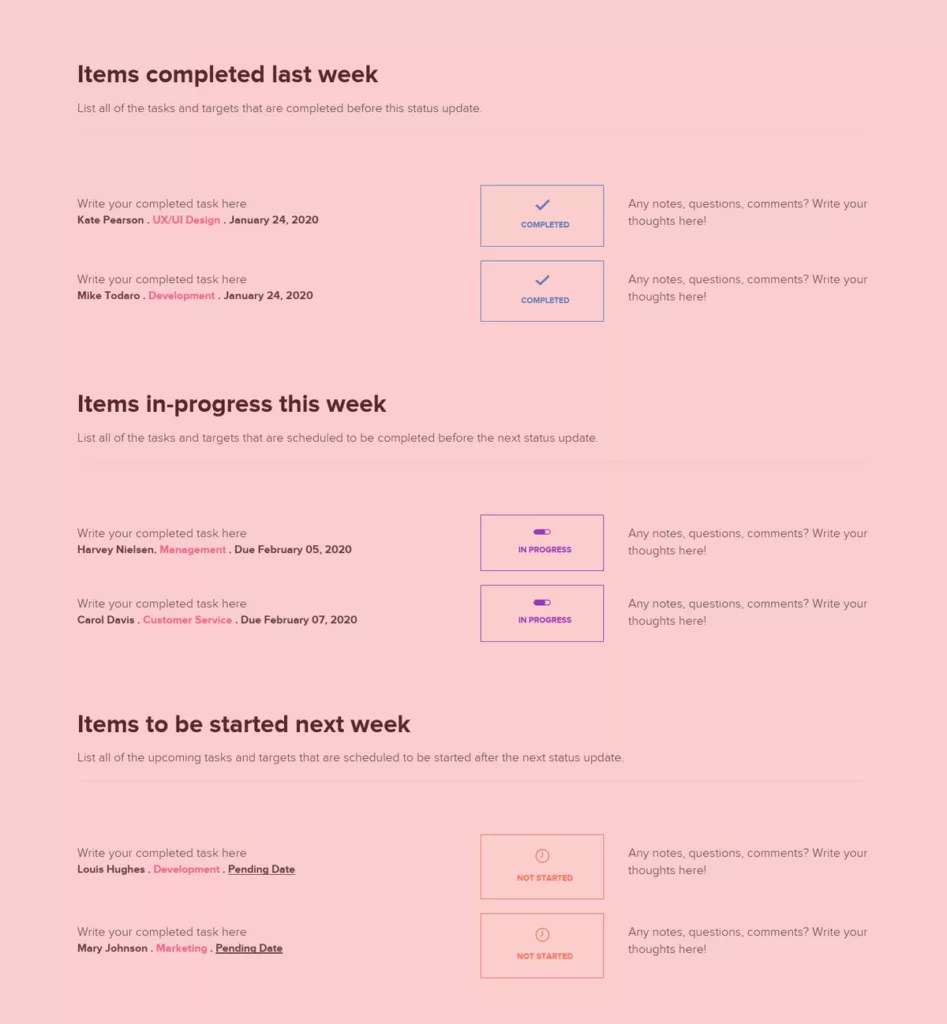
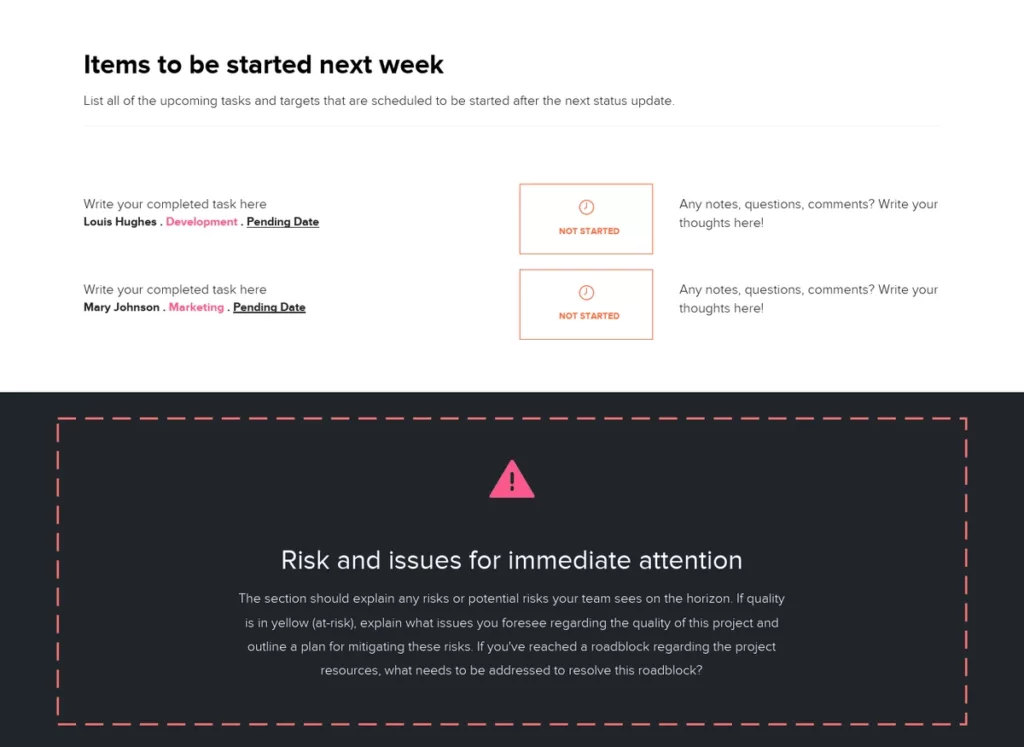
3. Detail 2-3 key milestones or tasks that your team worked on last week, items that will be completed next week, and the tasks on the roadmap for next week
Looking at the past, present, and future, list all of the tasks and targets that your team is working on. It’s a good idea to indicate which team member is in charge of each item and the target due date so that everyone and everything is held accountable.
Notes, questions, and comments can also be added next to each item. While you don’t want to give every detail about how your project is progressing, some individuals will want to know more or require more background information. So you can also link to other resources and documents as needed.
4. Highlight risks, issues, or challenges the project has run into
All projects run into roadblocks. Keeping stakeholders in the loop when issues arise will help everyone adjust accordingly to stay on track. This section should explain any risks or potential risks your team sees on the horizon.
- If quality is in yellow (at-risk), explain what issues you foresee regarding the quality of this project and outline a plan for mitigating these risks.
- If you’ve reached a roadblock regarding the project resources, what needs to be addressed to resolve this roadblock?
Share your project status report as a link, monitor, evaluate & iterate
Remember, these are just guidelines for what information goes into your status report. You’ll want to focus your weekly report on what matters the most to your team. In your analysis, you can focus on a key item highlighting an accomplishment, a hurdle, or a recommendation to help your team align goals.
When you’ve finished creating your project status report with Xtensio’s editor, you can send the live link to your folio to share it as a responsive webpage (and add password protection), export a PDF and post it on your bulletin board and continuously optimize with new learnings. The weekly project status report is adaptable just like other Xtensio tools, it can and should be repurposed, revisited, and revised regularly.
Written by

Design, manage and share beautiful living documents… easily, together. Explore Xtensio
- Click and edit anything… together.
- Customize to match your branding.
- Share with a link, present, embed or download.

Create and deliver beautiful work, professionally.
Build, brand, and deliver living documents your clients actually engage with.







Join 409,632 professionals delivering work with Xtensio.
Related reports: Annual Report Template, Monthly Performance Report Template