How To Do A Pestle Analysis
Updated by Xtensio
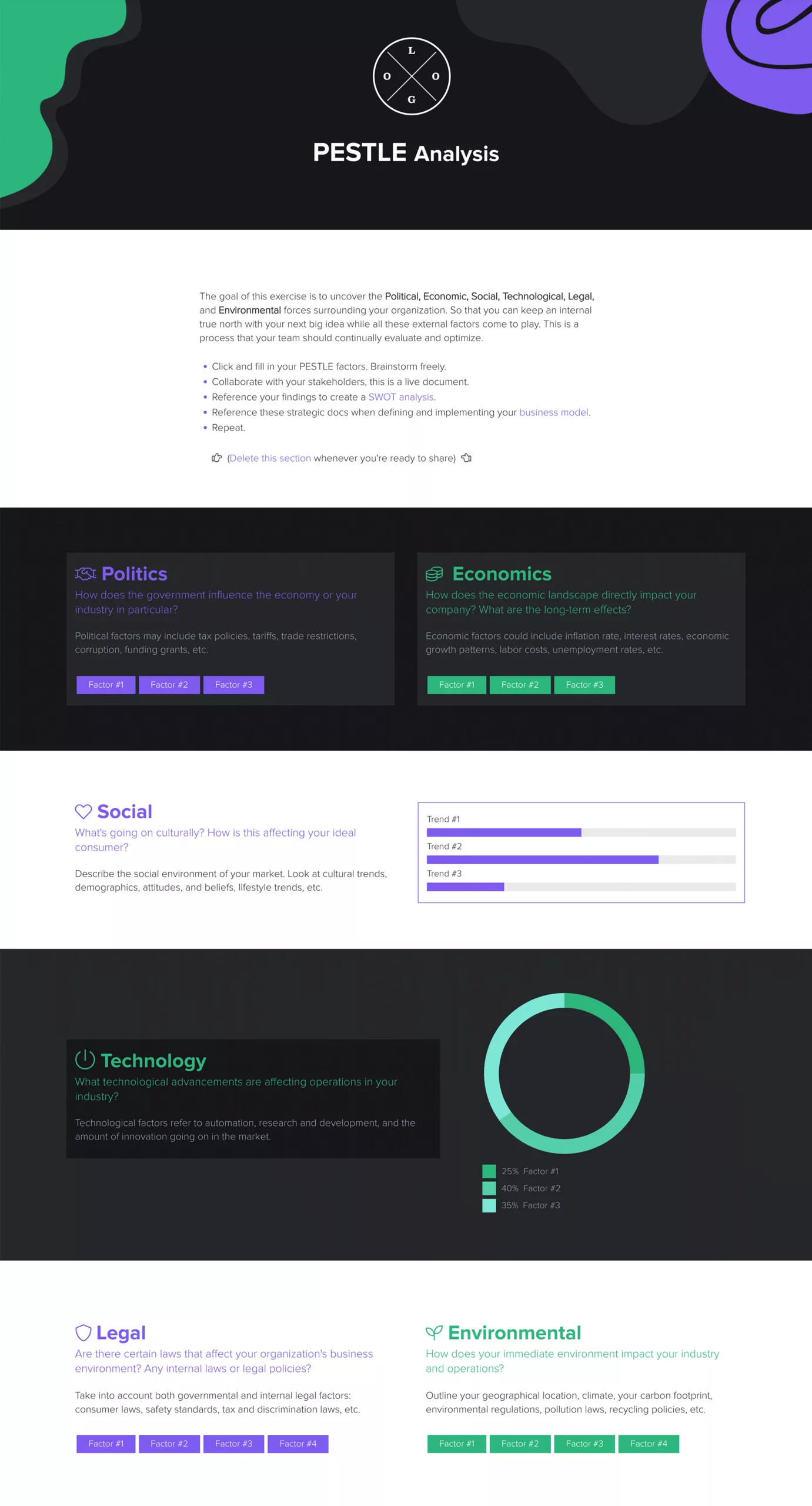
PESTLE Analysis is a strategic framework to identify, analyze, organize, and monitor key external factors that may impact an organization now and in the future. The goal of this exercise is to uncover the Political, Economic, Social, Technological, Legal, and Environmental forces surrounding your organization. So that you can keep an internal true north with your next big idea while these external factors come to play.
Click and start editing the template. Follow along with this step-by-step guide to complete your PESTLE Analysis. Explore this template.
Xtensio is your team space for beautiful living documents.
Create, manage and share business collateral, easily.
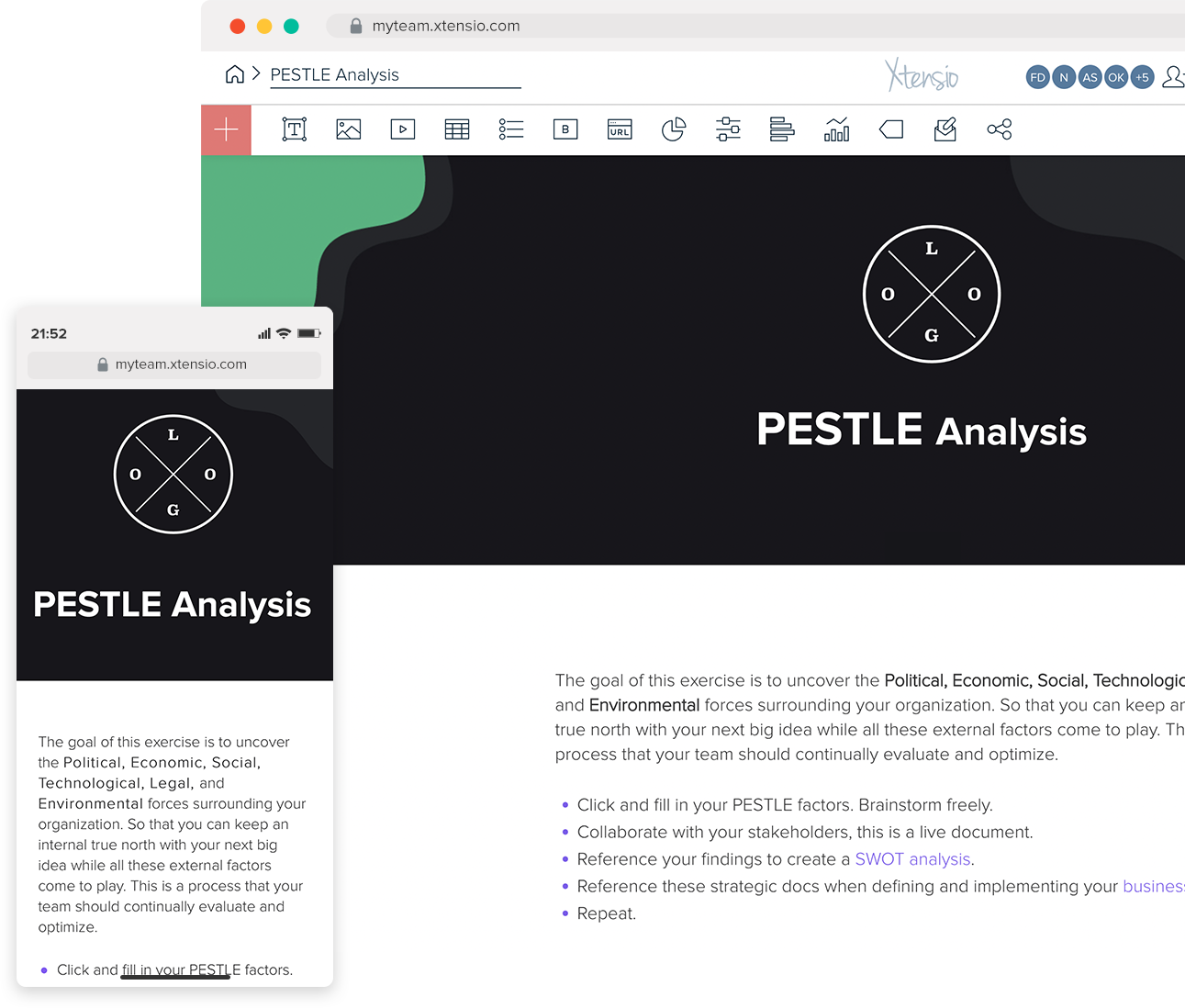
Table of Contents
With Xtensio, you can easily generate a PESTLE analysis tailored to fit your specific requirements. Click and fill info to brainstorm your PESTLE factors. The framework is most useful when you get input from participants with a range of different perspectives. Collaborate with your stakeholders, this is a live document. Then reference your findings to create a SWOT analysis. And use these strategic documents when defining and implementing your business model.
How To Do A Pestle Analysis | Step 1
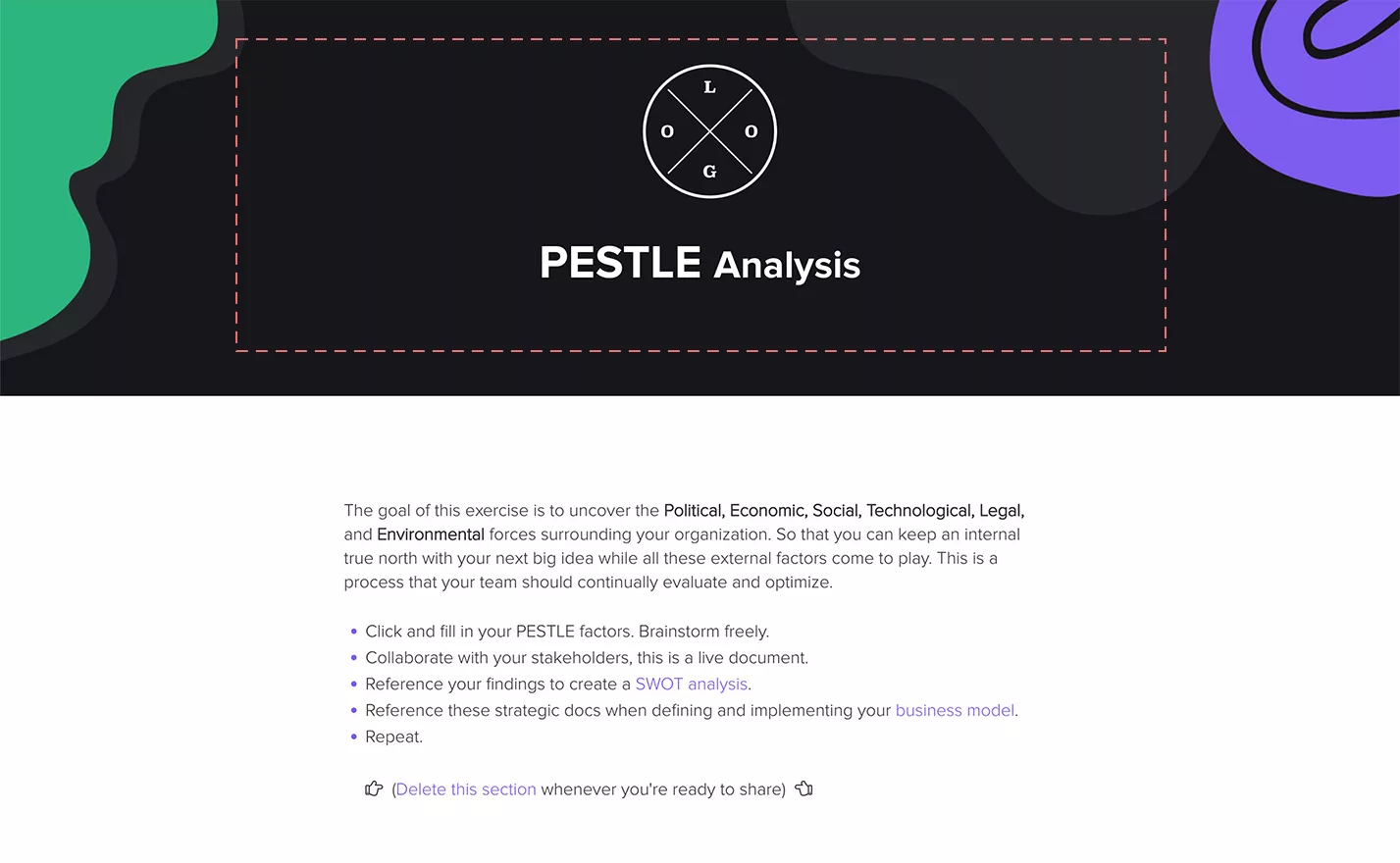
Create your PESTLE Analysis header
Introduce your analysis by adding your company name, uploading your logo, and adding the date. You can also update the folio color scheme and background to match your company branding.
The PESTLE analysis template helps you uncover six major external factors that may affect your organization: the political, economic, social, technological, legal and environmental. This is a process that your team should continually evaluate and optimize so keeping track of the data will help align your team.
How To Do A Pestle Analysis | Step 2
What Is a PESTLE Analysis
PESTLE is a strategic framework that examines six categories of external factors affecting your business: Political, Economic, Social, Technological, Legal, and Environmental. It provides a structured way to scan the macro environment and identify forces that could create opportunities or threats.
The framework originated in the 1960s as PEST (without Legal and Environmental) and has since expanded to reflect the growing importance of regulatory compliance and sustainability. Some practitioners add an ‘E’ for Ethical, creating STEEPLE, but the core six factors cover the vast majority of external influences.
PESTLE is most useful during strategic planning, market entry decisions, product launches, and major investment evaluations. Any time your organization is making a decision that will play out over months or years, understanding the macro environment helps you anticipate headwinds and tailwinds.
Industries with heavy regulation (healthcare, finance, energy) benefit especially from PESTLE analysis because political and legal factors can reshape the competitive landscape overnight. But even tech startups benefit — regulatory changes like GDPR have transformed how every company handles data.
PESTLE vs SWOT vs Porter’s Five Forces
PESTLE, SWOT, and Porter’s Five Forces are complementary frameworks, not competitors. PESTLE looks outward at macro factors you cannot control. SWOT looks at both internal (strengths, weaknesses) and external (opportunities, threats) factors. Porter’s Five Forces examines the competitive dynamics within your specific industry.
A thorough strategic analysis often uses all three in sequence: start with PESTLE to understand the macro environment, use Porter’s Five Forces to analyze industry-level competition, then synthesize everything into a SWOT that includes both external insights and internal capabilities. For a strengths-focused alternative to SWOT, consider a SOAR analysis, which emphasizes what’s working rather than what’s wrong.
The common mistake is using SWOT alone and filling in the Opportunities and Threats quadrants without the structured external analysis that PESTLE provides. This leads to vague entries like ‘market growth’ or ‘new competitors’ instead of specific, actionable insights tied to real macro trends.
Use your workspace to store all three analyses side by side. When you update one, you can quickly check whether the insights carry through to the others.
Common PESTLE Analysis Mistakes
The most frequent mistake is being too broad. Listing ‘the economy’ as an economic factor is useless. Instead, identify specific economic forces relevant to your business: ‘Consumer discretionary spending in our target demographic declined 8% in Q3 due to rising interest rates, reducing demand for premium-tier subscriptions.’
Another error is treating the six categories as independent silos. In reality, they interact constantly. A political decision (trade tariffs) creates an economic impact (higher input costs) that drives a technological response (reshoring manufacturing with automation). Map these connections — they reveal second-order effects that single-category analysis misses.
Many teams complete a PESTLE analysis once and file it away. External factors change continuously — a PESTLE analysis from six months ago may be dangerously outdated. Schedule quarterly reviews to update each factor with current data and reassess which trends are accelerating, decelerating, or reversing.
Finally, do not let the analysis become an academic exercise. Every factor you identify should connect to a strategic implication for your business. If a factor does not affect your strategy, operations, or competitive position, it does not belong in the analysis.
How to Turn PESTLE Findings into Strategy
After completing the analysis, rank each factor on two dimensions: likelihood (how probable is this trend?) and impact (how significantly would it affect your business?). Plot the results on a simple 2×2 matrix. Factors that score high on both dimensions are your strategic priorities.
For each priority factor, define a specific response. Political risks might require lobbying, diversification, or scenario planning. Technological shifts might call for R&D investment, partnerships, or acquisitions. Economic headwinds might trigger pricing adjustments, cost reduction, or market repositioning.
Assign ownership for each response. A PESTLE insight without an owner is just an observation. Someone needs to be accountable for monitoring the factor, triggering the response if conditions change, and reporting progress to leadership.
Present your PESTLE findings to leadership as a one-page summary with three columns: Factor, Impact on Our Business, and Recommended Response. Executives do not want to read a 20-page analysis — they want to see the implications and the plan. Share it as a live link that stays current as your macro environment evolves.
Uncover your company’s political and economic factors
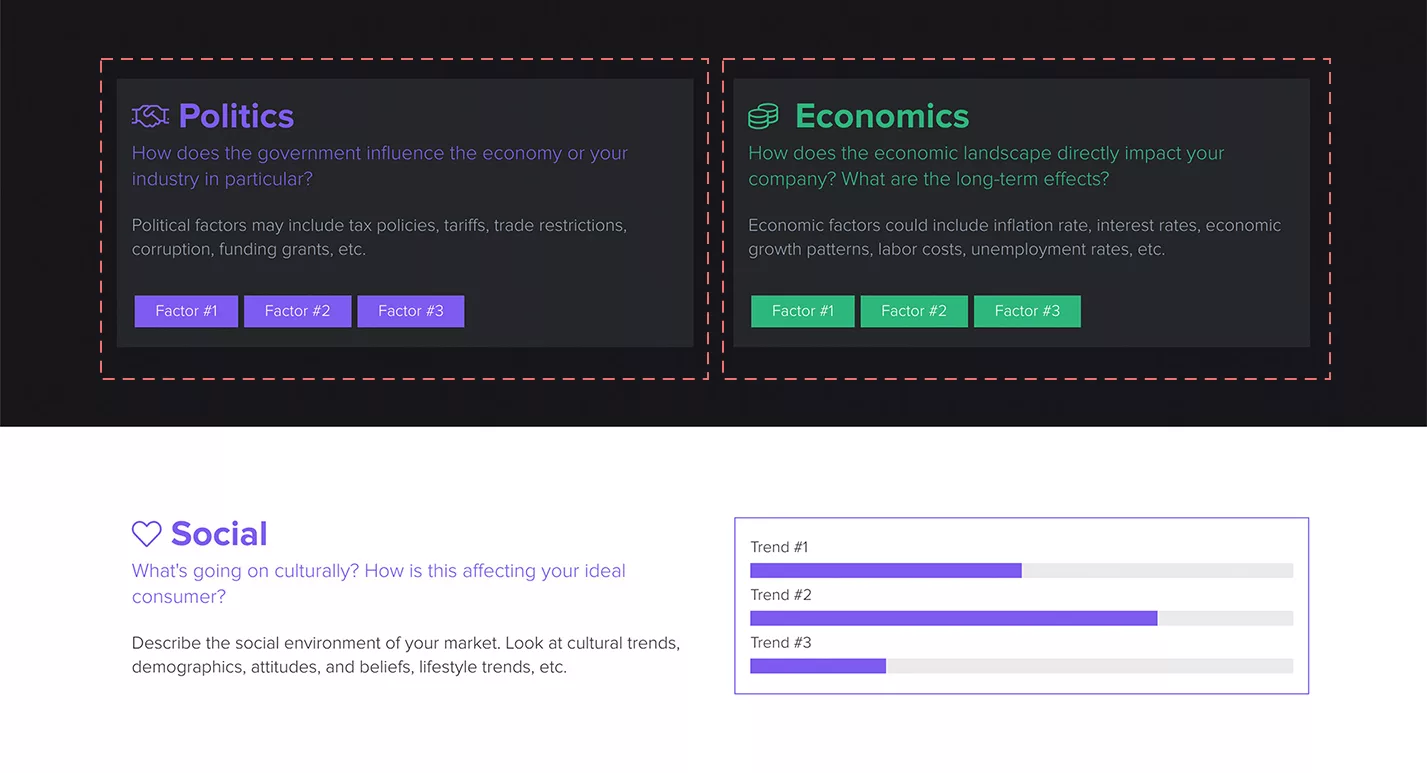
POLITICS: This factor represents the way and extent to which the government influences the economy and certain businesses. This could be at the federal, state or local level. Political factors may include tax policies, tariffs, trade restrictions, corruption, funding grants, etc.
How does the government influence the economy or your industry in particular? Is the political environment stable or likely to change?
ECONOMICS: This factor refers to the areas unique to the economy that directly influence your business. Economic factors could include inflation rate, interest rates, economic growth patterns, labor costs, unemployment rates, etc. Economic factors could be both local and global.
How does the economic landscape directly impact your company? What are the long-term effects? How does each economic factor impact our pricing, revenues, and costs?
Quick Tip: Use the tag module to highlight key factors so key decision-makers can quickly scan and understand possible threats and opportunities in your environmental landscape.
How To Do A Pestle Analysis | Step 3
Determine your social factors
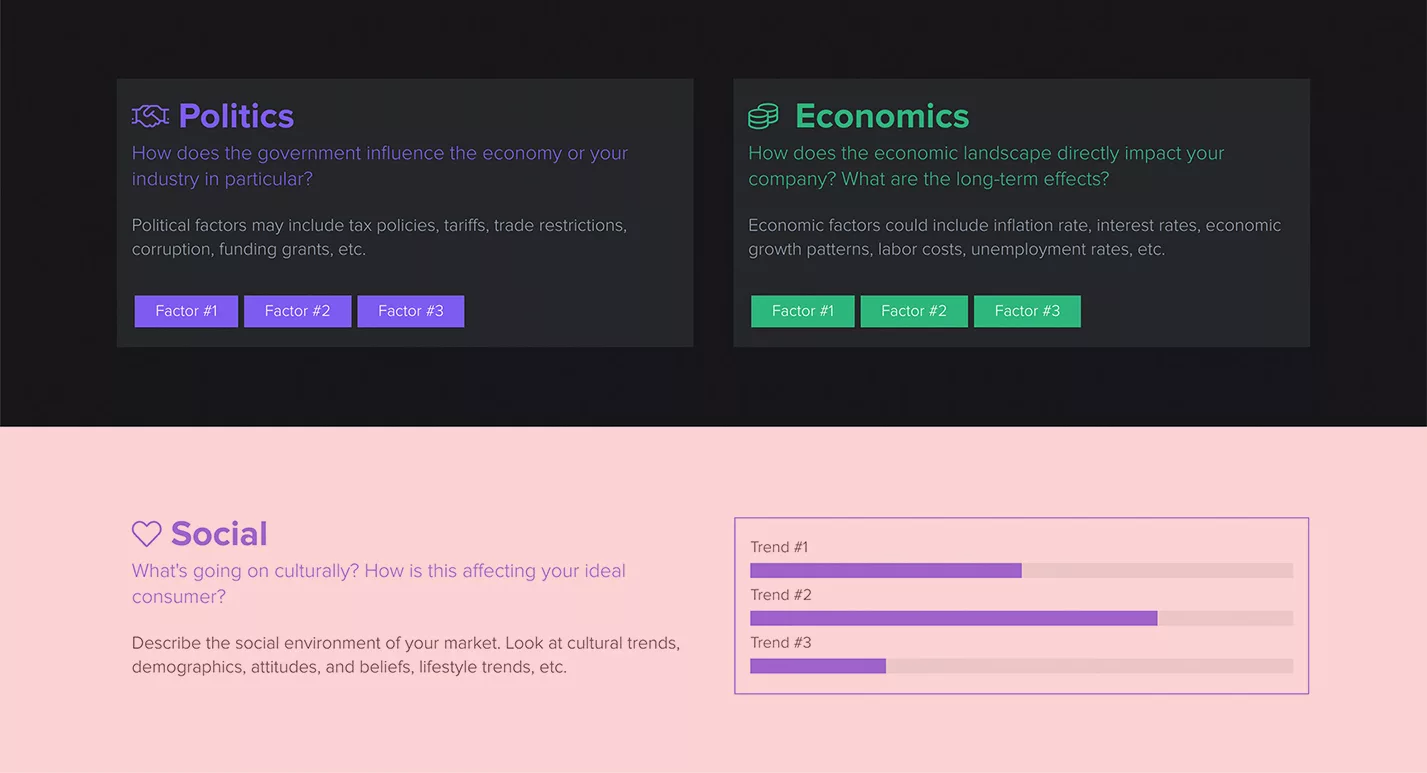
SOCIAL: These are demographic factors, including population growth rates, cultural trends, the age distribution of the population, attitudes and beliefs, lifestyle trends, etc. Many of these factors may impact the way you do business with your clients or global business partners.
What’s going on culturally? How is this affecting your ideal consumer? Does human behavior or cultural trends play a role in our business?
How To Do A Pestle Analysis | Step 4
Outline technological factors affecting your business
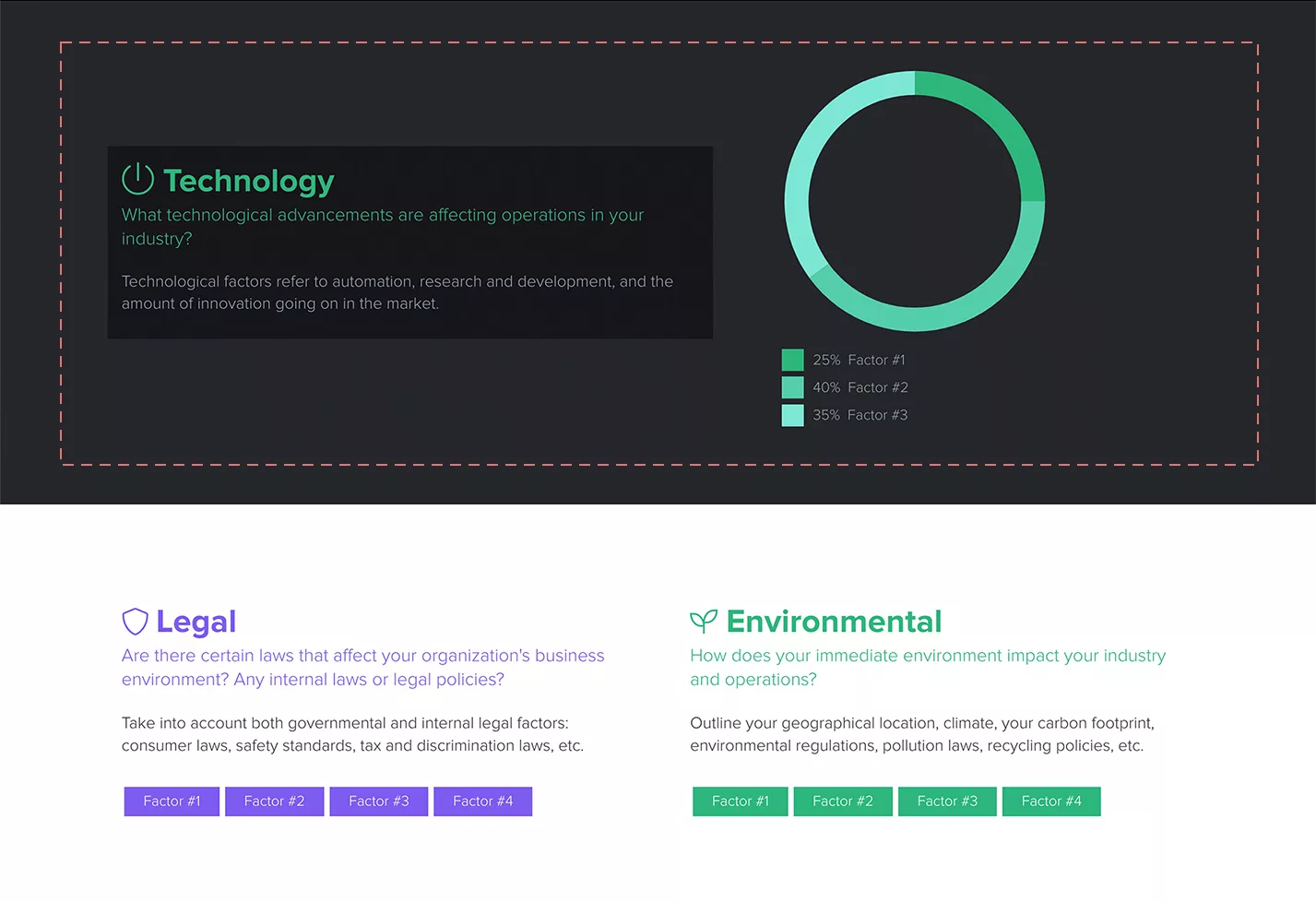
What technological advancements are apparent or emerging in your market? How will they affect operations in your industry?
TECHNOLOGICAL: These factors refer to the rate of technological changes, automation, research and development, and the amount of innovation going on in the market. Technological factors may influence outsourcing decisions, quality, and efficiency considerations.
How To Do A Pestle Analysis | Step 5
Understand legal and environmental factors
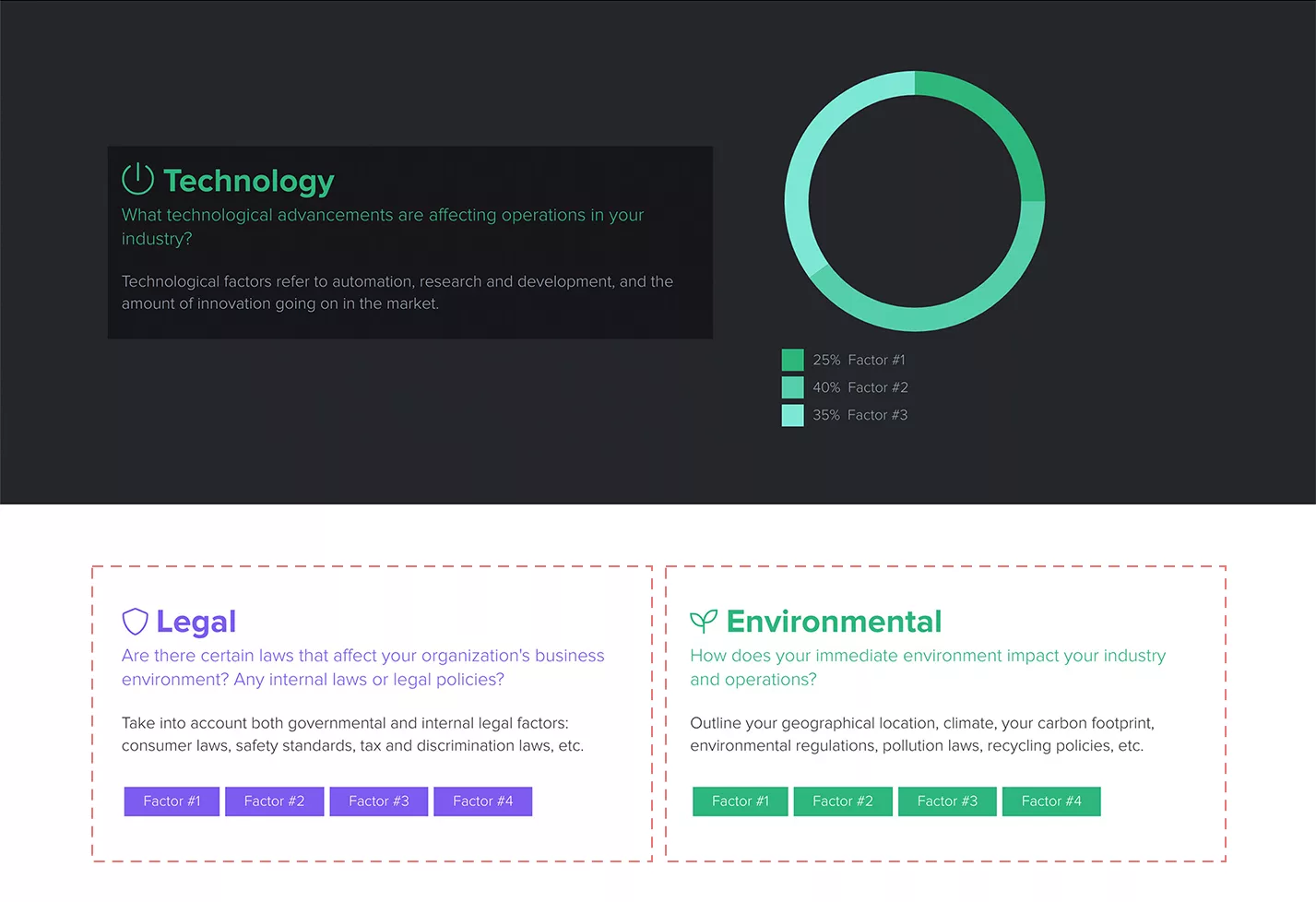
LEGAL: Take into account both governmental and internal legal factors that affect business operations. These could include consumer laws, safety standards, tax and discrimination laws, etc.
Are there certain laws that affect your organization’s business environment? Any internal laws or legal policies? Do we understand the laws across all our markets?
ENVIRONMENTAL: Outline your geographical location, climate, your carbon footprint, environmental regulations, pollution laws, recycling policies, etc to understand how environmental forces impact your businesses and/or customer’s buying power.
How does your immediate environment impact your industry and operations? What are the effects of climate, weather, or geographical location? Are we prepared for future environmental targets?
How To Do A Pestle Analysis | Step 6
Identify the implications of each PESTLE factor on your business
After uncovering each of the external factors affecting your business, individually rate each of the ideas based on the level of impact you think they will have on your business. Generally, this involves assessing their impact over time (short, medium and long-term), impact by type (positive or negative affects), and impact by dynamics; i.e. the significance/importance of the implication increasing, decreasing, or remaining unchanged.
Discuss any significant discrepancies in the ratings between departments. Ask participants to explain their rationale and ideally, have them re-rate that idea based on discussions. The more aligned you can get your team’s thinking around each factor, the better understanding everyone will have about challenges facing other parts of the organization, and the more focused your strategic planning will be.
Share your PESTLE analysis as a link, monitor and evaluate
When you’ve finished creating your user PESTLE Analysis with Xtensio’s editor, you can send the live link to your folio to share it as a responsive webpage (and add password protection), export a PDF and post it on your bulletin board and continuously optimize with new learnings. Distribute the PESTLE Analysis to relevant stakeholders. Use the report to monitor progress and as a foundation for future reviews.
Reference this and your SWOT analysis (Learn how to do a SWOT Analysis) or SWOT alternative when defining and implementing your business model. And repeat the PESTLE analysis at regular intervals to stay on top of changes in the macro-environment and keep your strategies and plans up to date. The PESTLE Analysis template is adaptable just like other Xtensio tools, it can and should be repurposed, revisited, and revised regularly.
Written by

Design, manage and share beautiful living documents… easily, together. Explore Xtensio
- Click and edit anything… together.
- Customize to match your branding.
- Share with a link, present, embed or download.
PESTLE vs SWOT vs Porter’s Five Forces
Strategic analysis frameworks often get confused because they all involve listing factors and making decisions. But each framework examines a different layer of your business environment, and using the wrong one produces incomplete analysis.
PESTLE analysis scans the external macro environment: the broad political, economic, social, technological, legal, and environmental forces that affect your industry as a whole. These are forces no single company controls. Government regulations, inflation rates, demographic shifts, emerging technologies, and climate legislation all fall into PESTLE. The output is a map of external conditions that create opportunities or threats for your business over the next one to five years.
SWOT analysis bridges internal and external perspectives. Strengths and Weaknesses look inward at your organization’s capabilities, resources, and limitations. Opportunities and Threats look outward at market conditions, competitor moves, and environmental changes. SWOT is broader but shallower than PESTLE. It gives you a snapshot of where you stand, but it does not systematically cover the macro factors that PESTLE examines. For a deeper dive on how to use SWOT effectively, see our SWOT analysis guide.
Porter’s Five Forces focuses specifically on competitive industry structure. It examines five dynamics: the threat of new entrants, the bargaining power of suppliers, the bargaining power of buyers, the threat of substitute products, and the intensity of competitive rivalry. Porter’s framework helps you understand why your industry is or is not profitable and where competitive pressure will come from. It is narrower than both PESTLE and SWOT but goes deeper on competitive dynamics.
Here is how they complement each other:
- Start with PESTLE to understand the macro forces shaping your industry. This gives you the “big picture” context that informs everything else.
- Use Porter’s Five Forces to analyze the competitive dynamics within your specific industry. PESTLE factors often drive changes in Porter’s forces (e.g., new regulation lowers barriers to entry).
- Finish with SWOT to synthesize everything into an actionable view of your organization’s position. Your PESTLE findings feed into Opportunities and Threats. Your Porter analysis sharpens your understanding of competitive Strengths and Weaknesses.
Running all three in sequence takes more time, but it produces analysis that is significantly more thorough than any single framework alone. Use the SWOT analysis template alongside your PESTLE analysis to capture both macro and organizational factors in one workspace.
How to Turn PESTLE Findings Into Strategic Decisions
The most common failure point in PESTLE analysis is not the analysis itself. It is what happens (or does not happen) afterward. Teams invest hours identifying political, economic, social, technological, legal, and environmental factors, then file the document away and return to business as usual. Turning PESTLE findings into actual strategic decisions requires four specific steps.
Step 1: Prioritize by impact and probability. Not every PESTLE factor matters equally. Plot each factor on a simple 2×2 matrix: high impact/high probability (act now), high impact/low probability (prepare contingency plans), low impact/high probability (monitor), low impact/low probability (note and move on). This exercise typically reduces a list of 20 to 30 factors down to 5 to 8 that demand strategic attention.
Step 2: Map factors to business functions. Each high-priority factor affects specific parts of your organization. A new data privacy regulation (Legal) may require changes in your product team, legal department, and marketing operations simultaneously. Map each prioritized factor to the teams and functions it affects, with a named owner responsible for monitoring and responding. Without ownership, PESTLE factors remain abstract observations instead of actionable items.
Step 3: Create scenario plans. For the highest-impact, highest-uncertainty factors, develop two or three scenarios: best case, worst case, and most likely case. For each scenario, define the trigger event (what would signal this scenario is unfolding), the business impact (revenue, operations, headcount), and the response plan. Scenario planning is not about predicting the future. It is about preparing your organization to respond quickly when a PESTLE factor shifts.
Step 4: Set monitoring triggers. PESTLE analysis is not a one-time exercise. The macro environment changes continuously, and your analysis needs to change with it. For each prioritized factor, define a monitoring trigger: a specific event or threshold that signals the factor has shifted enough to warrant revisiting your strategy. Examples: “If the central bank raises interest rates above 5%, revisit our expansion timeline.” “If competitor X enters our market segment, activate our contingency pricing plan.”
Keep your PESTLE analysis in a workspace alongside your SWOT and competitive analysis documents. Share it as a live link with your strategy team so the analysis stays current as new information surfaces. A PESTLE document that gets updated quarterly is vastly more valuable than one that sits untouched after the initial workshop.

Create and deliver beautiful work, professionally.
Build, brand, and deliver living documents your clients actually engage with.







Join 409,446 professionals delivering work with Xtensio.