
How-to Guide
How to Write a Key Account Plan
Your biggest clients deserve more than a renewal reminder. Here is how to plan an account: goals, stakeholders, growth, risks and a rhythm to review it.
Most businesses have a handful of clients that matter far more than the rest. They bring in a large share of revenue, refer new work, and would leave a real gap if they went. Yet they are often managed like everyone else: a renewal date in the calendar, a few check-in calls, and growth that happens only when the client asks for it.
A key account plan changes that. It is a short document that sets out where the account stands, who matters on the client’s side, where you could do more for them, what could go wrong, and how often you will review it. This guide walks through each section, and how to keep the plan alive after the first draft.
Which Accounts Need a Plan
Not every client needs one. Write a key account plan for the accounts where any of these is true:
- They are a large share of your revenue. Losing one would change your year.
- They have room to grow. Other teams, regions or services they do not buy from you yet.
- The relationship rests on one person. If your main contact left, would you still have the account?
- They are strategic. A well-known name, a new market, or work that leads to more work.
For most small firms that means a handful of accounts. Plan more than your team can keep up to date and the plans stop being updated.
What to Include in a Key Account Plan
Keep it to one page your team can read before any client meeting. Six sections cover what most accounts need:
- Account summary and goals. Who the client is, what they buy today, why the account matters, and three goals for the period.
- Where you stand. How strong the relationship is and where it is thin, plus the client’s priorities this year, in their words.
- Stakeholders. The people who decide, influence and use your work, what each cares about, and who on your team owns each relationship.
- Growth opportunities. Where you could do more for the client, each with an estimated value, a next step and a date.
- Risks and actions. What could weaken or end the account, and what you will do about each.
- Review rhythm. When you review the plan internally and when you review progress with the client.
The Key Account Plan Template has all six sections in this order, with a short prompt in each one telling you what to write, and a finished example to follow.
Write Goals the Client Would Recognize
Start with the account summary: who the client is, what they buy from you today and why the account matters, in three sentences. Then set three goals for the period. At least one should be about the client’s success, not only your revenue. “Grow the account by a third” is a fine internal goal, but it is stronger next to “help them launch in a second region by the autumn”, because that is what makes the growth possible.

Be Honest About Where You Stand
The second section is where plans most often flatter the account. Write down how strong the relationship really is and where it is thin. Do you only know the person who approves the invoices? Has the client gone quiet since a project slipped? Then note the client’s own priorities for the year, using their words from meetings, plans or announcements, not your guess at them.
Every opportunity later in the plan should connect to one of those priorities. If it does not, it is your goal rather than theirs, and it will be hard to sell.

Map the Stakeholders, Not Just Your Contact
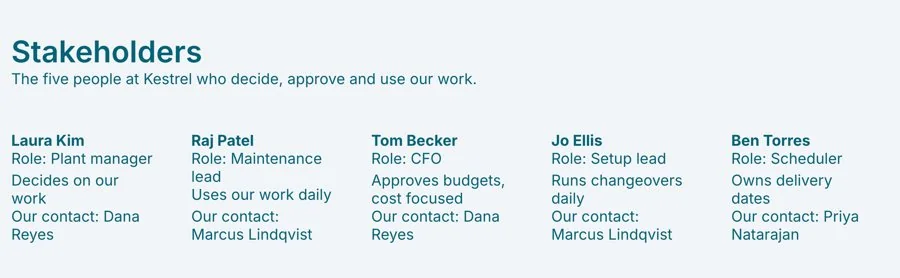
Accounts are often lost when the one person who knows you moves on. List the people who matter on the client’s side, with three notes for each:
- Role. Their title, and whether they decide, influence or use your work.
- What they care about. One line, such as cost, speed, quality or how the work makes them look to their own boss.
- Who owns the relationship. One named person on your side for each of them.
Then look for gaps. If a decision maker has no owner on your team, or every relationship runs through one person, write it down as a risk.
Put a Value and a Next Step on Every Opportunity
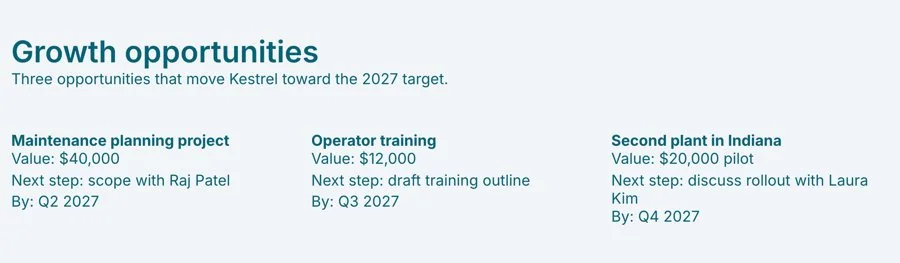
Growth opportunities are where the plan earns its keep. For each one, write what it is, roughly what it is worth, the next step and the date it should happen by. “Expand into marketing” stays vague for a year. “Propose the quarterly report service to their marketing lead by the end of March” gets done.
Keep the list short. Three well-chosen opportunities with owners and dates are worth more than ten ideas nobody follows up.
Name the Risks Before They Happen
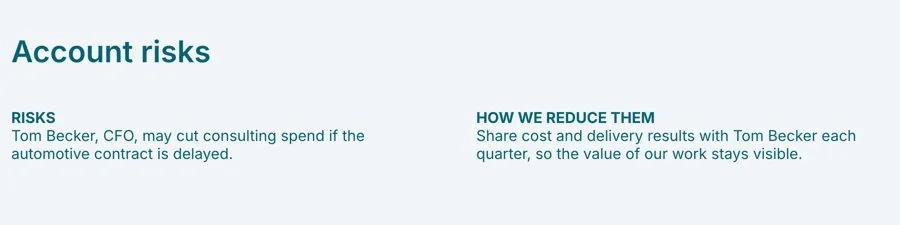
Every key account carries risks: a contract coming up for review, a new procurement process, a champion who might leave, a competitor pitching for the work, a project that went badly. Write each one down with the action you will take and who owns it. Naming a risk early is what gives you time to deal with it.
Set a Review Rhythm and Keep It
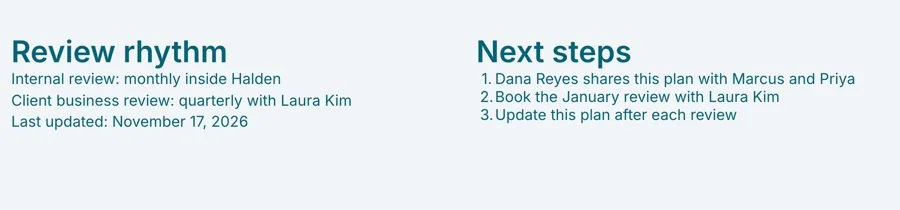
A key account plan written once and filed is not a plan. Agree two rhythms: an internal review, often monthly, where your team updates the plan, and a regular review with the client, often quarterly, where you look at results and their priorities together. A monthly client report gives those conversations a shared starting point.
Keep It as a Live Plan Your Team Shares
Account plans go stale because they live in a file only one person opens. Keep yours as a live link instead, so everyone who works on the account reads the same version and sees updates as soon as they are made. Store it in a project workspace with the proposals, reports and notes for that client, so nothing about the account is scattered across inboxes.
Keep the internal plan internal. If you want to share part of it with the client, such as the goals and review dates, make a separate client-facing page and send that link instead.
Common Key Account Planning Mistakes
- Planning around your revenue only. Tie every goal and opportunity to something the client wants.
- One relationship. If everything runs through one contact, the account can leave when they do.
- Opportunities without owners or dates. They stay ideas.
- Ignoring risks because the account feels safe. The accounts that feel safest are often the least watched.
- Writing it once. A plan nobody reviews is out of date within a quarter.
Prefer to start with AI? The AI Key Account Plan Generator writes a first draft from your account notes, with the summary, stakeholders, opportunities, risks and review rhythm, ready for you to edit.
Related Templates and Guides
- Key Account Plan Template
- Customer Success Plan Template
- Monthly Client Report Template
- 30-60-90 Day Sales Territory Plan Template
Frequently Asked Questions
What is a key account plan?
A key account plan is a short document for one important client that sets out your goals, the current relationship, the stakeholders, growth opportunities, risks and how often you will review it.
How is a key account plan different from a sales plan?
A sales plan covers a whole territory or pipeline. A key account plan goes deep on one client, so you can protect the relationship and grow it.
How many key accounts should I plan for?
As many as your team can keep up to date, usually a small handful. Start with the accounts that bring in the most revenue or have the most room to grow.
How often should I update a key account plan?
Review it internally every month and with the client every quarter, and update it whenever a stakeholder, priority or risk changes.
Should I share the plan with the client?
Share the goals and review dates, not your internal notes on risks and relationships. A separate client-facing page sent as a live link works well for that.
Ready to plan your most important account?
Start from the template, add what you know about the client, and keep one live plan your whole team works from. Free, no credit card required.

