How To Write Investor Updates (With Template and Examples)
Updated by Xtensio
Investor reports share key qualitative and quantitative data with your financial investors, including important information about recent wins, the state of finances, and other relevant insights. These reports are meant to give investors a high-level view of what’s going on in your business over time. Use this step-by-step guide to create your investor updates reports, easily. Explore this template.
Xtensio is your team space for beautiful living documents.
Create, manage and share business collateral, easily.
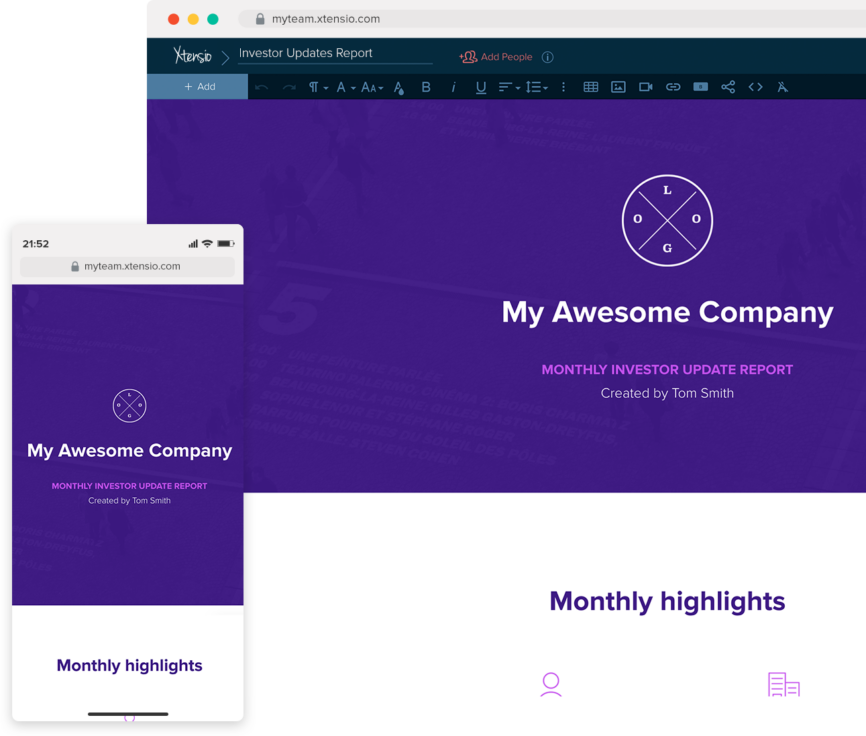
Table of Contents
Why Investor Updates Matter Beyond Reporting
Investor updates serve three purposes beyond basic reporting. First, they build trust. Consistent, transparent communication — especially about challenges — demonstrates maturity and earns the benefit of the doubt when you need it.
Second, investor updates activate your investor network. When you include a specific ask — an introduction, a hiring referral, a strategic opinion — investors can help. But they cannot help if they do not know what you need. Most founders under-ask because they treat updates as one-way reporting instead of two-way engagement.
Third, regular updates create a documented history of your company’s evolution. When you raise your next round, due diligence teams often request prior investor communications. A consistent stream of honest, well-structured updates is powerful evidence of responsible management.
The founders who communicate best with investors tend to get more support, better terms, and faster follow-on decisions. The update is not a chore — it is a strategic asset.
What to Include in Bad-News Investor Updates
Transparency is not optional — it is expected. When results are poor, your investors will find out eventually. Hearing it from you first, with context and a plan, is far better than hearing it secondhand or discovering it in the next board meeting.
Structure bad-news updates with three sections: what happened (state the facts clearly), why it happened (root cause analysis, not excuses), and what you are doing about it (specific actions, timelines, and expected outcomes). This framework shows that you understand the problem and are actively addressing it.
Avoid the temptation to bury bad news between good news. The ‘compliment sandwich’ does not work with sophisticated investors — it reads as evasive. Lead with the most important information, whether it is good or bad. Your credibility depends on it.
End bad-news updates with a specific ask. Do you need introductions to potential hires? Advice on a strategic pivot? An extension on your runway? The worst thing you can do during a downturn is go silent and try to solve everything alone. Your investors have seen these situations before — let them help.
Investor Update Frequency and Timing
Monthly updates are the gold standard, especially in the first 18 months after a raise. Quarterly is acceptable for later-stage companies with more predictable metrics. Going longer than quarterly signals disengagement and makes investors nervous.
Send updates in the first week of the month for the prior month’s data. Consistency in timing matters — investors learn to expect your update and may check in if it is late. Treat it like a publication deadline.
Keep the update to one page or one screen. Investors receive updates from 20 to 50 portfolio companies. A concise update gets read; a five-page report gets skimmed or saved for later (which means never). Use a live link format so investors can read it on any device without downloading attachments.
If something significant happens between scheduled updates — a major customer win, a key hire, a pivot decision — send a brief ad-hoc update. Do not wait for the monthly cadence to share news that investors would want to know immediately.
Your guide to creating powering investor updates reports
It’s important to maintain a healthy relationship with investors and key stakeholders by providing regular portfolio updates. You need to build relationships so you can build trust, transparency, and long-lasting partnerships with your investors. Investor reports highlight important information about recent wins, the state of finances, and other relevant insights, and are meant to give investors a high-level view of what’s going on in your business over time. These reports will help you maintain a healthy relationship with investors and key partners. Here’s how:
- Provide investors with an ongoing glimpse of your company’s performance over key metrics.
- Build trust with VC firms and angel investors by making it easy for them to make decisions about actions they might take with their portfolio.
- Increase your chances of receiving help, time, and introductions from investors.
Your investor updates report should take only a few minutes a month and will create an everlasting impact on your business and future endeavors. Xtensio’s free monthly investor updates report template makes it easy to keep track of productivity, roadblocks, and deadlines.
You can also use the Annual Report Template to give your investors an overall summary of your company’s yearly achievements.
1. Create your investor updates report header and highlight monthly achievements
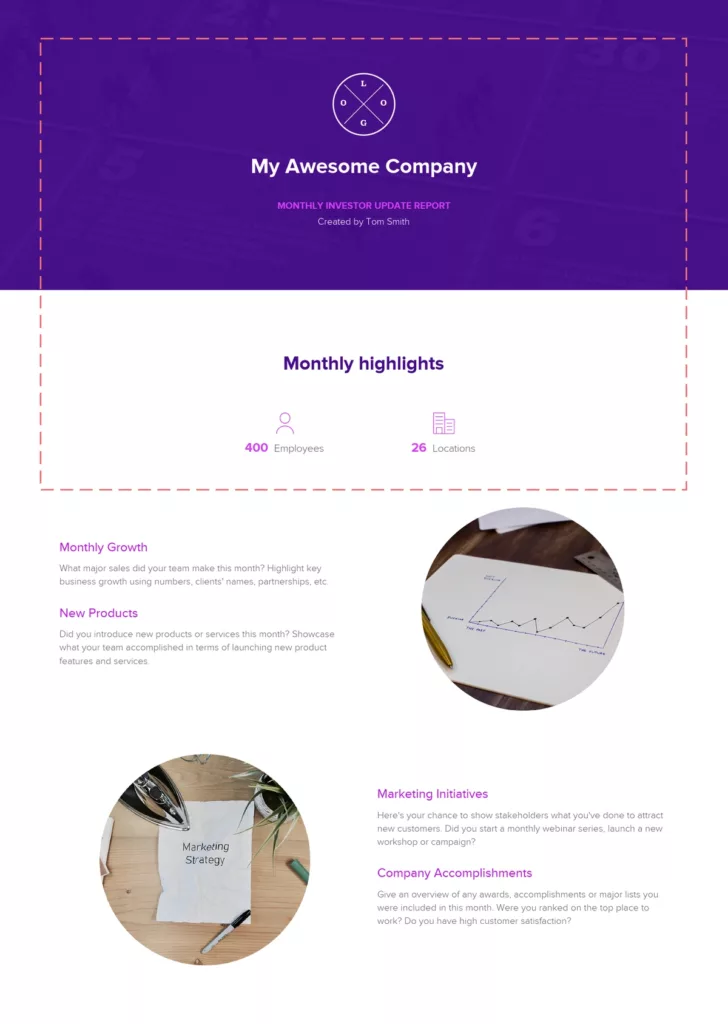
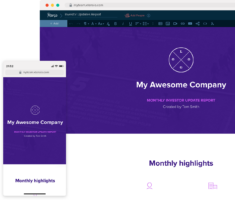
Introduce your investor updates report by adding your company name, the project name, and the name of who prepared the report. You will also want to add the date so it’s easy to go back and reference these reports for your investors, partners, and stakeholders. You can also update the logo, the folio color scheme, and the background to match your company branding.
QUICK TIP: Once you set up your header section and update the color scheme and background to match your brand, you can save a custom template to easily repurpose for your ongoing investor reports.
2. Give a high-level overview of business initiatives and metrics your investors care about
Highlight key stats – number of employees and locations, monthly/annual revenue growth, or other important stats your investors would want to know about. Some factors to think of when using the stoplight report:
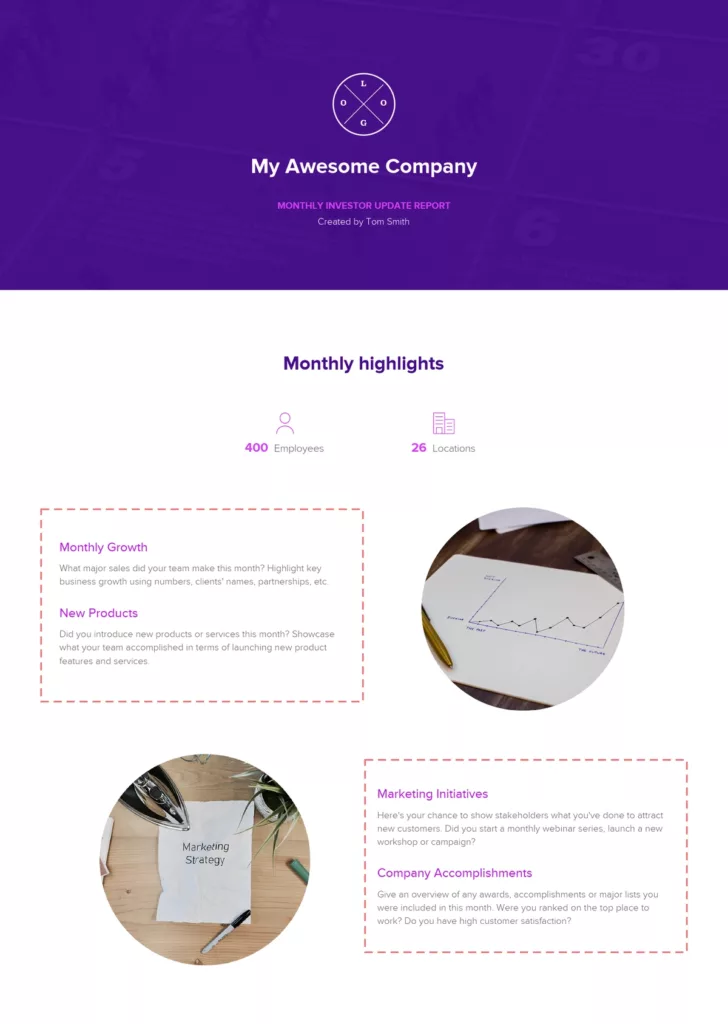
- Monthly growth — Highlight key growth info from the start so investors get a clear overview. What major sales did your team make this month?
- Product development — Did you introduce new products or services this month? Showcase what your team accomplished in terms of launching new product features and/or services.
- Marketing initiatives — Here’s your chance to show stakeholders what you’ve done to attract new customers. Did you start a monthly webinar series, or launch a new workshop or campaign?
- Company wins & losses — Give an overview of any awards, accomplishments, or major lists you were included in this month. Were you ranked as the top place to work? Do you have high customer satisfaction?
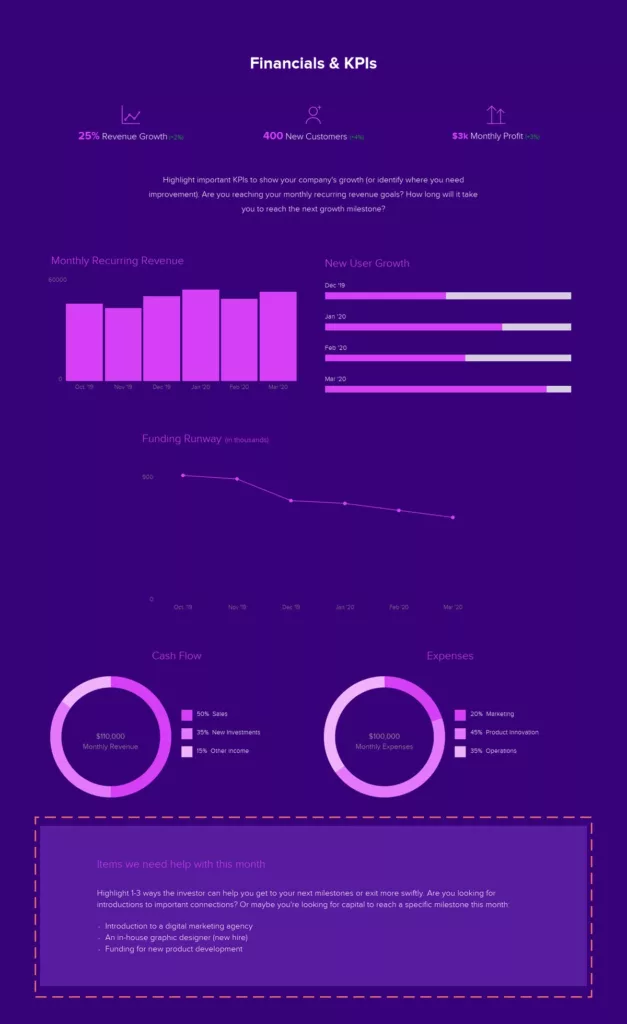
3. Detail your financials and KPIs
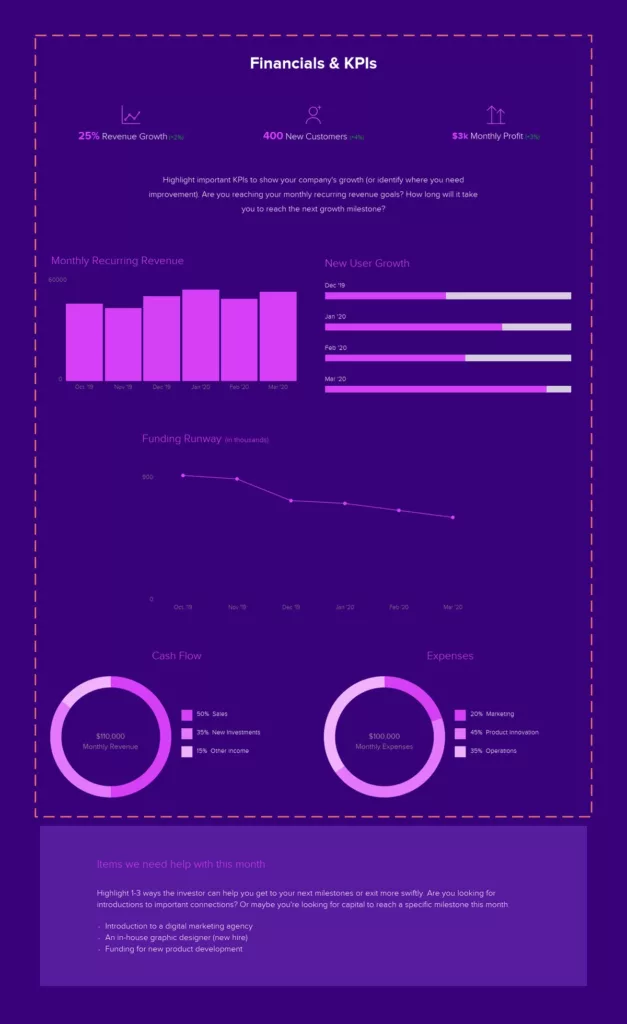
Highlight important KPIs to show your company’s growth (or identify where you need improvement). Are you reaching your monthly recurring revenue goals? How long will it take you to reach the next growth milestone?
Use charts and graphs to highlight key financial data.
- Revenue — Being able to generate revenue is essential to a business. How much did you grow this month? How many new customers did you bring in? What’s your monthly profit margin? However, you determine to measure revenue should be kept consistent from month to month. For example, don’t share bookings one month and revenue the next.
- Cash & burn — Cash is king and investors expect to see some insight into how their capital is being managed and used in your organization. Use a line chart to highlight your funding revenue month over month. And pie charts will help detail your cash flow and expenses.
- Margins — Generating solid margins is a must for any successful business. While this is more important during fundraising, sharing your margins will help investors evaluate your COGS and acquisition costs.
4. Ask your investors for help
Arguably, this is the most important part of the investor report – especially for your company. Highlight 1-3 ways the investor can help you get to your next milestones or exit more swiftly. Are you looking for introductions to important connections? Or maybe you’re looking for capital to reach a specific milestone this month:
- Introduction to a digital marketing agency
- An in-house graphic designer (new hire)
- Funding for new product development
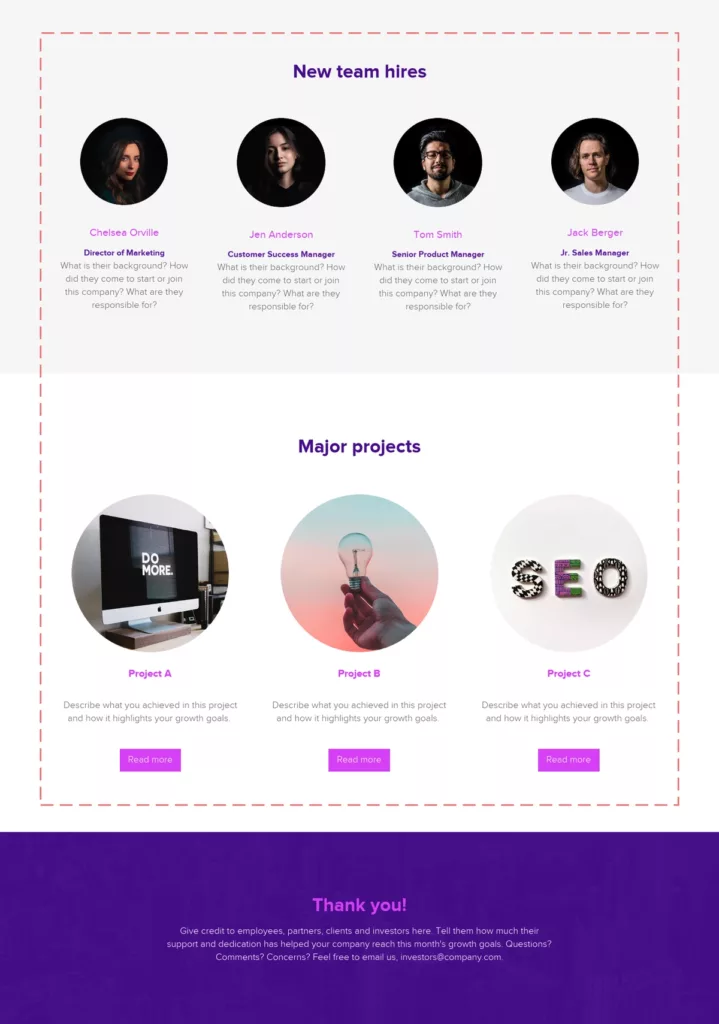
5. Showcase new hires, important projects and give credit to key players
Put a face to your company by introducing key hires you made this month. Add a photo, their name, and title. What is their background? How did they come to start or join this company? What are they responsible for?
Did you start (or complete) any major projects this month? Describe what you achieved in each project and how it highlights your growth goals.
Lastly, give credit to employees, partners, clients, and investors. Tell them how much their support and dedication have helped your company reach this month’s growth goals. Questions? Comments? Concerns?
Share your investor updates report as a link, monitor, evaluate & iterate
Remember, these are just guidelines for what information goes into your investor updates report. You’ll want to focus your monthly report on what matters the most to your investors, stakeholder, and partners.
When you’ve finished creating your investor updates status report with Xtensio’s editor, you can send the live link to your folio to share it as a responsive webpage (and add password protection), export a PDF or present it as a slideshow during an investor meeting. The monthly investor updates report is adaptable just like other Xtensio tools, it can and should be repurposed, revisited, and revised regularly.
Written by

Design, manage and share beautiful living documents… easily, together. Explore Xtensio
- Click and edit anything… together.
- Customize to match your branding.
- Share with a link, present, embed or download.

Create and deliver beautiful work, professionally.
Build, brand, and deliver living documents your clients actually engage with.







Join 409,446 professionals delivering work with Xtensio.