How To Prepare A Project Handover Document (With Free Template)
Updated by Xtensio
Handover documents provide essential information needed for someone to take over key project responsibilities. They are useful when handing the project over to a client, transitioning to a different department, bringing in a contractor, shifting to a new position or project, or covering responsibilities while you’re away from the office. Use this step-by-step guide to prepare your project handover documents, easily. Follow along with the FREE template.
Listen to this article:
Xtensio is your team space for beautiful living documents.
Create, manage and share business collateral, easily.
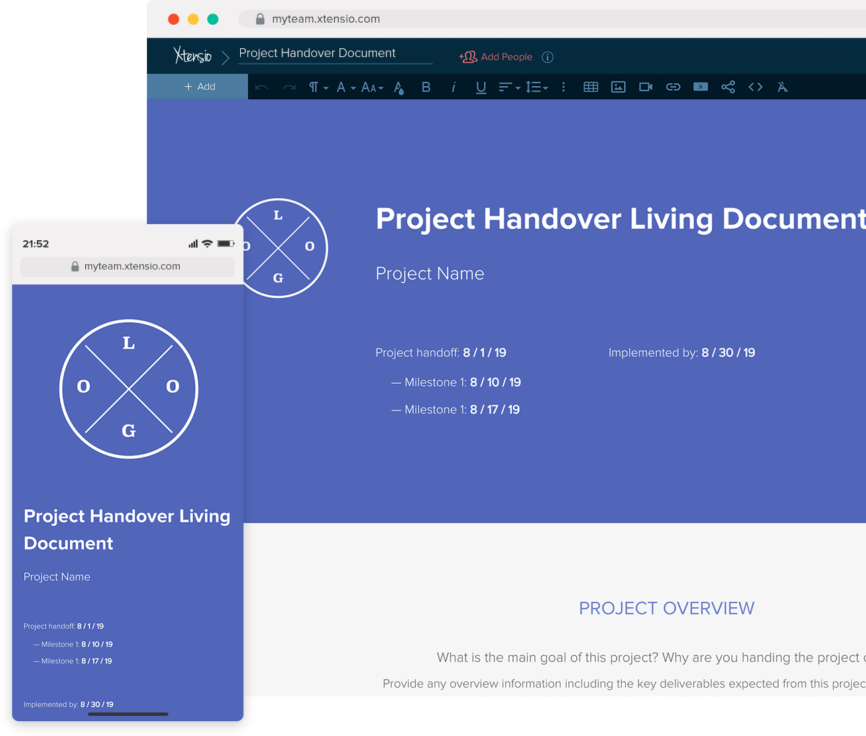
Table of Contents
What is a project handover document?
A project handover document is a comprehensive guide that summarizes all the details, processes, and instructions related to a specific project. It typically includes information about project deliverables, deadlines, resources, responsibilities, key stakeholders, and other crucial details.
This document is essential for facilitating a smooth transition between project teams. It ensures that every significant detail of the project is communicated, thus preventing confusion or missed opportunities. Using a project handoff template simplifies the process and makes project management more efficient.
Now that you understand the purpose of project handover notes, let’s learn how to write successful handover documentation.
Why Project Handovers Fail
The most common reason handovers fail is they start too late. When a project manager schedules the handover for their last day, there is no time to answer follow-up questions, walk through edge cases, or transfer institutional knowledge that lives only in their head.
Another frequent failure mode is the ‘document dump’ — handing over a folder of files without context. The receiving team gets hundreds of pages of meeting notes, spreadsheets, and email threads but no roadmap explaining what matters, what is outdated, and where the landmines are.
Knowledge loss during handovers is expensive. Studies on organizational knowledge transfer consistently show that undocumented processes and relationships are the hardest to replace. The cost is not just the time to figure things out — it is the mistakes made while the new team operates with incomplete information.
A structured handover document prevents all of these failures. It forces the outgoing owner to organize their knowledge into a format that is useful to someone with no prior context. Think of it as writing a manual for someone who has never seen your project before — because that is exactly what it is.
Project Handover Checklist
Every handover document should cover these categories: project objectives and current status, timeline and upcoming milestones, key contacts (internal and external), access credentials and system permissions, open issues and known risks, pending decisions that need resolution, and file locations for all relevant documents.
For the contacts section, go beyond names and email addresses. Note each person’s role in the project, their communication preferences, any political dynamics the new owner should be aware of, and the status of the relationship (strong, strained, new). This context prevents the new owner from making avoidable missteps.
The open issues section is the most valuable part of the handover. For each issue, document what it is, who is responsible, what has been tried so far, and what the recommended next step is. Do not leave the new owner to rediscover problems you already understand.
Store the handover document as a living document rather than a static file. During the transition period, both the outgoing and incoming owners can update it in real time as questions surface and answers are documented.
Who Should Receive the Handover Document
The primary recipient is the new project owner, but they should not be the only one. Share the document with all team members who will work on the project going forward, the project sponsor or executive stakeholder, and any external partners or vendors who need to know about the transition.
For each audience, consider what level of detail they need. The new project owner needs everything. Team members need the sections relevant to their work plus the contacts and timeline. The executive sponsor needs the summary, risks, and pending decisions. You can share the same living document with all audiences — they will naturally focus on the sections relevant to them.
If the project involves client relationships, inform the client about the transition proactively. Introduce the new owner, confirm that continuity is maintained, and reassure them that all context has been transferred. A smooth handover strengthens client confidence; a sloppy one damages it.
Best Practices for a Smooth Project Handover
Start the handover at least two weeks before the transition date. This gives you time to document processes, schedule a walkthrough session, and let the incoming owner shadow you during active work. Last-minute handovers are incomplete by definition.
Schedule a live walkthrough of the handover document with the incoming owner. Reading a document is not the same as understanding it. The walkthrough is where questions surface, assumptions get corrected, and the incoming owner builds enough context to operate independently.
After the walkthrough, have the incoming owner attempt to run the project for a few days while the outgoing owner is still available. This overlap period reveals gaps in the documentation that neither party anticipated. Update the handover document with whatever you discover.
Finally, schedule a check-in 30 days after the transition. By that point, the incoming owner will have encountered real situations that the handover document did not cover. Capture those learnings and update the document — it may be used again for the next transition. Organize all your project documents in a dedicated workspace so nothing gets lost between transitions.
How To Prepare A Project Handover Document in 5 easy steps
Project handover documents provide all the key information needed for someone to cover your major responsibilities. They are useful in various situations, such as:
- Organizing a project handover to a client
- Passing a project to a different department or contractor
- Shifting to a different position or project
- Ensuring your responsibilities are covered while you’re out of the office
Handoff documentation aligns the person taking over the project with the necessary tasks. Specifically, it allows you to:
- Create a project handover checklist and information hub for all important projects
- Set clear expectations when handing a project off to a team member, client, or external stakeholder
- Align everyone involved in completing the project and keep them updated throughout the process
This tool helps your marketing, sales, and product teams collaborate and stay aligned.
1. Define clear project goals and expectations
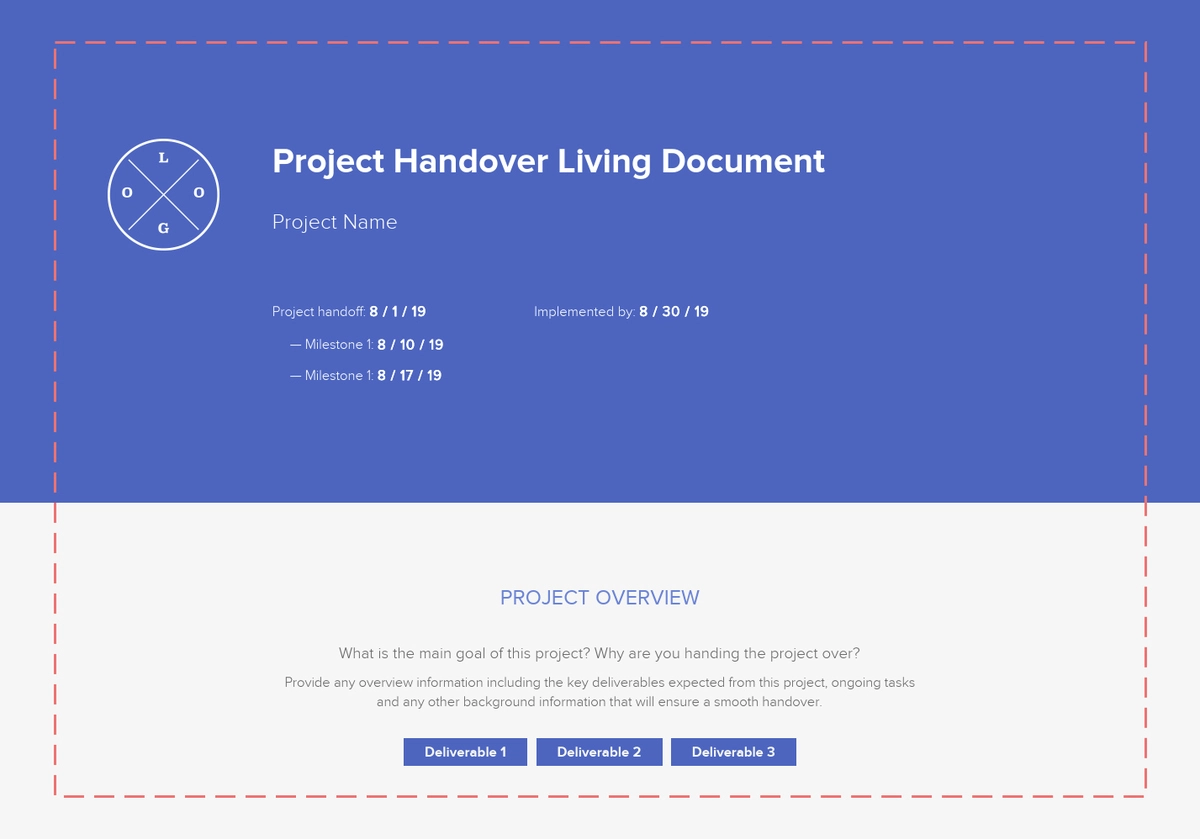
Create a header that includes your company branding and the project name. Define clear dates for the handover and important milestones. Include a brief project overview to explain the project scope. What is the main goal of the project? What key deliverables are needed? List the ongoing tasks and other background information.
Providing a clear outline, goals, and deliverables sets clear expectations while explaining the level of involvement needed once you hand the project to the next team. Remember, this document will serve as a master checklist and information hub for stakeholders taking over the project. You’ll need to detail all aspects of the project that are critical to your project handover document’s success.
2. Identify and manage key stakeholders, including both your team and the group who will be taking the project over
Start your project handover process as early as possible. Inform stakeholders from both your team and the receiving team about the upcoming transition promptly.
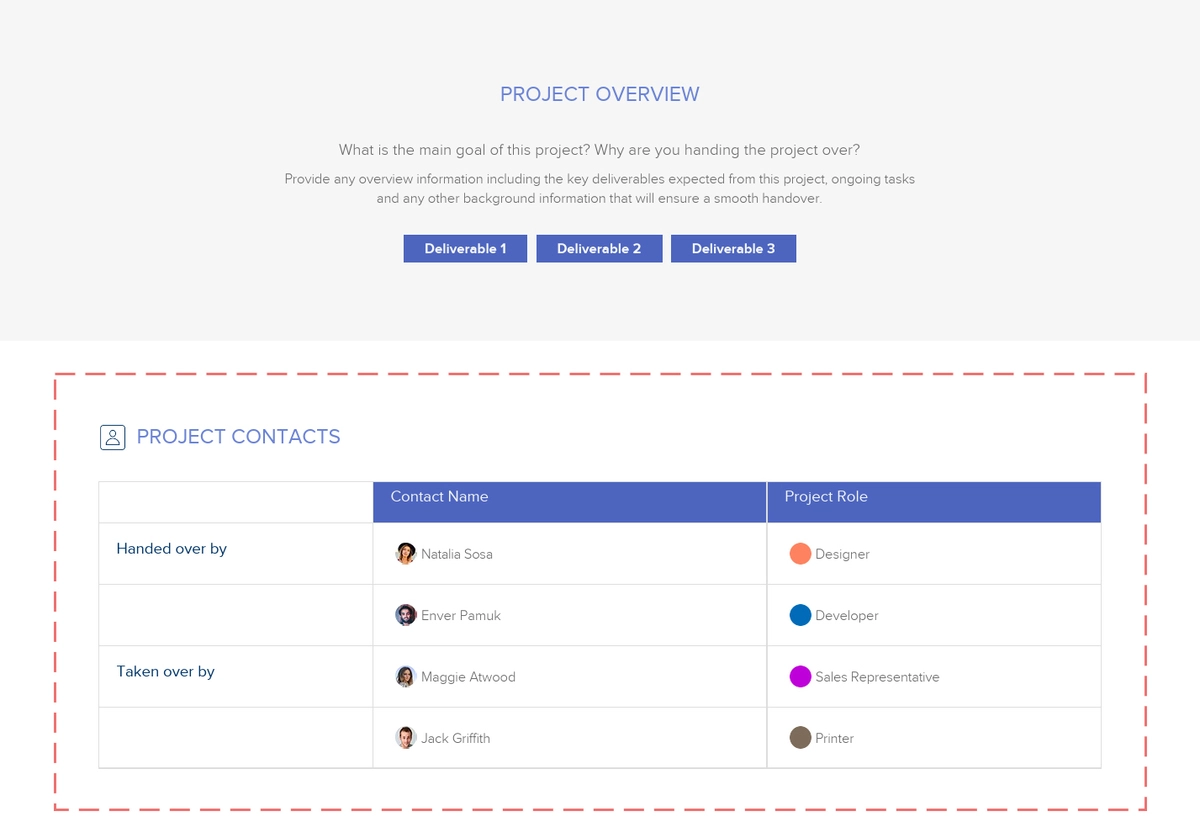
Hold a quick handover meeting to avoid any misconceptions about project tasks. Introduce the main points of contact on both sides and give everyone enough time to adjust their work and plan for the new project. Designate each stakeholder and their role, and include contact information for all team members as needed.
4o
3. Communicate the project details, tasks, and deliverables
The benefits and deliverables must be measurable and clearly communicated from the start. Ask yourself: Why are we doing this project? How will we know when it is complete?
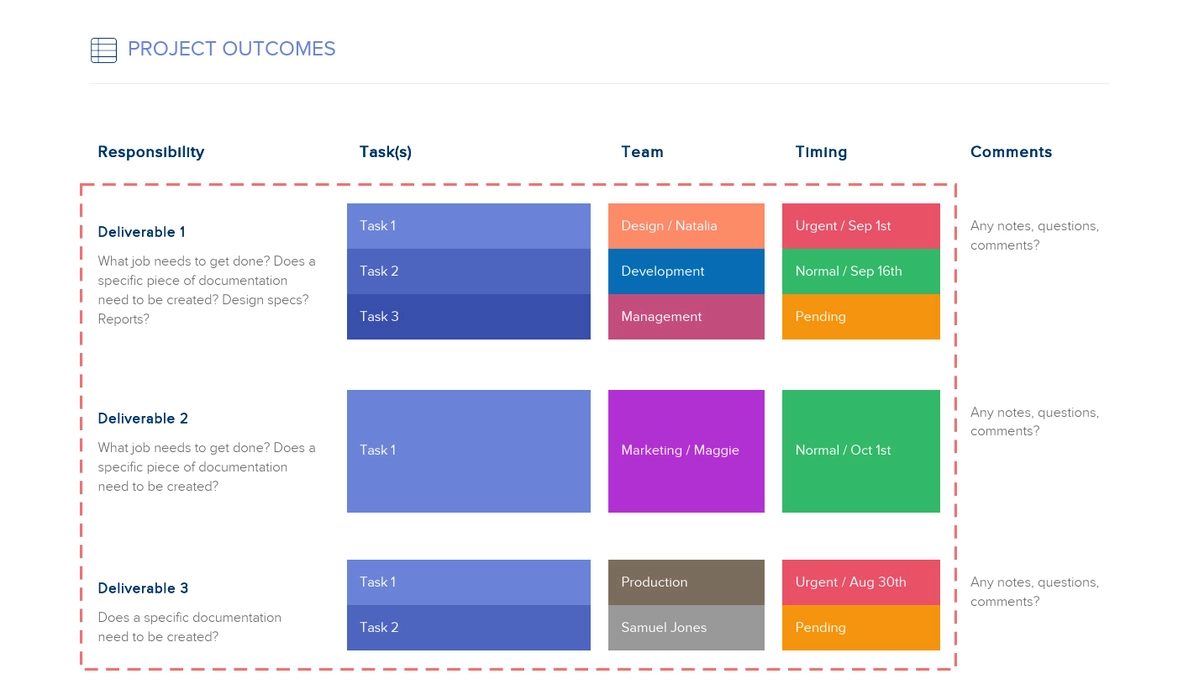
Remember, tasks and deliverables won’t get done if they aren’t assigned. Assign each milestone, task, and deliverable to the appropriate contact to ensure accountability.
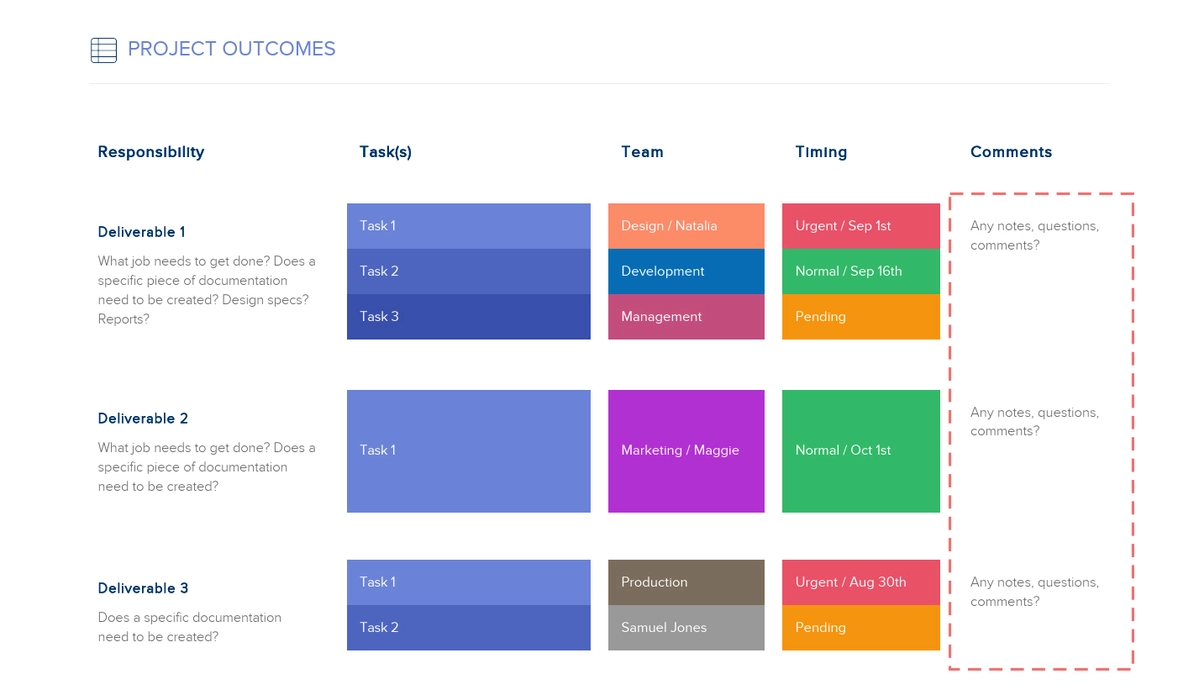
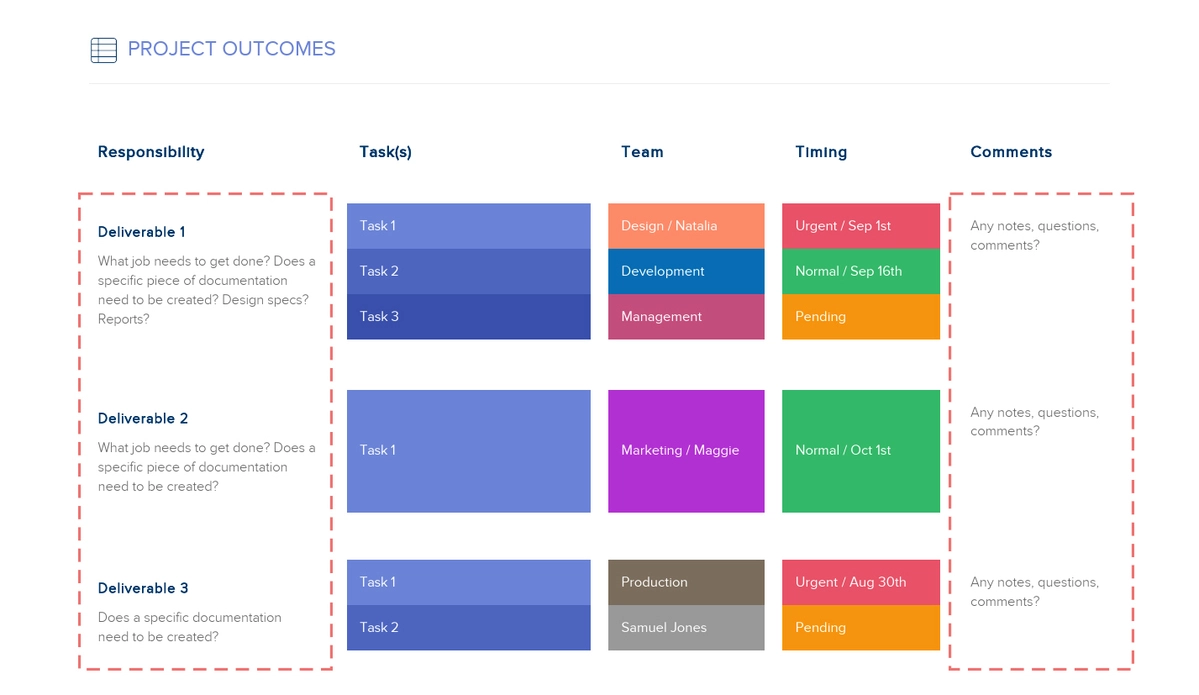
When creating your project outcomes section, prioritize important activities to ensure everyone is aligned. In most cases, the project manager stepping in will help assign tasks to the appropriate contacts on their team.

Quick Tip: Along with the table created in Xtensio’s project handover template, you can add task list modules to update the status of each item and track the live document as the project progresses. This allows all stakeholders to maintain visibility into what’s in progress, what’s next, and what’s completed. Update statuses as you go and share the link to keep both your marketing team and management on the same page.
4. Outline potential risks and roadblocks beforehand so change management issues can be handled efficiently
This section should explain any risks or potential risks you foresee for this project or during the handover process. You can add these to the comments section in the project objectives table or create a new section at the bottom of the template for more detailed notes.
5. Develop appropriate training and guidance for the group taking over the project, or ensure that the handover notes include thorough instructions
Once your project handover plan is structured with all details, requirements, issues, and challenges, organize a meeting with the new project manager or main point of contact to discuss the plan in detail.
Walking stakeholders through the project handoff document allows you to discuss project goals, achievements so far, and the upcoming roadmap. Clearly highlight important deadlines and milestones to ensure everyone is aligned before the handover. This conversation will also help identify gaps in your process and improve planning for future projects.
Share your project handover document as a link, review and improve the project handoff process
The project handover document is interactive and should be updated as tasks and input items evolve. Involve your team members and stakeholders from the receiving team to update statuses, tasks, and notes as the project progresses. Share the public link to your folio as a responsive webpage (with optional password protection), export a PDF, or post it on your bulletin board.
The project handover template is adaptable just like other Xtensio tools, it can and should be repurposed, revisited, and revised regularly.
Written by

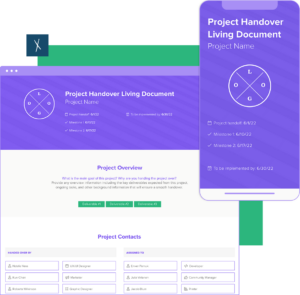
Design, manage and share beautiful living documents… easily, together. Explore Xtensio
- Click and edit anything… together.
- Customize to match your branding.
- Share with a link, present, embed or download.
Project Handover Document vs Transition Plan vs Knowledge Transfer
These three terms get used interchangeably, but they describe different activities. Using the wrong one leads to gaps in your handover process.
Project handover document. This is a comprehensive written record that captures the current state of a project at the point of transfer. It includes project objectives, completed deliverables, outstanding tasks, known risks, key contacts, access credentials, file locations, and decision history. The handover document is a static snapshot designed to give the incoming team everything they need to continue work without guessing. Think of it as the “here is where things stand” reference that the new owner reads on day one.
Transition plan. A transition plan is a timeline with responsibilities for executing the handover. Where the handover document is a reference, the transition plan is a schedule. It defines who does what during the changeover period: who conducts walkthroughs, who transfers access, who introduces stakeholders, and by what dates. Transition plans typically span two to four weeks and include checkpoints to verify that the incoming team has absorbed critical information. Without a transition plan, handovers tend to collapse into a single rushed meeting where half the important context gets lost.
Knowledge transfer. Knowledge transfer is the process of sharing skills, context, and institutional memory that cannot be captured in a document. It happens through working sessions, shadowing, paired walkthroughs, and Q&A conversations. Knowledge transfer covers the “why” behind decisions, the unwritten rules of stakeholder relationships, and the tribal knowledge that exists only in the outgoing team’s heads. It is the hardest part of any handover because it requires time, patience, and the outgoing team’s active participation.
A complete handover uses all three: the handover document provides the reference material, the transition plan provides the schedule and accountability, and knowledge transfer provides the context that no document can fully capture. Start with the handover document (use a project brief template as a structural starting point), build the transition plan around it, and schedule knowledge transfer sessions for the highest-risk areas.
5 Project Handover Mistakes That Cause Failures
Most project handover failures are not caused by incompetent incoming teams. They are caused by preventable gaps in the handover process itself. These five mistakes account for the majority of post-handover problems.
1. Last-minute documentation. When the handover document gets written in the final two days before the outgoing team leaves, critical details are forgotten, oversimplified, or skipped entirely. The outgoing team is mentally checked out, deadlines are tight, and the result is a surface-level document that raises more questions than it answers. Start your handover document at least two weeks before the transition date. Update it continuously as the handover approaches. Better yet, maintain a living version throughout the project so the handover document is always close to ready.
2. No stakeholder introductions. The handover document might list key stakeholders and their roles, but a name on a page is not a relationship. The incoming team needs face-to-face (or video call) introductions with every stakeholder who has influence over the project. These introductions should happen while the outgoing team is still involved so they can provide context on each stakeholder’s communication preferences, concerns, and priorities.
3. Missing access credentials and tools. Login credentials, API keys, admin access to project management tools, shared drives, vendor portals, and deployment systems are easy to overlook and painful to recover after the outgoing team is gone. Create a dedicated “Access and Tools” section in your handover document. List every system the project touches, who currently has access, and the steps to transfer that access. Verify each one works before the transition date.
4. Undocumented decisions and context. Every project accumulates decisions that shaped its direction but were never written down. Why was vendor A chosen over vendor B? Why does the timeline skip July? Why is the reporting format different from the company standard? Without this context, the incoming team will either repeat investigations or make changes that reverse deliberate choices. Include a “Decision Log” section in your handover document with the decision, the date, the rationale, and who made it.
5. No post-handover support period. A clean break sounds efficient but rarely works in practice. The incoming team will have questions that only emerge once they start doing the actual work. Build a two-week support period into your transition plan where the outgoing team remains available for questions via a dedicated channel. This single step prevents more failures than any other item on this list. Keep your handover documents in a shared workspace so both teams can reference and update them throughout the support period, and share the handover itself as a live link that stays current as new information surfaces.

Create and deliver beautiful work, professionally.
Build, brand, and deliver living documents your clients actually engage with.







Join 409,446 professionals delivering work with Xtensio.