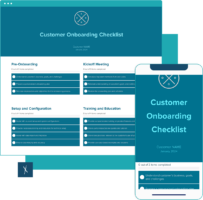
Customer Onboarding Checklist Template
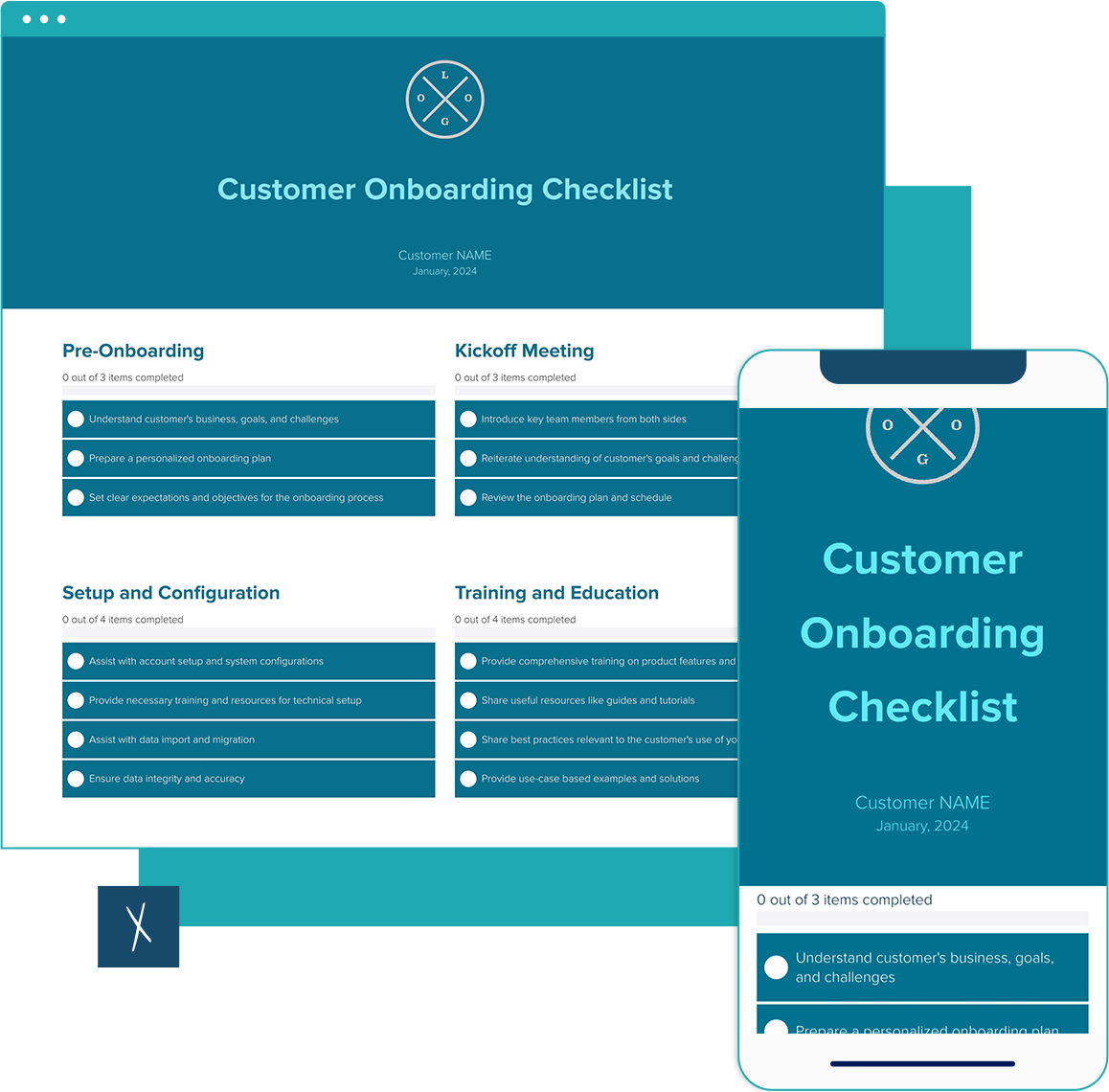
Your customer onboarding process is not just a basic introduction of your clients to your product or service; it’s like rolling out a red carpet that welcomes them to a fruitful partnership. But without a good plan, this journey can quickly become overwhelming. No more messing with spreadsheets, emails, or printouts; our template is your buddy in offering a memorable onboarding experience, making each interaction successful and enjoyable.
Beautiful living documents, built like web pages.
Join 398,095 professionals using Xtensio.
Xtensio is the workspace for professional deliverables.
Make one deliverable today—then build a repeatable system for every client and project.
This is where teams create, collaborate, organize, and deliver the documents that run their work.
Everything stays on-brand, current, and ready to share.

Organize every deliverable
Keep strategy, sales, marketing, and client docs together by workspace.
Create fast, stay consistent
Start from 200+ templates or AI drafts, then apply your brand kit.
Collaborate in the doc
No more “final_v7.pdf” loop.
Standardize across deliverables
Apply your brand kit + reusable modules so every deliverable matches.
Improve what you send
See engagement, iterate, and reuse what works across projects.
The First 90 Days: A Phased Onboarding Framework
Customer onboarding is not a single event; it is a 90-day process with three distinct phases. Days 1-7 (Activation): Welcome email sequence, account setup assistance, first value delivery. The goal is to get the customer to their first “aha moment” within the first week. Companies that achieve this see 3x higher 12-month retention. Days 8-30 (Foundation): Feature discovery, workflow integration, first business review. Assign a dedicated onboarding contact and schedule weekly check-ins. Days 31-90 (Expansion): Advanced features, team rollout, success metrics review. This is where you transition from onboarding to ongoing customer success.
Each phase should have its own checklist with clear ownership. The activation checklist is owned by the onboarding specialist. The foundation checklist is shared between the customer and the CSM. The expansion checklist involves the customer’s team lead. Maintain all three as living documents in a workspace so every stakeholder sees the current completion status via a single live link.
4 Onboarding Metrics That Predict Retention
Time to First Value (TTFV): How many days between signup and the customer achieving their first meaningful outcome. Best-in-class SaaS companies target under 24 hours. Activation Rate: The percentage of new customers who complete all activation checklist items within the first 7 days. Benchmark: 70%+. Onboarding NPS: Survey at Day 30. A score below 30 means your process has structural problems. Feature Adoption Depth: How many core features the customer uses by Day 60. Customers using 3+ core features churn at half the rate of single-feature users. Track these in your onboarding document and review them at every business review. With engagement analytics, you can also see whether the customer is actually reading the materials you share.
Your customer onboarding process is not just a basic introduction of your clients to your product or service; it’s like rolling out a red carpet that welcomes them to a fruitful partnership. But without a good plan, this journey can quickly become overwhelming. No more messing with spreadsheets, emails, or printouts; our template is your buddy in offering a memorable onboarding experience, making each interaction successful and enjoyable.
Why a Structured Customer Onboarding is Crucial:
First Impressions Matter: The way you welcome your customers sets the tone for your relationship. A clear and helpful onboarding process shows that you value their business and want to help them succeed.
Setting the Stage for Long-Term Relationships: When customers have a good start, they’re more likely to stick around. An effective onboarding process helps build trust and understanding from the get-go.
Early Value Delivery: Showing your customers the benefits of your product right away encourages them to keep using it. It’s all about making sure they see the value early on.
Compliance and Clarity: A checklist makes sure all important steps are covered. This provides clear guidance and helps meet any necessary requirements.
Features of Xtensio’s Customer Onboarding Checklist Template:
User-Friendly Interface: Our template is easy to use. You can start organizing your onboarding process with a simple and clear layout.
Customizable Checklists: Make the checklist yours! Adjust it to match your brand and what your business needs.
Real-Time Collaboration: Work together with your team at the same time to provide a well-organized onboarding experience.
Comprehensive Task Management: Assign, track, and manage tasks easily to ensure everything goes smoothly during onboarding.
Integration Capabilities: Our template can work with your existing tools, bringing everything together in one place for better control over the onboarding process.
How Xtensio Stands Out From Alternatives:
Xtensio’s Customer Onboarding Checklist Template is not just another checklist. It’s a complete tool designed to make your onboarding process smooth and effective. Unlike other options, Xtensio’s template is easy to use, customizable to your needs, and allows your team to work together in real time. Plus, it’s part of a trusted platform that understands the importance of a great onboarding experience.
Conclusion
A structured onboarding process is one of the highest-leverage investments a customer-facing team can make. Xtensio’s Customer Onboarding Checklist Template gives you a reusable framework that covers every phase, from the initial welcome through the 90-day adoption review. Share it as a live link so every stakeholder sees the current status without chasing email threads. Reuse it across every new customer engagement and refine it as your process matures.
Customer Onboarding Checklist vs Onboarding Plan vs Implementation Guide
These three documents serve different purposes, and confusing them is one of the most common onboarding mistakes. A customer onboarding checklist is a tactical, task-level tool. It lists every action item that needs to happen, who owns it, and the deadline. Think of it as the daily to-do list for onboarding: send welcome email, configure account settings, schedule kickoff call, grant access to training materials. It is binary: each item is done or not done.
An onboarding plan is strategic. It defines the overall timeline, milestones, success criteria, and stakeholder roles across the full onboarding period. The plan answers “what does success look like at Day 30, 60, and 90?” while the checklist answers “what do we do today?” A plan typically includes a project timeline, resource allocation, risk mitigation steps, and escalation paths. It is the document your executive sponsor reviews.
An implementation guide is technical. It covers system configuration, data migration, API integrations, user provisioning, and testing protocols. Implementation guides are product-specific and usually owned by a solutions engineer or technical account manager. While the checklist and plan are customer-facing, the implementation guide is often internal.
Most teams need all three. The plan sets the strategy, the checklist drives daily execution, and the implementation guide handles the technical work. Keep them as separate living documents in your workspace and link them together so everyone sees the full picture. When a checklist item depends on an implementation step, the connection should be visible, not buried in someone’s inbox.
Common Onboarding Mistakes That Drive Churn
Information overload in Week 1. New customers do not need to learn every feature on Day 1. They need to reach one meaningful outcome. Companies that front-load training with 90-minute product walkthroughs see 40% lower activation rates than those using a progressive, milestone-based approach. Prioritize the three features that deliver immediate value and introduce advanced capabilities only after the customer has completed the activation phase.
No personalization by customer segment. An enterprise account with 200 users has entirely different onboarding needs than a 5-person startup. Yet many teams use the same generic checklist for both. Segment your onboarding checklists by company size, industry, and use case. A SaaS company onboarding a marketing agency needs workflow-focused training, while a financial services firm needs compliance and security configuration first.
Missing handoff from sales to customer success. The most fragile moment in the customer lifecycle is the transition from the sales team to the onboarding team. If the customer has to repeat their goals, pain points, and requirements to a new person, trust erodes immediately. Build a handoff document that captures the deal context, stated goals, technical requirements, and any promises made during the sales process. Share it as a live link so both teams can update it in real time.
No check-in cadence after the first week. Many onboarding programs front-load touchpoints in Week 1 and then disappear until the quarterly business review. This gap between Day 7 and Day 90 is where most silent churn happens. Build check-in milestones at Day 14, Day 30, Day 45, Day 60, and Day 75 into your onboarding checklist. Each check-in should have a specific agenda tied to the customer’s progress against their stated goals.
Treating onboarding as a one-time event. Onboarding does not end when the customer completes the checklist. Every new feature release, team expansion, or strategic shift triggers a mini-onboarding cycle. The companies with the highest net revenue retention treat onboarding as a continuous process, not a 90-day project. Use engagement analytics to spot when a customer stops engaging with shared materials, because that disengagement is the earliest churn signal you will get.
How to Build a Customer Onboarding Checklist That Actually Gets Used
The difference between an onboarding checklist that drives adoption and one that collects dust is structure. Start by mapping every onboarding task to a specific outcome the customer cares about. “Configure SSO” is a task. “Ensure your team can log in securely on Day 1” is an outcome. Frame every checklist item around the customer’s goal, not your internal process.
Next, assign clear ownership. Every checklist item should have exactly one owner: the customer’s project lead, your CSM, or your technical contact. Shared ownership means no ownership. If a task requires input from multiple people, break it into subtasks with individual owners and deadlines.
Build in dependencies. Some tasks cannot start until others finish. Data migration cannot begin until the customer exports their existing records. Training sessions should not be scheduled until the account is fully configured. Make these dependencies visible in your checklist so no one wastes time on blocked tasks.
Finally, make the checklist a living document, not a static PDF. Requirements change, timelines shift, and new stakeholders join mid-project. When your onboarding checklist lives in a workspace and is shared as a live link, every update is instantly visible to everyone involved. No version confusion, no outdated printouts, no “I was looking at last week’s version” excuses.
Onboarding Checklist Templates by Industry
SaaS and technology: Focus on product activation, integration setup, and feature adoption milestones. Key checklist items include API key provisioning, SSO configuration, data import, first workflow creation, and team invitation. Success metric: time to first value under 48 hours.
Professional services and agencies: Focus on scope alignment, communication protocols, and deliverable expectations. Key items include statement of work review, shared workspace setup, reporting cadence agreement, and first deliverable review. The checklist should link directly to the customer success plan and any project briefs.
Financial services: Compliance and security dominate the early phases. Key items include KYC document collection, regulatory disclosure review, account verification, risk assessment, and authorized user provisioning. Build a separate compliance checklist that must be fully complete before any product access is granted.
Healthcare and life sciences: HIPAA compliance, data handling agreements, and role-based access controls must be established before any patient or research data enters the system. The onboarding checklist should include BAA execution, security audit completion, and staff training certification.
Education: Academic calendars dictate onboarding timelines. Plan onboarding around semester starts, not contract signing dates. Key items include LMS integration, student roster import, faculty training sessions, and pilot program setup. Include a mid-semester check-in to assess adoption before the renewal conversation begins.
See how Xtensio can help your business

Build and launch products and services successfully.

Engage buyers more and close sales faster.

Used by the world’s top businesses.
398,095 users and counting.


Jerome Katz
Professor of Entrepreneurship @

Jake Peters
CEO @

Robin Bramman
Founder and Chief Brand Mixologist @

Alix Han
VP Product Experience @

Marc Anthony Rosa
Product Manager @

Anna Yunker
Content Strategist @

Robin Eyre
Owner @

Adam Sher
CEO @

Humma Arshad
Salesforce Project Manager @
What is a customer onboarding checklist?
A customer onboarding checklist is a step-by-step document that guides new customers through the setup, activation, and initial value realization of your product or service. It ensures every customer completes the critical steps that lead to long-term success and retention, rather than getting lost in a self-serve flow or waiting for a support ticket to find help.
The onboarding experience is the highest-leverage moment in the customer lifecycle. Customers who complete onboarding successfully are dramatically more likely to retain, expand, and refer. A checklist makes this process repeatable and measurable.
What to include in your onboarding checklist
- Welcome and orientation — Introduce the customer to their account, key contacts, and support channels. Set expectations for the onboarding timeline.
- Account setup — Technical configuration: integrations, user provisioning, data migration, security settings. The steps that must happen before the customer can use the product.
- First value milestone — The first meaningful action the customer takes. For a CRM, it might be importing contacts. For a deliverables workspace, it might be creating and sharing their first document. Identify this moment and make it a checklist item.
- Training and resources — Links to documentation, video walkthroughs, help center articles, and scheduled training sessions. Give the customer self-serve learning options alongside guided support.
- Key feature adoption — Checklist items for features that drive retention: inviting team members, setting up automations, connecting integrations, customizing settings. These are the behaviors that predict long-term success.
- Check-in schedule — Planned touchpoints: day 1, week 1, day 30, day 60, day 90. Each check-in has a purpose and a set of questions to assess progress.
- Success criteria — How you and the customer define “onboarding complete.” This should be specific and measurable, not just “feels comfortable with the product.”
Onboarding checklist vs. onboarding playbook
A checklist is tactical: it lists the steps. A playbook is strategic: it explains why each step matters, how to handle common objections, what to do when a customer goes silent, and how to escalate at-risk accounts. Most customer success teams need both. The checklist is what the customer sees. The playbook is what the CSM follows internally.
Common onboarding mistakes to avoid
- Information overload on day one — New customers cannot absorb everything at once. Sequence the checklist so each step builds on the previous one.
- No defined end point — If onboarding never officially ends, it never officially succeeds. Define clear criteria for “onboarding complete.”
- Same checklist for every customer — Enterprise customers and self-serve users need different onboarding paths. Customize the checklist by segment or use case.
- Tracking completion without tracking adoption — Completing setup steps is necessary but not sufficient. Track whether the customer is actually using the features, not just configuring them.
Why use Xtensio for customer onboarding
Customer onboarding checklists are shared documents by nature: your customer needs to see them, track progress, and reference them over time. Xtensio lets you share the checklist as a live link that both your team and the customer can access. Updates appear in real time. Engagement analytics show you whether the customer actually opened the onboarding materials. Clone the template for each new customer and customize it for their use case while keeping the proven structure intact. Keep all customer onboarding documents organized in a dedicated workspace.