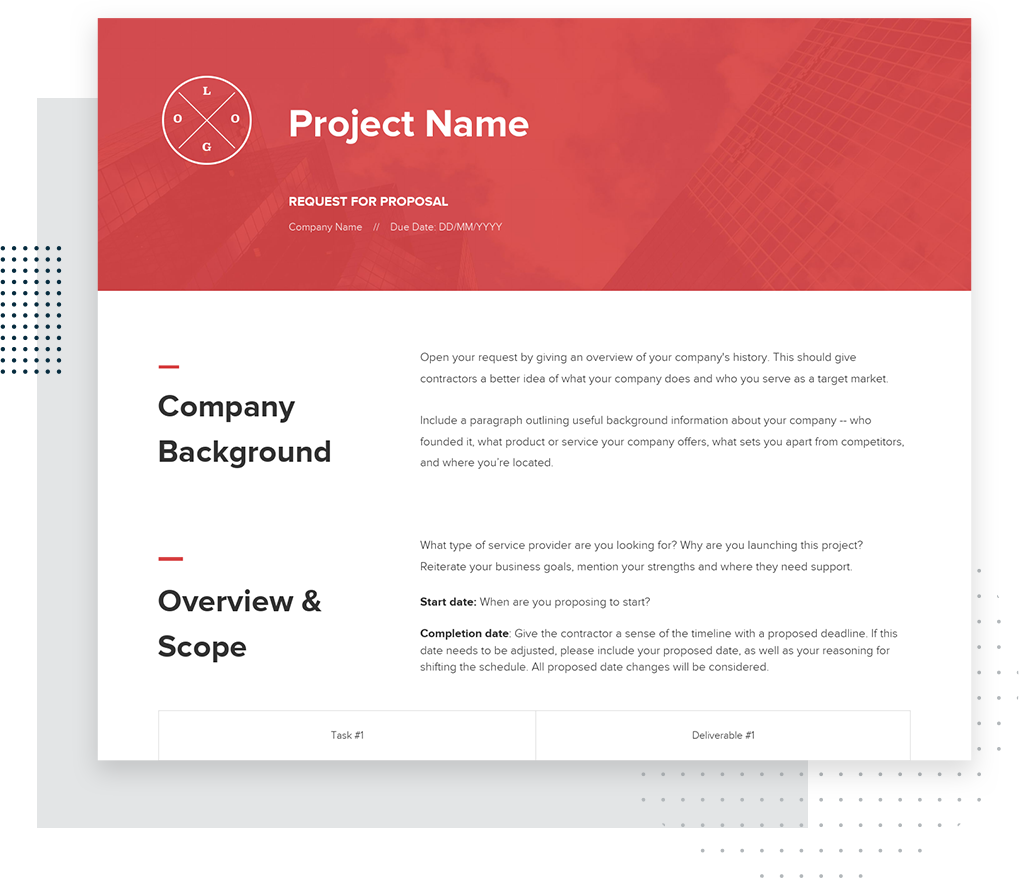
Request for Proposal Template
The request for proposal template (RFP) is a business document that announces and provides details about a project your company is launching. The goal of the request for proposal is to help you solicit and review bids from contractors who will help complete the project. Use Xtensio’s live template to keep everyone instantly up-to-date on the project details.
- Detail your project’s needs in a visual, easy-to-read RFP format to solicit and review bids from outside vendors.
- Ensure transparency and hold your organization and outside vendors accountable for project goals.
- Create benchmarks to measure a project’s success.
Xtensio is your team’s deliverables workspace.
Create, collaborate, and deliver client-ready docs—then keep them current.
Join 409,446 using Xtensio.
Xtensio is the workspace for professional deliverables.
Make one deliverable today—then build a repeatable system for every client and project.
This is where teams create, collaborate, organize, and deliver the documents that run their work.
Everything stays on-brand, current, and ready to share.

Organize every deliverable
Keep strategy, sales, marketing, and client docs together by workspace.
Create fast, stay consistent
Start from 200+ templates or AI drafts, then apply your brand kit.
Collaborate in the doc
No more “final_v7.pdf” loop.
Standardize across deliverables
Apply your brand kit + reusable modules so every deliverable matches.
Improve what you send
See engagement, iterate, and reuse what works across projects.
How to create a request for proposal with Xtensio
- Create a free account and start editing, no credit card required.
Follow along with the instructional RFP template details. Add charts, graphs, images, and videos to customize the RFP template and make it your own. Drag & drop. Resize. Customize the proposal format however you need. It’s the easiest editor ever.
- Customize everything in the RFP template to match your brand.
Define your style guide. Add your (or your client’s) brand fonts and colors. You can even pull colors directly from a website to easily brand your request for proposals and more.
- Work on your RFP process together on the cloud.
Add colleagues (or clients) to collaborate on the request for proposal RFP template. Changes automatically save and sync across all devices, in real-time.
- Share a link. Present a slideshow. Embed. Download a PDF/PNG.
The RFP seamlessly adapts to your workflow. No more jumping from tool-to-tool to design different types of deliverables.
- Reuse and repurpose.
Save your own custom RFP templates. Or copy and merge into other documents.

What is a request for proposal template?
RFPs: Requests for Proposals are how many professional consultancies and agencies win new work. It is a document that a business, non-profit or government agency creates to detail the requirements for an upcoming project. RFPs are shared to solicit bids from contractors who will help the company complete the project.
What is included in a request for proposal RFP?
RFPs come in all shapes, sizes, and visual formats depending on the needs of your company and the project you’re looking to receive bids for. There are some basic sections you’ll want to include in your table of contents, outlining all the information potential bidders will need to know in order to place a bid.
Company and background section:
- Company name and background information.
- Contact info: contact name, location, email address, phone number, web site.
- Proposal timeline and place of submissions.
Project requirements and scope:
- Project name and project description.
- Goals and scope of services.
- Technical requirements.
- Project timeline.
- Evaluation criteria.
- Budget.
Related to the Request for Proposal Template
Fully customizable templates that you can make your own.
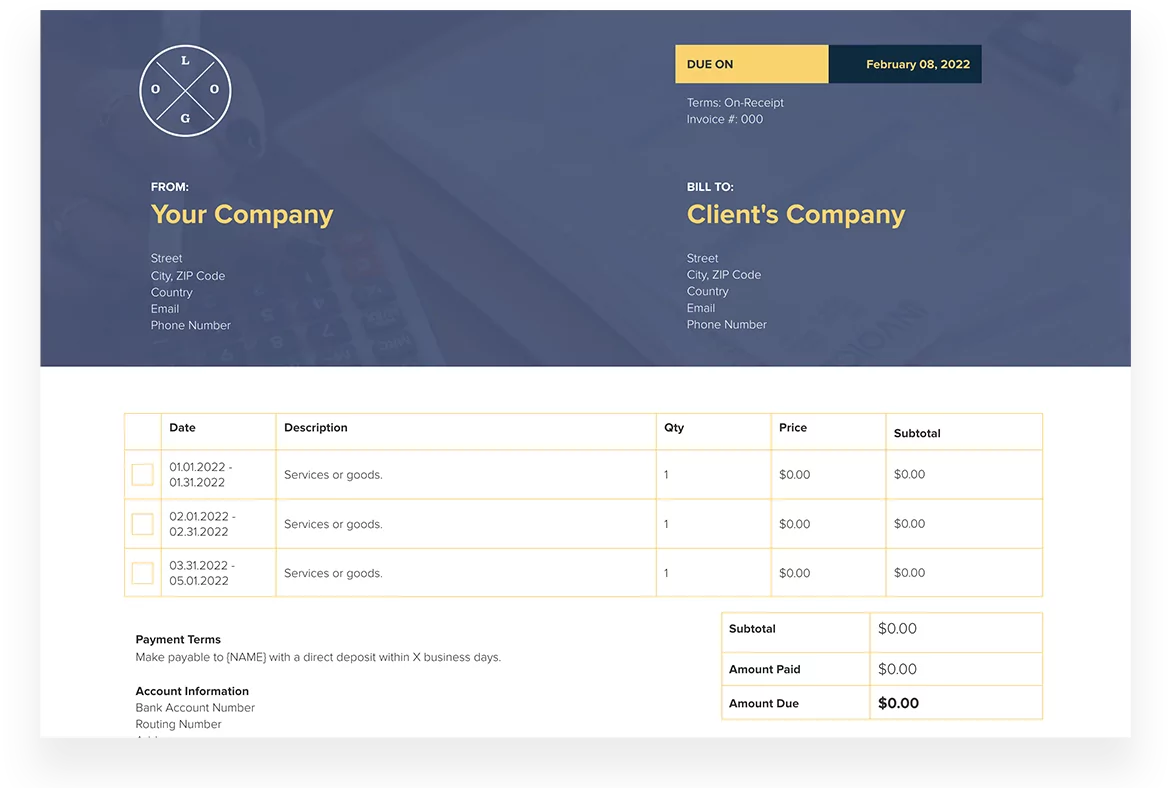
What is an RFP (Request for Proposal)?
A Request for Proposal (RFP) is a formal document that organizations use to describe a project or need and invite qualified vendors to submit proposals. It standardizes the evaluation process so you can compare vendors on the same criteria — scope, approach, timeline, pricing, and qualifications.
RFPs are used across industries for everything from software purchases and consulting engagements to marketing services and construction projects. A well-structured RFP saves weeks of back-and-forth by giving vendors exactly what they need to submit a competitive, comparable proposal.
Key sections of an effective RFP
- Project overview — What you need, why, and the business context. Give vendors enough background to propose intelligently.
- Scope of work — Specific deliverables, requirements, and boundaries. Be clear about what is in scope and what is not.
- Technical requirements — Systems, integrations, platforms, or technical constraints vendors must meet.
- Evaluation criteria — How you will score proposals. Transparency here gets you better responses.
- Timeline and milestones — Submission deadline, evaluation period, project start date, key milestones.
- Budget parameters — Even a range helps vendors right-size their proposals and saves everyone time.
- Submission guidelines — Format, length, required sections, contact for questions, submission method.
RFP vs RFI vs RFQ: which do you need?
- RFP (Request for Proposal) — You know what you need and want vendors to propose a solution with approach, timeline, and pricing. Best for complex projects where methodology matters.
- RFI (Request for Information) — You are exploring options and want to learn what vendors offer before defining requirements. Best for early-stage research.
- RFQ (Request for Quotation) — You know exactly what you need and want pricing. Best for commodity purchases or standardized services.
Most procurement processes start with an RFI to narrow the field, then move to an RFP for shortlisted vendors. Use an RFQ only when the scope is completely defined and the only variable is price.
How to write an RFP that gets quality responses
- Be specific about the problem, not just the solution. Vendors propose better when they understand your business challenge, not just a feature checklist.
- Include evaluation criteria upfront. When vendors know how they will be scored, they tailor their responses to what matters most to you.
- Set a realistic timeline. Rushed RFPs get rushed responses. Give vendors at least 2-3 weeks to respond to complex proposals.
- Provide a Q&A process. Allow vendors to ask clarifying questions and share answers with all respondents.
- Share your budget range. This is the single biggest factor in getting right-sized proposals instead of wildly inconsistent quotes.
- Use a consistent template. When every RFP follows the same structure, your team evaluates faster and vendors respond more completely.
Why manage your RFP process in a deliverables workspace
RFPs involve multiple stakeholders, iterative drafts, and tight deadlines. Managing this in email threads and shared drives creates version confusion and slows down evaluation.
With Xtensio, your RFP process lives in a workspace where your procurement team can:
- Collaborate on the RFP draft in real time — no more emailing Word docs between legal, procurement, and the business owner
- Brand it professionally — your RFP represents your organization; make it look like it
- Share as a secure live link — vendors always see the latest version, including amendments and Q&A responses
- Track engagement — see which vendors opened the RFP, how long they spent on each section, and who has not viewed it yet
- Reuse the template for your next RFP — update the scope, keep the structure, save hours of formatting
Common RFP Mistakes That Lead to Poor Vendor Responses
Most RFP problems start with the document itself. When an RFP is unclear, incomplete, or poorly structured, vendors either opt out or submit generic proposals that do not help you make a good decision. Here are the most common issues and how to avoid them.
Burying the problem in feature requirements
RFPs that list dozens of technical features but never explain the underlying business problem create a race to check boxes rather than a competition to solve problems. Vendors who understand your business challenge can propose creative approaches that exceed your listed requirements. Give vendors the context — why this project matters, what success looks like for your organization, what has been tried before.
Not disclosing the budget
This is the single most common mistake. Organizations withhold budget ranges thinking it forces vendors to reveal their lowest price. In practice, it produces wildly inconsistent quotes (some vendors price conservatively, others expansively), forces multiple clarification rounds, and signals to experienced vendors that the process may not be serious. Providing a realistic budget range — even a broad one — consistently results in better-fit proposals and faster evaluation.
Setting an unrealistic response deadline
Giving vendors five to seven days to respond to a complex RFP guarantees one of two outcomes: they opt out (often the best vendors, who have options), or they submit a generic response recycled from a previous proposal. Give qualified vendors enough time to tailor their response — two to three weeks is appropriate for most professional services RFPs; four to six weeks for large or complex procurement.
No Q&A process or shared responses
Vendors will have questions. If they cannot ask them, they make assumptions — and different vendors make different assumptions, making proposal comparison difficult. A structured Q&A phase (written questions submitted by a deadline, answers published to all respondents) levels the playing field and consistently improves proposal quality. Include the Q&A timeline in your RFP so vendors plan for it.
How to Evaluate RFP Responses: Scoring and Selection
A good RFP process does not end when proposals arrive — evaluation rigor determines whether the effort results in a good vendor selection. Most organizations use a weighted scoring matrix that reflects the actual decision criteria rather than a holistic “gut feel” comparison.
Build a weighted scoring matrix
Define your evaluation categories and assign relative weights based on what matters most for this specific project. Common categories include technical capability, relevant experience and case studies, proposed methodology and approach, team qualifications, timeline feasibility, pricing and total cost of ownership, and references. The weights should reflect your actual priorities — if timeline is critical, weight it heavily. If price flexibility exists, weight approach and experience more.
Involve multiple evaluators
A single evaluator introduces bias and blind spots. Assemble a small evaluation team that includes the business owner, a technical lead, and a procurement or finance representative. Have each evaluator score independently before comparing — this reveals where the team agrees (clear signal) and where opinions diverge (explore why). Disagreement often surfaces a requirement that was not fully articulated in the RFP.
Shortlist to two or three finalists
After initial scoring, shortlist to two or three finalists for a more in-depth evaluation: presentations, reference calls, and detailed contract and pricing discussions. This structure — broad RFP response, then narrow finalist evaluation — is more efficient than trying to do deep due diligence on all respondents. Communicate clearly with non-shortlisted vendors — they invested time in their proposal and deserve professional notification.
RFP Best Practices by Use Case
Different types of projects require different RFP emphasis. Here is what to adjust by common use case.
Software and technology RFPs
Technology RFPs require a detailed technical requirements section covering integrations (which systems does the new software need to connect to?), data requirements (volume, structure, migration approach), security and compliance standards, implementation and onboarding expectations, and ongoing support levels. Include a section on total cost of ownership — software pricing can obscure implementation costs, training costs, and support tier costs that significantly change the actual spend.
Marketing and agency RFPs
Marketing RFPs benefit from detailed context about your brand, target audience, competitive landscape, and past campaigns — what has worked, what has not, and why you are looking for a new agency or vendor. Ask for process (how will they work with your team?), not just outputs. Request relevant case studies from similar industries or similar campaign types. Include questions about how they measure and report on results — this reveals how data-driven they actually are versus how data-driven they claim to be.
Professional services and consulting RFPs
Professional services RFPs should emphasize team qualifications — who specifically will work on the engagement, not just the firm’s credentials. Ask vendors to name the lead consultant and key team members in their proposal. Request a proposed project methodology, communication cadence, and how they handle scope changes. For consulting engagements, the working relationship often matters as much as the initial proposal quality — consider a structured interview or working session with shortlisted finalists before making a final decision.
Government and nonprofit RFPs
Government and nonprofit RFPs often have legal or regulatory requirements around format, content, and evaluation process. Mandatory sections, required certifications, specific documentation for vendor qualifications, and formal evaluation committees are common. If you are issuing a public-sector RFP, review applicable procurement regulations for your jurisdiction before drafting — both to ensure compliance and to understand required disclosure requirements for the process and results.
RFP Template by Industry
A generic RFP rarely produces useful vendor responses. Each industry has distinct requirements, risk factors, and evaluation criteria that your RFP should reflect. Here is how to adapt your request for proposal across four common procurement categories.
IT and software procurement
IT RFPs need to be explicit about technical environment, integration requirements, and security standards. Include your current technology stack, expected user count, data migration needs, and compliance requirements (SOC 2, GDPR, HIPAA). Evaluation criteria should weight implementation timeline, ongoing support SLAs, and total cost of ownership over three to five years rather than just license price. Ask vendors to describe their deployment methodology and provide references from organizations with similar infrastructure.
Marketing agency selection
Marketing RFPs should focus on strategic thinking, not just capabilities lists. Ask agencies to diagnose a real challenge your brand faces and propose a 90-day plan. Require case studies with measurable outcomes (not just creative samples) and details on the specific team members who would work on your account. Include questions about reporting cadence, how they handle underperforming campaigns, and their approach to channel allocation. Creative chemistry matters in marketing partnerships, so include a chemistry session or mini-brief as part of your evaluation process.
Construction and facilities
Construction RFPs require detailed scope documentation including site conditions, material specifications, safety requirements, and permitting responsibilities. Break the project into clear phases with milestone deliverables and payment schedules tied to completion. Evaluation should heavily weight safety record, relevant project experience, and subcontractor management approach. Include a site visit requirement and ask for a detailed work breakdown structure rather than a lump-sum estimate. Bonding and insurance requirements should be stated upfront to avoid wasting time with unqualified bidders.
Consulting and professional services
Consulting RFPs should balance methodology with team quality. Ask for named resources, not just firm credentials, and require a clear description of knowledge transfer plans. Include questions about how the consultant handles scope creep, what happens when key team members leave, and their approach to measuring engagement success. Weight past performance on similar-scale projects heavily, and consider a two-stage process: an initial written response followed by an oral presentation for shortlisted firms.
Regardless of industry, your RFP should evolve as you learn from each procurement cycle. Build your RFP in Xtensio as a live link and update it between procurement rounds so your team always starts from the latest version rather than hunting for last year’s Word document.
How to Evaluate RFP Responses Objectively
Collecting proposals is the easy part. Evaluating them consistently across a committee of reviewers is where most procurement processes break down. A structured evaluation framework removes bias and gives stakeholders a shared basis for comparison.
Build a weighted scoring matrix
Before you read a single response, agree on evaluation criteria and their relative weights. A typical scoring matrix includes technical capability (25-30%), relevant experience (20%), pricing and value (25%), implementation approach (15%), and team qualifications (10-15%). Each criterion gets a 1-5 rating, multiplied by its weight. This prevents the loudest voice in the room from dominating the selection and gives you a defensible record of how you made the decision.
Separate must-haves from nice-to-haves
Create a pass/fail gate for non-negotiable requirements before scoring begins. If a vendor does not meet your security certification, insurance minimums, or geographic requirements, they should not reach the scoring phase regardless of how polished their proposal looks. This saves hours of evaluation time and prevents the team from rationalizing a great-looking proposal that fails a basic requirement.
Spot red flags in vendor responses
Certain patterns in RFP responses signal problems ahead. Watch for: vague timelines without milestones, pricing that is dramatically lower than other respondents (often means they misunderstood the scope), excessive use of subcontractors without clear management structure, generic case studies that do not match your project type, and responses that answer a different question than what you asked. A vendor that cannot follow your RFP instructions precisely is unlikely to follow project requirements precisely either.
Shortlisting and next steps
Narrow your list to three to five finalists based on scoring, then move to a deeper evaluation stage. This might include oral presentations, reference checks, site visits, or a paid pilot project depending on the engagement size. Share your evaluation scorecard with the committee beforehand so everyone evaluates on the same criteria. After selection, debrief with unsuccessful vendors. This builds goodwill for future procurements and often surfaces feedback that improves your next RFP.
Keep your evaluation matrix, vendor scores, and committee notes in one place. With Xtensio workspaces, your procurement team can review, score, and discuss proposals without juggling email threads and spreadsheets. The evaluation stays current as a living deliverable that you reuse and refine for every procurement cycle. See our full guide on how to write a request for proposal for more on structuring the entire RFP process.
Teams use Xtensio to create, share, and improve professional deliverables.
Trusted by 409,446 teams, founders, and consultants.



Jerome Katz
Professor of Entrepreneurship @

Jake Peters
CEO @

Robin Bramman
Founder and Chief Brand Mixologist @

Olakunle Oladehin
Executive Director @
Everybody Dance Now!

Aaron Friedland
Executive Director @
The Walking School Bus

Robin Eyre
Owner @

Adam Sher
CEO @

Stephen Paterson
Chief Product Officer @
See how Xtensio compares
Wondering whether Xtensio is the right fit for your team? See how it stacks up:

Create and deliver beautiful work, professionally.
Build, brand, and deliver living documents your clients actually engage with.







Join 409,446 professionals delivering work with Xtensio.